Case Study: Rapid Sales Growth and Ownership

Case Example Using Term Insurance

By Thomas J. Perrone, CLU, CIC

This was a situation where the company needed protection but wasn’t ready to purchase permanent insurance, even though the situation called for it.  However, the term insurance gave them what they wanted at the time and gave them the needed protection. 

Scenario: 

 A thriving business, comprising three partners—a relationship builder, an idea generator, and a product engineer—experienced remarkable sales growth within a few years. However, a potential challenge arose regarding ownership transfer upon a partner’s death, as all partners shared familial ties. 


To mitigate this concern, a comprehensive stock redemption program was devised and funded through a term insurance policy with a premium exceeding $60,000. This strategic approach enabled the business to navigate ownership transfer complexities and ensure the continuity of its operations.

Through the years, parts of the term insurance has been converted, and the company is paying about $125,000 in insurance premium to fund their liabilities and commitment.  

The case was developed through a relationship i had with one of the owners, through an introduction.  

Lesson:  

Even though this was a start up and a young company, if I has assumed it did not have the cash flow, I would have lost out on all the great potential.  Don’t assume anything, but let your client tell you what they want and why. 

THE WHY: 

There was a past history of the one of the current partners where their family member was part of a company where the partner died.  No planning was done, so the deceased partners family became the new partners.  This was not pretty, and the business ended up in chaos.  Obviously, a motivating factor for the current owner to have a good Buy and Sell Agreement where it was funded 

If you are an advisor who is working with business owners or wants to develop a business market segment in your practice, we should talk. We offer great opportunities working with our organization and deep backup.  

Thomas J. Perrone, CLU, CIC

tperrone@necgginc.com

THREE WAYS TO GROW YOUR BUSINESS WEALTH! 

Thomas J. Perrone, CLU, CIC – NEW ENGLAND CONSULTING GROUP OF GUILFORD, INC

Growing value in your business can create tremendous wealth, however, only 15-30% of the small businesses will sell, which creates the “if factor”, the unknown.  

The percentage of sales is lower for the smaller owned business, more like 15%.  

Building your business to its highest potential value is possible by having guidelines of what must be done as you grow the business.  

To hedge the “what if’s” of selling it, you can use the cash flow of the business to create other assets such as executive compensation and qualified benefits and plans.   

Many owners neglect to consider these options and end up with too much wealth in their business, causing liquidity and tax problems when they leave, die or become disabled. This presents the problem of “how do you get your wealth out of your business on a tax advantaged method” when you want to leave the business and you need it?  

Building Your Business to Sell in The Future! 

Here is a list of strategies that will help in growing a robust business and greatest potential value.  

  • Develop value drivers  
  • Create a culture- employees come to you because of it 
  • Develop a middle management 
  • Systematize your business 
  • Customer diversification  
  • Avoid being dependent on a few customers for your sales  
  • Marketing plan- and always update it and analyze it 
  • Focus on growth of revenue, lowing of costs 
  • Protect yourself from litig 
  • Make sure you protect yourself such as  
  • Fund your Buy & sell agreements, bank loans, audit your liability insurance, protective documents, etc. 
  • Have a strategy to sell or transition your business, such as growing the middle management, and key people to step in and run the company, or even buy it. This is a long-term process, but you must put things in order and work on strategies to get the greatest potential value from the business.  

When Considering Using Your Business Cash Flow to Develop Executive Compensation and Other Benefits,  

Such as:  

  • Executive Compensation plans, where the company contributes to the plan, and you as owner pay as little as 2% in taxes on the contribution.  
  • Salary Continuation and deferred compensation arrangements for you.  
  • Deposit into your company’s retirement plan (like 401k, profit sharing, 403b, etc.). However, if you are a “high earning business owner”, do not load up on 401k contributions and other contributory plans as the tax consequences are severe.  
  • Make sure your buy and sell agreements are funded and updated. Make sure they cover at least the seven major triggers (death, disability, voluntary and non-voluntary termination, divorce, bankruptcy, retirement).  
  • Have critical illness plans set up such as medical reimbursement plans, disability, and health coverage.  
  • Tie your major Key group to your company as they are the value of the company and contribute to the cash flow of your company, allowing you to implement these strategies.  
  • Create vested benefit schedules to keep them with you  
  • Have a company evaluation /appraisal periodically.  
  • Focus your attention on growing sales, as all things point to sales revenue. 

Executive Compensation Is a Fantastic Way to Extract the Value of Your Company on a Tax-favored Basis, And Not Tie It Up in Your Company, Having It Available to You When Needed. 

There are but a few thoughts concerning building wealth through your business while building your business.  

If you would like to receive my report on the “JFK ERA BENEFITS THAT CREATED SUBSTANTIAL WEALTH FOR BUSINESS OWNER”, CLICK THE link and it will download. This benefit was around in the 50’s, but only for the bigger companies, now it is available to the smallest of businesses, and may be one of the greatest business owner benefits available.  CLICK JFK 

The Benefits Of Keeping Your Key Person And Key Group!


Recently, I wrote an article about the “Quintessential Employee” and covered all the benefits of having a key person in your company. 

The Education of the Quintessential Employee! 

Some of the attributes of the key person are:  

  • Creates more business value by freeing owners to focus on other profitable tasks 
  • Purchasers of a business want to have middle management in place 
  • Builds reputation and culture 
  • Key people tend to impress other employees as a good example 
  • Key people, as described, are also likely future purchasers of the business, or 
  • Likely to run the business while the owner enjoys life, but still has the control and wealth 

For the full article, download The Benefits Of Keeping Your Key Person And Key Group

Enjoy the download of the full article. The link in the article will download immediately the option of receiving the report.

Download The Article

Rushing Through the Most Important Document in Your Business!

In my career I have experienced several business owners rushing through the implementation stages of designing their buy and sell agreement (BSA), probably one of the most important documents they will ever need, treating the process with little thought.   As Rodney Dangerfield would say, “No respect”.  When it was completed, it was very basic, doing more harm than good. 

In some cases, maybe more than I think, the document being used by the drafting attorney was a “hand me down” from another attorney.  While the “hand me down form” may have been useful in drafting another person’s situation and making it easier for the drafting attorney to do, it was not going to maximize my client’s planning situation.

In Paul Hood’s great book, “Buy And Sell Agreements, Last Will And Testament For Your Business”, he covers the consequences of not designing the right buy and sell agreement, and how important it is to spend the time and money preparing and designing this important document, with an experienced lawyer.  [i]

Paul specifically speaks about attorneys using a “hand me down agreement”, and how it may be more harmful by having it than not. 

The “Paul Hood Fire Drill”

He uses the idea of the “fire drill”. What happens when a “trigger happens? What will be the outcome and the consequences based on how your BSA is set up (or not set up), when you play it out. Like you were the leaving owner, and then again as the remaining owner.  On a personal note, the “fire drill” advocated by Paul is something I use all the time and has been instrumental helping my clients and their attorneys in drafting the proper strategies for their situations.  I have found that this has been a great way of helping my clients design the best BSA for themselves. It has allowed them to make it real and start developing questions and ideas that they can implement in their design. It keeps them involved with the process.

The “Fire Drill” strategy has put my clients in the “power seat” of knowledge, so when they discuss their BSA with their attorney, the elements and strategies that are being used are not foreign to them. This consequently helps them design a better BSA, reducing the time needed to spend with their attorney ($$$$$).    

Keep in mind, many business owners start the process of designing the BSA when there has been no experience of consequences with an owner or co-owner leaving the company. 

Everyone is Equal at the Start!

When owners design their BSA, they are all equal in status.  People that enter into agreements want the agreement to favor them when a triggering event happens, even if the agreement has not been updated in years or there is no reference to the triggering event. 

When are clients initially design their BSA, it probably will be one of the few times that all the partners will be negotiating with each other, because when there is a triggering event, chances are they will be negotiating with someone other than their co-owner.  

The representative of the departing co-owner will have a different perspective as to what they want out of the BSA!  Whether it is the spouse, their child, their law firm, whomever, they will be negotiating from a different point of interest.

Business relationships, and friendships are put aside.  It is at this point you would hope your BSA covers all the areas of concern that need to be covered.  The bottom line is the agreement must be exact as to what will specifically happen based on the triggering event.  There is no room for errors if the document is specific.  The best time to do this is when everyone is on equal ground. 

For this reason, owners designing their BSA with their attorney should take it very seriously because they are really pre-negotiating for the people, they love the most without any certainty of which trigger will occur and which side of the trigger they will be on, leaving or a remaining co-owner.

It is extremely important that the triggering events be identified and that you will understand what will occur with each trigger event.  

Paul Hood’s “fire drill” has made it easier for my clients to understand the importance of designing a solid BSA.  By posing questions to the scenario, the BSA becomes very real to them.  

Examples of how they would play out the “fire drill”  

·       What if you’re the first co-owner to leave?

·       What if you’re the last remaining original owner? 

·       What if you end up with a co-owner you don’t want to be owners with? 

·       What happens if one of your co-owners, dies, divorces, or goes bankrupt?  

      By implementing your “fire drill”, you will start to formulate different scenarios for your own situation creating your own buy and sell design.  

This is a critical document in keeping your business going should a trigger happen to any of the co-owners.  Unfortunately, you must deal with it in advance and before there is a triggering event. 

Risks when implementing your BSA:  

·       Using an attorney who is using a fill in the blank form.

·       Not planning the scenarios before designing the plan. 

·       Not having a BSA.

·       Not signing it. 

·       No dealing with how to fund such triggers.  

There are so many elements to the buy and sell agreement that need to be covered, the planning of this document can’t be taken lightly.  However, that is not to say you can’t have a great BSA.  Having experienced professionals to help guide you through the process will pay off great benefits in designing and implementing your BSA. 

We suggest you find competent counsel who has experience in designing the buy and sell agreements and discuss your goals and objectives with them. 

Again, my best advice is pick up Paul Hoods book (“Buy and Sell Agreements, last will and testament for your businesss”.) Read and study it. 

 If you would like our free Business Succession and Transition Planning Guide, click the link and we will send you a FREE WHITE PAPER to get you started. in your planning.   YOUR FREE GUIDE


[i] E. Paul Hood is a prolific technical author. He has published a number of books on planning and is one of the leaders in estate planning and business succession planning.  

If you didn’t think you had to plan- Get ready to in 2022!

Over the years I have observed the inability of many business owners to plan their business and personal estate effectively, for one reason or another. Any excuse doesn’t matter, the bottom line is many (great majority of business owners) don’t have adequate estate and business financial plans. I have often referred to them as “plan by default”, as opposed to a “designed plan”. Guy Baker is were I first heard the terms this way. Very adequate considering the subject.

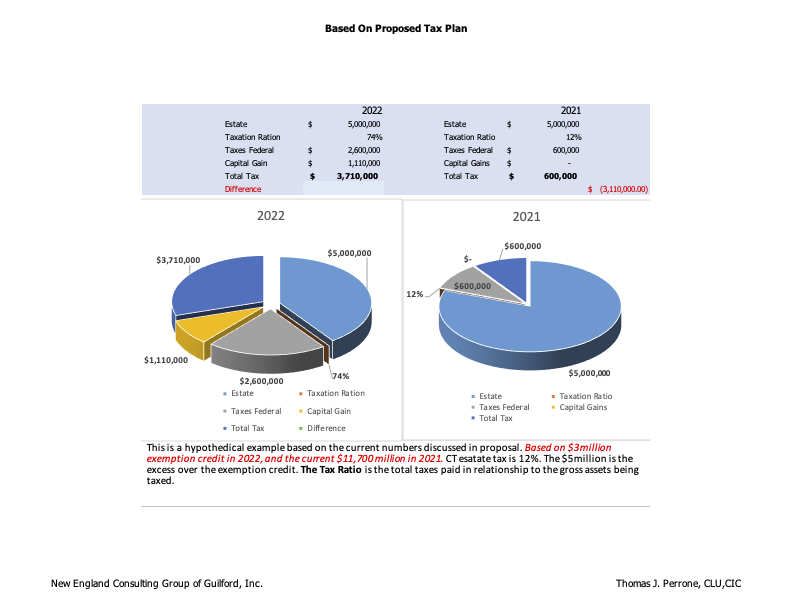
As you can see in the illustration below, when you consider the exposure of $5 million estate after exemption credits are use, you have the additional loss of the stepped up cost basis. There is a tax ratio of 74% vs. 12% in 2022 if some of the proposals go forth.

Image the business owner who has a high value property which has deferred gain locked in, and the results of that property when at death it is passed to the children?

Here is one of the reasons why business owners should pay attention.

zoom in.

Finally, A Way To Work On Your Business Without Giving Up Working In Your Business!

Give Me Two Hours A Month, And Your Problems Are Solved!

In my book, “Unlocking Your Business DNA”[1], I discuss a system called, “The One Page Blueprint Solution”, or “OPBS”.    This system is designed to help business owners solve specific problems in their business, effectively, efficiently and without giving up time to work in their business.  It is a way to finally have business owners “work on their businesses” and solve business issues important for the success of their business.    

The OPBS does many things, among them:

  1. Prepares the owner for the planning session in advance.
  2. Organizes what needs to be discussed.
  3. The business owners control the agenda discussed. 
  4. Covers the elements which need focus. 
  5. Allows owners to work at their own pace.
  6. Creates brevity in your planning, leaving more time to work in your business. 
  7. Planning time is 1-3 hours a month which 60% of the time involves a self-study review. 
  8. Issues get resolved very quickly.  
  9. Many other benefits…

I use 15-20 key areas that I feel most business owners need to address if they wish to maximize their business growth and create the highest potential value for their business.  Here are two of 15 as examples of what is needed in the planning. 

This is an example of two of the many areas of planning.  I work with about 15-20 areas.  Not every company needs to fix all the areas, however, over time without reviews, areas of planning which were up to date at one time, can lose their effectiveness when not fine-tuned.

The Sale of Your Business to The Outside: 

  1. This could be in two months or thirty years; it is different for each business. In this planning session there are several areas the business owner needs to focus on. 
    1. Systemized business
    1. Put business in growth mode
    1. Delegate to middle management and upper management
    1. Lock the key group into the company
    1. Attract several potential buyers 
    1. Receive maximum cash for the sale
    1. Prepare to leave when you want to leave (maybe stay only if you want to stay)
    1. Plan to do something the rest of your life
    1. If you start early, you can control the whole process
  2. Tools needed: 
    1. Value Drivers
    1. Systemizing the business
    1. Golden Handcuffs for management and stay documents, (disclosure, competition, non-compete)
    1. Controlled Auction for the sale
  • #Sale of your Business from Inside the business or to your family! 
  • Make sure the new owners can run the company without you 
  • Lock in non-owners’ managers
  • Delegate your responsibilities to management
  • Due diligence to make sure you don’t end up with the business after the sale
  • Put business in growth mode
  • Guarantee income stream from the sale
  • Minimize taxes to you
  • Minimize taxes to the seller
  • Have a lifetime plan
  • Teach employee to be employers

Tools needed:

  1. Market Value Drivers 
  2. Systemizing the business
  3. Golden handcuffs for management team 
  4. Well Designed transition Plan

With the help of “zoom”, phone conferences, and the cloud, we can discuss an array of topics without parties leaving their offices.  Our designed meetings are previewed before our discussions so questions can be prepared about the subject matter.  (This creates a great give and take of the subject) 

It is my opinion that business owners should review all the key areas of their business periodically to make sure they stay “a fine-tuned machine” and maximize their future potential value of growth.  

If you wish to participate in a one-minute business assessment, to see how ‘fined tuned” you are; 

 LESS THAN A MINUTE SURVEY

Trust me: (it takes one- minute to do).  I will send you a FREE report card and summary of where you may want to focus for your business efficiency.  ALSO, along with the completion of the survey, I will send you a copy of my newly published book: Unlocking Your Business DNA”.


[1] You can purchase this book at Amazon-kindle and paperback. Profits go to “Wounded Warrior Foundation”

Three Key Value Drivers  and Why Do They Matter? 

Value drivers are the elements of a business (systems and procedures), which create business value.   This post will cover  Next Level Management (NLM).  In part 2, I will cover  diversified client base  and  operational systems.  

Although there are nine transferrable value drivers, I am going to concentrate of three of them. Although all the value drivers are important, the three I will discuss are considered key drivers.  

The three value drivers are key in creating appeal to prospective purchasers of the business. They are important drivers, and at the very least, drivers’ businesses must have in order to grow.   

When a new business owner asks me when they should be thinking  about their future exit of their business, my answer always is, “the day theystarted their business is the time to start planning for an exit.”     

As you will see, the value drivers in most cases  need time to develop.  As we go through the three of them, you will see that they are strategies that can be implemented at once, but in many cases, need time to develop.    

Next Level Management (NLM):  Successful businesses with value, require business owners to delegate responsibilities to the management team.  NLM is particularly important because without a good management team, it would be hard to implement the other value drivers which are needed to create the maximum business potential value.i    

Finding and developing a  NLM  team is a challenge for many business owners. However, once the NLM is created, they usually become the team responsible to make the difference between where the business is now, and where the business would like to be.   The NLM is the key to  implementing the value drivers and the operation of them.   

Roadblocks for Business Owners in Developing Their Next Level Management

Many owners believe only they can keep and control the company’s success, since they built the business from infancy.   They  struggle  giving up even small types of control. The thought of not being involved in some of the daily business decisions, scares the daylights out of them, nor do they like the loss of control.    

Lack of installing the value drivers over time.   

 They spend their time working in the business as opposed to working on the business.   I call it their “Business DNA.”    Change is scary and thinking that someone else would be running the business is not consistent with their  fundamental  beliefs.  The possibility of someone else making decisions, which could build or ruin their business is too much for them to imagine.   

Fear of change.    Even if a business owner is not thinking in terms of an exit plan, they do like to think of creating business value. Once they are educated as to how value drivers affect the future value of their company, they become more open to  creating the value drivers, and making the changes.    

Misconception of owners:   Benefits derived to the business owners by installing value drivers is the result of the “full potential value of the business.”   The business grows as the business owner does less work, since the work has been handed off to the NLM.     However, owners have the common concern that installing value drivers will take too much of their time.  With proper planning, implementing the value drivers will create a more stable business, create better performance and scalability.   It is important that the owner understand the concept of developing the NLM team, so that team can create, implement, and manage  the value drivers, as opposed to the owner.     

It is possible for the owner to create the NLM where the owners have some control, and still can play a key role in the company.  Their leading role would be to delegate more responsibilities to the NLM, while focusing on other business responsibilities.    

 Many owners continue to do tasks they despise, just to keep a perceived control.  In many cases, the owner needs to take small steps in giving up control before they can start to feel more comfortable.  This is understandable since these are the things, they did to grow their business from day one of the business.     

The owner will see more growth in their company by implementing the value drivers, which will create more options for them when a future transition is a being considered.   

In my book, “Unlocking Your  Business  DNA,” I  discuss the problems business owners have working on their business as opposed to time spent working in it.  One of the factors missing is the value of creating value drivers for their business growth.   Once they realize value drivers create increasing company value, they get on board for future changes.  

 Through our discussions with business owners, we need to express to them that most future buyers will not want to buy the owner.   They want systems, management, and growth ability.       

Many owners think that they need to be involved with all the problems and issues of their company, thinking they have all the answers and the solutions.   Although this makes the owner feel in control and gives them  self-worth, it does absolutely nothing for the future value of the company, and in some cases may decrease the value.   

Insight 18 Key Groups Have a Voice In Your Company!

Your Key Group Holds The Key To Your Success! But! You Need To Listen To Them!

This was an interesting case we worked on. There were a few educational moments that I would like to share with you. 

Scenario:  Three brothers owned a successful manufacturing company. The company had several government contracts over the years and built an exceptionally good reputation with the government agency. These contracts were very profitable and kept the company busy. The company took pride in its work, delivery of the projects, and having the staff to accommodate the project, which lead to ongoing contracts. Over time, it became clear that doing work for the government and a few other companies was all the manufacturing company needed to be profitable and grow. 

So, what is the problem? On the outside, nothing, but inside there were some disturbing situations brewing. 

This scenario set up the problem we had to deal with. The key person in the firm developed a strong relationship with the agency head who awarded the contracts. He did an excellent job enhancing the relationship over the years. Through his efforts, the owners were able to be very profitable and to take sizable salaries each year. 

Because the key person ran the business like he was the owner, the three owners were able to take a lot of time off. They usually spend about two days in the business a week and took long vacations. 

The problem started when the owners decided to give the key person a large bonus the past year for doing a fantastic job. However, the key person assumed this would be the norm each year. A good salary and a fabulous bonus, which the key person was looking for each year. So, when a new year rolled around, there was anticipation by the key person to receive the bonus. When he approached the owners about the bonus, there was a clear disconnect between their vision and the employees. 

The owners felt that the bonus was based on performance of a particular year and did not think the key person would be looking for this substantial bonus each year. In a way, the owners felt they were being held hostage by the key person. “Once a luxury, it became the necessity”

However, when we broke it down for them, they realized the key person had the relationship with the government agency, not the owners (they did not even know the contact). The government contract represented about 40-50% of their sales. The keyman also had a great relationship with the private companies. We suggested to the owners that key person was more than a key person, he was their middle management! 

PROBLEM: The key person wants to receive a bonus as if it was part of his salary each year. Owners did   not want to pay it! Also, the company had 40% or more of its revenue in one basket (the government agency). 

Our part:  We communicated to the owners that based on the relationship the key person has with the vendors and customers, there would be a potential disaster if the key person were to leave. A few things which would happen: 

  1. He would take the business to a new employer.
  2. He could take employees with him. 
  3. He could stay but put less of an effort in building the business. 

After looking at all the facts, the owners realized they had a great deal and what they were receiving from the efforts of the key person was certainly more than what the keyperson wanted. 

 Educational moment:  We suggested the following.

  1. Owners communicate to the key person that he is a part of the growth of the company, and not only give him a bonus, but include an incentive of a % of business growth, or some metric that was measurable.
  2. Create a “graded-vested benefit,” which would be hard for the key person to walk away from. 
  3. Execute a non-compete clause and a non-disclosure agreement concurrently with the implementation of a selected benefit for the key person. “This is what we would like to give you, but for this we want you to agree to this.
  4. We discussed the disproportionate revenue from the government and discussed ways to increase their customer base. We suggested that no more than 10-15% of revenue should be coming from one source. 

These were only a few of the steps we suggested. 

It is common for owners to reevaluate their middle management; however, compensation is only part of the equation. Creating a middle management culture takes time, loyalty, along with compensation and benefits. Your key person(s), may be one of the most valuable assets of your company. Certainly, it is one of the value drivers which increase the value of your company. 

Critical Step Needed To Create An Exit Strategy! Part 1 

Some business owners think that selling their business is a matter of getting an appraisal and putting the business on the market hoping for a good offer.

Many business owners that I have worked with initially assumed they knew the value of their business and what they could sell it for.

Through our education process they realized there is much more to selling their business, then just the establishing a value and then going to market.     One of those factors or variables is whether the business owner needs the business value for their future retirement, most do!

Helping the owner figure out what they need for retirement is critical in establishing what they need to sell their business for, and what action is needed to increase the future value of the business (Value Drivers).  In this article I will cover two of the seven steps that  are the most critical when planning a future exit from the business.

Whether the sale is one year or ten years from now, these are the steps needed to sell  a business.

  1. Must identify the Exit Objectives (why, when, and in some cases who) 
  2. Identify Personal and business financial resources; (this is part of the future financial security of the business owner and their family).  
  3. Maximize and Protect Business Value
  4. Ownership Transfer to Third Parties
  5. Ownership Transfers to Insiders
  6. Business Continuity
  7. Personal Wealth and Estate planning

In this post I will cover steps 1-3, and cover steps 4-7 in the June issue.  

In comprehensive Exit planning, (when you break the process down it looks like this):

Your Exit Objectives

  • Building and preserving business value
  • Selling your company to a third party
  • Transferring your ownership to insiders

Your Business and Personal Financial Resources

  • Business Continuity
  • Personal wealth and estate planning

Owner’s goals and aspirations are

  • Financial Need
  • Overall Goals
  • Value based goals
  • Defining the owner’s goals and aspirations shows the client’s wants and needs and identifies what is  important to the business owner. By spending time collecting this information from the business owner we establish a strong relationship, while differentiating you, and allowing you to be the quarterback of the plan.

Accurate information from the owner is critical to planning.      Calculating what the GAP of resources the owner needs to have in order to supply their future retirement income is critical.  It is here where the measurement of their resources helps to decide what they need to sell their business for, to help fund the gap.    Continue reading “Critical Step Needed To Create An Exit Strategy! Part 1 “

A Road Map For A Succession Planning  Essentials For Planning   Creating Your Team Of Advisors 

Who Are They 

Their Role 

Accountant 
  • Develops financial statements 
  • Provides tax advice 
  • Assists in Estate planning 
  • Assists in Business value 
Attorney 
  • Negotiates agreements 
  • Tax Advice 
  • Prepares estate documents 
  • Advises on business structure along with implementation 
Management Team 
  • Manages the ongoing operation  
  • Operational advice and expertise for new owner 
  • Enables business continuity 
Business Appraiser 
  • Estimates fair market value of Business  
  • Provides the credibility of asking price 
  • Advice on how to maximize business value 
Business Broker 
  • Finds buyer and market insight for value 
Financial Advisor 
  • Facilitates and council’s family goals and value 
  • Plans for the future of the estate and distribution 
  • May have the capacity to help fund Buy and Sell Agreements and Deferred Compensation situations 
  • Offers financial advice to all the members 
  • Helps project future financial needs 
Banker-Commercial 
  • Financing options for acquisition 
  • Access to other experts that may be needed 
  • Supports the business transition before and after the acquisition 

Exit Options: 1 

  • Transfer the business to a family member; This represents about 42% 
  • Sell to partners or your employees (directly or through ESOP); This represents about 17% 
  • Sell to a third party; 19% 
  • Partner: 10% 
  • Wind down business -3% 
  •  Don’t know -8% 

Questions To Consider 

  1. Are there one or more family members who want to take over the business?  
  2. Does the family successor have the skills to operate the business and guarantee the return on your investment?  
  3. What are the qualifications and skills someone would need to purchase your business to guarantee the successful transition?  
  4. If you transitioned to your family member, how will your employees, suppliers and customers react?  
  5. What is the most tax-efficient way to pass ownership to family members?   
  6. Will you continue to have a role in the business? 
  7. How will this succession option impact the rest of the family? 

Selling to partners or your employees 

  • Which employees or partners are best suited to purchase your business?  
  • Do they have funds or access to funds?  
  • Will you have to finance part of the sale?  
  • Do they have the management capability to run the business successfully?  
  • Can the business take on debt for this transaction long term?   
  • Where will the purchase price come from?  
  • Do the purchasers have assets as collateral?   

Third party  

  • Who are likely candidates in your industry that would be interested in your business?  
  • Do you want to sell the whole business or only part of it?  
  • Will the potential buyer have the entire financial resources to purchase the business, or would you be prepared to partially fund their acquisition?  
  • What is the most tax-effective way to sell your business?