Case Study: Rapid Sales Growth and Ownership

Case Example Using Term Insurance

By Thomas J. Perrone, CLU, CIC

This was a situation where the company needed protection but wasn’t ready to purchase permanent insurance, even though the situation called for it.  However, the term insurance gave them what they wanted at the time and gave them the needed protection. 

Scenario: 

 A thriving business, comprising three partners—a relationship builder, an idea generator, and a product engineer—experienced remarkable sales growth within a few years. However, a potential challenge arose regarding ownership transfer upon a partner’s death, as all partners shared familial ties. 


To mitigate this concern, a comprehensive stock redemption program was devised and funded through a term insurance policy with a premium exceeding $60,000. This strategic approach enabled the business to navigate ownership transfer complexities and ensure the continuity of its operations.

Through the years, parts of the term insurance has been converted, and the company is paying about $125,000 in insurance premium to fund their liabilities and commitment.  

The case was developed through a relationship i had with one of the owners, through an introduction.  

Lesson:  

Even though this was a start up and a young company, if I has assumed it did not have the cash flow, I would have lost out on all the great potential.  Don’t assume anything, but let your client tell you what they want and why. 

THE WHY: 

There was a past history of the one of the current partners where their family member was part of a company where the partner died.  No planning was done, so the deceased partners family became the new partners.  This was not pretty, and the business ended up in chaos.  Obviously, a motivating factor for the current owner to have a good Buy and Sell Agreement where it was funded 

If you are an advisor who is working with business owners or wants to develop a business market segment in your practice, we should talk. We offer great opportunities working with our organization and deep backup.  

Thomas J. Perrone, CLU, CIC

tperrone@necgginc.com

THREE WAYS TO GROW YOUR BUSINESS WEALTH! 

Thomas J. Perrone, CLU, CIC – NEW ENGLAND CONSULTING GROUP OF GUILFORD, INC

Growing value in your business can create tremendous wealth, however, only 15-30% of the small businesses will sell, which creates the “if factor”, the unknown.  

The percentage of sales is lower for the smaller owned business, more like 15%.  

Building your business to its highest potential value is possible by having guidelines of what must be done as you grow the business.  

To hedge the “what if’s” of selling it, you can use the cash flow of the business to create other assets such as executive compensation and qualified benefits and plans.   

Many owners neglect to consider these options and end up with too much wealth in their business, causing liquidity and tax problems when they leave, die or become disabled. This presents the problem of “how do you get your wealth out of your business on a tax advantaged method” when you want to leave the business and you need it?  

Building Your Business to Sell in The Future! 

Here is a list of strategies that will help in growing a robust business and greatest potential value.  

  • Develop value drivers  
  • Create a culture- employees come to you because of it 
  • Develop a middle management 
  • Systematize your business 
  • Customer diversification  
  • Avoid being dependent on a few customers for your sales  
  • Marketing plan- and always update it and analyze it 
  • Focus on growth of revenue, lowing of costs 
  • Protect yourself from litig 
  • Make sure you protect yourself such as  
  • Fund your Buy & sell agreements, bank loans, audit your liability insurance, protective documents, etc. 
  • Have a strategy to sell or transition your business, such as growing the middle management, and key people to step in and run the company, or even buy it. This is a long-term process, but you must put things in order and work on strategies to get the greatest potential value from the business.  

When Considering Using Your Business Cash Flow to Develop Executive Compensation and Other Benefits,  

Such as:  

  • Executive Compensation plans, where the company contributes to the plan, and you as owner pay as little as 2% in taxes on the contribution.  
  • Salary Continuation and deferred compensation arrangements for you.  
  • Deposit into your company’s retirement plan (like 401k, profit sharing, 403b, etc.). However, if you are a “high earning business owner”, do not load up on 401k contributions and other contributory plans as the tax consequences are severe.  
  • Make sure your buy and sell agreements are funded and updated. Make sure they cover at least the seven major triggers (death, disability, voluntary and non-voluntary termination, divorce, bankruptcy, retirement).  
  • Have critical illness plans set up such as medical reimbursement plans, disability, and health coverage.  
  • Tie your major Key group to your company as they are the value of the company and contribute to the cash flow of your company, allowing you to implement these strategies.  
  • Create vested benefit schedules to keep them with you  
  • Have a company evaluation /appraisal periodically.  
  • Focus your attention on growing sales, as all things point to sales revenue. 

Executive Compensation Is a Fantastic Way to Extract the Value of Your Company on a Tax-favored Basis, And Not Tie It Up in Your Company, Having It Available to You When Needed. 

There are but a few thoughts concerning building wealth through your business while building your business.  

If you would like to receive my report on the “JFK ERA BENEFITS THAT CREATED SUBSTANTIAL WEALTH FOR BUSINESS OWNER”, CLICK THE link and it will download. This benefit was around in the 50’s, but only for the bigger companies, now it is available to the smallest of businesses, and may be one of the greatest business owner benefits available.  CLICK JFK 

The Benefits Of Keeping Your Key Person And Key Group!


Recently, I wrote an article about the “Quintessential Employee” and covered all the benefits of having a key person in your company. 

The Education of the Quintessential Employee! 

Some of the attributes of the key person are:  

  • Creates more business value by freeing owners to focus on other profitable tasks 
  • Purchasers of a business want to have middle management in place 
  • Builds reputation and culture 
  • Key people tend to impress other employees as a good example 
  • Key people, as described, are also likely future purchasers of the business, or 
  • Likely to run the business while the owner enjoys life, but still has the control and wealth 

For the full article, download The Benefits Of Keeping Your Key Person And Key Group

Enjoy the download of the full article. The link in the article will download immediately the option of receiving the report.

Download The Article

The Education of the Quintessential Employee!

My friend of fifty-four years, George, is a very remarkable personIn a recent conversation I had with him, I realized that George defines the “quintessential employee.”  Why? He makes the “quintessential employee” easy to spotJust follow him around when he works.

As George was telling me about his history with his company, he related how the company owner came to visit him unexpectedly to thank him for his service of 29 yearsWhen I asked him why he thought the owner appreciated him, he described for me all the things he did over that period. 

Consequently, what George told me was the definition of the “model key person.” A person that every business owner wants, and needs, in their organization. 

You can spot a model employee in a heartbeat because:

They are the first ones to come to work. They almost never take time offThey volunteer time when needed to cover for others. They learn more than they must and are eager to learn. They are so good at their job (s) you would think that they were the owner. 

Key employees like George are valuable for the owners because, they always make life easier for the ownersKey people bring so much to the table, and are the most valuable asset in a company

Intrinsic rewards examples in the workplace

Below are some intrinsic rewards that may affect your workforce. Fostering these activities and feelings in the work environment could help your team grow and thriveA key person exemplifies these values. 

  • Completing meaningful tasks
    • Letting employees be selective
    • Gaining a sense of competence
    • Making noticeable progress
    • Feeling inspired to be more responsible
    • Being an important part of an organization or team
    • Feeling accomplished
    • Feeling pride

I have frequently suggested to many business owners that they groom talented people in their firms who have the take charge values and attitudes which parallel the owner’s. They normally get it, want it, and can do it. 

A key thing an owner can do is to surround themselves with like-minded and value driven employees and build from there. The key person has the values of the owner, and the key person influences other workers over time. They set the example of the company’s culture and the value of the owner and the company

Two Questions:  

  1. How do you find such a person? 
    1. How do you keep them

Finding is the hard part, keeping is the easy part.

Finding the right person really comes down to the culture which the company portrays to the publicLike Costco or Trader Joe’s, who have the reputation of a wonderful place to work. They continually enhance their reputation of wonderful places to workBy having a well-known culture, companies attract like-minded individualsAlso, having the sense of value, the company can immediately filter applicants who apply for a position. Knowing the company values, is a built-in filter and a screening tool for the company when hiring. Question: “Can this person develop into a key person”And “Does this person have the values that represent this company?”

Small family businesses can build that type of culture by hiring based on value, creating good compensation, benefits, giving respect to workers, positioning them in the right seat, (also taking them out of the seat if it does not fit, and putting them in another seat the is more appropriate), respect for the workers, along with other factors

Retaining employees can be accomplished through benefits, time off, respect, vested benefits, ownership interests, and several other ways

The importance of developing and keeping key people cannot be overlooked

  • Creates more business value
    • Purchasers of a business want to have middle management in place
    • Builds reputation and culture
    • Key people tend to impress other employees as a good example 
    • Key people, as described, are also likely purchasers of the business, or
    • Likely to run the business while the owner enjoys life, but still has the control and wealth

My suggestion to many small business owners over the years has been to find ways to build a key group as quickly as they can and to build the group around the values which the owners have

If you have an interest in learning other ways of keeping your key people, this video will be of value. 

Case Study #3. Corporate Executive Equity Plan (CEEP)

For A Free White Paper called, “Wealth Without Taxes”. Click


If you didn’t think you had to plan- Get ready to in 2022!

Over the years I have observed the inability of many business owners to plan their business and personal estate effectively, for one reason or another. Any excuse doesn’t matter, the bottom line is many (great majority of business owners) don’t have adequate estate and business financial plans. I have often referred to them as “plan by default”, as opposed to a “designed plan”. Guy Baker is were I first heard the terms this way. Very adequate considering the subject.

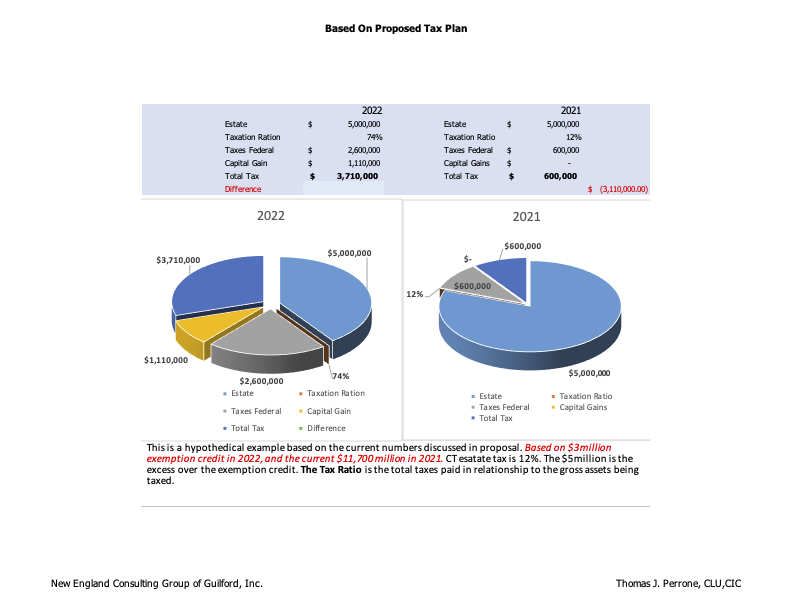
As you can see in the illustration below, when you consider the exposure of $5 million estate after exemption credits are use, you have the additional loss of the stepped up cost basis. There is a tax ratio of 74% vs. 12% in 2022 if some of the proposals go forth.

Image the business owner who has a high value property which has deferred gain locked in, and the results of that property when at death it is passed to the children?

Here is one of the reasons why business owners should pay attention.

zoom in.

Business Owners Essential Planning Tools! Part 2!

Good planning can often begin with owners transferring ownership interest to family members, without giving up control of the business. This type of planning sets the stage for the future passing of the baton and can be highly effective.

The long-term plan of business transition can also focus on who can run the business operations once the senior guard leaves the business. Just because a family member has worked in the business, it does not mean they can run the business effectively.

Business Transition And Succession Planning requires many years to develop the right plan. It starts with finding the right employees to train for the job, and the right people to run the business (this includes family succession situations).  

I have found that “Passive Ownership” can be a particularly good possibility for many business owners. They stay in control and slowly give away the duties over time while running the business, but at the same time slowly disengaging from the business. It gives them time to help prepare the junior successor for the job.

The procedure for “Transition Planning” is critical for a long-lasting understanding amongst the family members, both in and out of the business. Without clear communication to the family members, conflict and bad feelings may occur. 

Business Succession Planning  (Click to receive full report and guide; R-1)

  • What would happen to the business if one of the partners died? 
    • Who will buy your interest in the business?
    • Will the company, shareholders, or the heirs keep the right to own the shares. Are the party’s mandated to buy your shares? 
    • Where will the capital to buy the shares come from? 
    • Do you want the deceased shareholders/beneficiaries to have the choice to run the business? 
    • What is the funding mechanism to buy the business? 
    • How is the life insurance structured to help fund the purchase price?
    • Is the same true for a disability? If so, what is the definition of a disability to trigger the sale. Is the disability funded?
    • What are the rules if a partner wants to sell to a 3rd party? 
    • Is there a “put” right; to have the company buy the shares of a disputed share holder? 
    • What are doing concerning incentives to key employees?
    • How are you supporting retirement through the company? 
    • What are you providing in executive compensation to the key people active owners, and officers of the business?

There are many more questions that need to be answered. The elements of your business succession plan will normally be in your business succession agreement and incorporated in the operating or stockholder’s agreement.

CLICK TO Request our Full White Paper and Business Guide Free request (R-1)

Operating Agreement:  

An agreement which regulates the company and manages the relationships between the members of the company.

Buy-Sell Agreement

An agreement between the business owners to buy and sell interest in the business at a specified price upon a “triggering event”, such as death, disability, divorce, voluntary withdrawal, non-voluntary withdrawal, bankruptcy, and retirement.

This document is important and serves to obtain a fair price for the stockholder and a path for a smooth transition for the parties involved.

Type of Buy and Sell agreements:

  • Cross purchase: This is between stockholders to buy departing stockholder’s shares
  • Redemption agreement:  The entity (business) buys the shares
  • Hybrid/ a combination of above: A “wait and see buy and sell[1]

Provisions in the buy and sell agreement

The sale price of the departing owners’ interest and how it will be paid

  • Installment
  • Sinking fund
  • Cash 
  • Life insurance[2]

Other Methods To Transfer Property:

Although the buy and sell agreement is an effective method to transfer property, other methods, such as ESOPs, compensation plans, and pension plans have a place in funding.

There are other areas and issues in your business planning that need to be addressed at some point and redefined over time.

The valuation of your company should be done by a qualified and certified appraiser. Business owners seem to think they know the value of their business, however, in more cases than not, they are incorrect.

Having A Team Of Financial Experts Will Help You Plan Your Business And Your Estate.

My suggestion is to create a team of advisors who can meet periodically and report on the status of the business to the “team”.

I have found this to be a valuable tool as everyone gets on the same page in the planning process and understands what the owner wishes to accomplish. 

Over the years I have created the team consisting of the CPA, attorney, banker, investment, insurance and other professionals who come together and review what the status of the planning is up to that point for the business owner. Normally, the team consists of the professionals who have a relationship with the business owner and are currently doing planning for them. Unfortunately, each professional has their own agenda, and rarely knows what the other professional are doing for the business owner.,

In most cases this is the first time the advisors have communicated with each other. I have always thought this was in the best interest of the business owner and was prudent to use these resources. Putting the business owners’ advisors in the same room once a year could be the best planning strategy, they can employ. 

The Bottom-Line Thought

The solutions and strategies are in abundance to solve the issues. The problem is defining what the owner wants in their plan.

CLICK TO Request our Full White Paper and Business Guide Free (CODE R-1)


[1] A combination of the redemption and the cross purchase. Usually, the stockholder or trust owns the life insurance on the partners.  Normally driven by tax issues and positioning.   

[2] Life insurance is normally the least expensive way of funding the death benefit when compared to alternatives. The life insurance can also play a role in providing funds to help stockholders purchase interest in the company. 

You Saw It Coming And I Saw It Coming, We Both Saw It Coming…But we still bought it!…

After fifty years of running a tremendously successful planning firm, WORKING ONLY eighty days a year, I can make this statement with full confidence!  

Every business owner deserves success and financial independence when they give all they must to build a business.  NO issue here.  If done correctly they will enjoy financial independence and an abundance of leisure time which I call “your beach”.   

What gets in the way of preventing a business owner from becoming financially independent and finding their “own beach”, are two things:   

First Reason: The business owner has their hands in everything. Nothing gets by them.    They work eighty hours a week and wonder why they have no time for themself or families.   They believe you must work “hard” (to them that means anything that keeps them busy).   While they are doing insubstantial work, they are neglecting the important work (The Business and Financial Key Elements to Their Business).   

Second Reason Archaic and falsehood beliefs that business owners “bought into”, such as.  

  • Your inventory and your receivables are like money in the bank,  
  • You must work hard in the early years so you can slow down in the later years 
  • Take every dime you have and invest it in your business 
  •  You need to invest in your business in order to grow 
  •  Every business needs time to grow 
  •  You can’t grow fast 
  •  Borrow as much as you can 
  •  It’s a lot of money, but it’s a write off 
  •  When you go into business you initially spend more money than you want to 
  •  You need to invest in your business   
  • Plow all your profits back into the business   
  • You don’t need to give your key people additional benefits 
  • “It’s easier for me to do it, I’ll do it the right way” attitude 
  • If I train someone to do it, they may leave me and start their own business 
  • You don’t need a business valuation just use a simple formula 
  • I have all the systems in my head, we don’t need a document 
  • I’m not worried about leaving the business, they will figure it out 

Falsehoods, and archaic business principals   do more to destroy businesses than a bad economy.   If you don’t fix this situation, no matter how hard you work; YOU WILL NEVER GET TO YOUR FINANCIAL INDEPENDENCE AND “YOUR BEACH”.   It’s that simple!  

But the good news is that you can correct these problems by using a technique that has worked for me and my business clients for over fifty years.    It’s called the “ONE PAGE BLUEPRINT SOLUTION”, and it only takes TWO HOURS MONTH (two lunch breaks) to implement and correct the two major reasons why business owners can’t become financially independent and find their “own beach.”    

To help you learn more on how you can eradicate the two reasons, I am offering a free copy of my eBook called, “Unlocking Your Business DNA”, (Cracking the code to a better business, bigger profits and more time on the beach).   THIS BOOK WILL help you understand the principals discussed.  Limited supply.  To receive your FREE EBOOK, CLICK.

* Book can be purchased on Amazon; Kindle and Paperback. All profits go to Wounded Warrier Project.

**Full Steam Ahead (title; You Saw It Coming)

Finally, A Way To Work On Your Business Without Giving Up Working In Your Business!

Give Me Two Hours A Month, And Your Problems Are Solved!

In my book, “Unlocking Your Business DNA”[1], I discuss a system called, “The One Page Blueprint Solution”, or “OPBS”.    This system is designed to help business owners solve specific problems in their business, effectively, efficiently and without giving up time to work in their business.  It is a way to finally have business owners “work on their businesses” and solve business issues important for the success of their business.    

The OPBS does many things, among them:

  1. Prepares the owner for the planning session in advance.
  2. Organizes what needs to be discussed.
  3. The business owners control the agenda discussed. 
  4. Covers the elements which need focus. 
  5. Allows owners to work at their own pace.
  6. Creates brevity in your planning, leaving more time to work in your business. 
  7. Planning time is 1-3 hours a month which 60% of the time involves a self-study review. 
  8. Issues get resolved very quickly.  
  9. Many other benefits…

I use 15-20 key areas that I feel most business owners need to address if they wish to maximize their business growth and create the highest potential value for their business.  Here are two of 15 as examples of what is needed in the planning. 

This is an example of two of the many areas of planning.  I work with about 15-20 areas.  Not every company needs to fix all the areas, however, over time without reviews, areas of planning which were up to date at one time, can lose their effectiveness when not fine-tuned.

The Sale of Your Business to The Outside: 

  1. This could be in two months or thirty years; it is different for each business. In this planning session there are several areas the business owner needs to focus on. 
    1. Systemized business
    1. Put business in growth mode
    1. Delegate to middle management and upper management
    1. Lock the key group into the company
    1. Attract several potential buyers 
    1. Receive maximum cash for the sale
    1. Prepare to leave when you want to leave (maybe stay only if you want to stay)
    1. Plan to do something the rest of your life
    1. If you start early, you can control the whole process
  2. Tools needed: 
    1. Value Drivers
    1. Systemizing the business
    1. Golden Handcuffs for management and stay documents, (disclosure, competition, non-compete)
    1. Controlled Auction for the sale
  • #Sale of your Business from Inside the business or to your family! 
  • Make sure the new owners can run the company without you 
  • Lock in non-owners’ managers
  • Delegate your responsibilities to management
  • Due diligence to make sure you don’t end up with the business after the sale
  • Put business in growth mode
  • Guarantee income stream from the sale
  • Minimize taxes to you
  • Minimize taxes to the seller
  • Have a lifetime plan
  • Teach employee to be employers

Tools needed:

  1. Market Value Drivers 
  2. Systemizing the business
  3. Golden handcuffs for management team 
  4. Well Designed transition Plan

With the help of “zoom”, phone conferences, and the cloud, we can discuss an array of topics without parties leaving their offices.  Our designed meetings are previewed before our discussions so questions can be prepared about the subject matter.  (This creates a great give and take of the subject) 

It is my opinion that business owners should review all the key areas of their business periodically to make sure they stay “a fine-tuned machine” and maximize their future potential value of growth.  

If you wish to participate in a one-minute business assessment, to see how ‘fined tuned” you are; 

 LESS THAN A MINUTE SURVEY

Trust me: (it takes one- minute to do).  I will send you a FREE report card and summary of where you may want to focus for your business efficiency.  ALSO, along with the completion of the survey, I will send you a copy of my newly published book: Unlocking Your Business DNA”.


[1] You can purchase this book at Amazon-kindle and paperback. Profits go to “Wounded Warrior Foundation”

Single Appraiser vs. Multiple Appraiser Choices

This month I wrote about multiple and single Appraiser choice.  My friend Ed Pratesi was nice enough to give me some of his thoughts, which I definitely respect due to his experience and training.   Ed, thank you for this contribution.

Ed Pratesi wrote:

I read with interest your comments on Single Appraiser vs. Multiple Appraiser choices that owners have for a BSA. I agree in part with your assessment that the single appraiser choice is preferred but I do have a number of caveats and suggest that before the number of appraisers needed is secondary to choices made before this decision. Let me explain my thoughts:

Firstly, the choice of number of appraisers almost always works, whether one, two or the three step approach – except when it doesn’t!

Prior to the determination of the number of appraisers needed is preceded by what I refer to as the education process that a business appraiser must take the owners through in order to develop an agreement and a process that will likely be triggered when an unanticipated or unfortunate event has occurred.

In never ceases to amaze me that owners will spend money on creating a business plan, invest in physical assets and talent and not spend enough time on one of the most important events that will occur in their lives – either their exit or a partners exit. My complaint is not pointed at the owners but at the appraiser called in to initially called in to assist in the valuation.

My point simply is the an appraiser needs to explain the valuation process, the valuation methods used to value a business, the applicability or not of the methods to the company, a discussion of the definition of value – (for example fair market value or fair value, more on this in a later discussion), a complete discussion of adjustments that appraiser consider in the valuation process, and what discounts could apply and the reasons for application of discounts.

This part of the valuation process is more consultative and sets the framework for the conduct of an initial appraisal and of the work product. Finally, once the appraisal is complete a meeting to discuss the results and the process is essential and should be prefeaced with scenario planning should a provision of the BSA be triggered.

The goal is to get buy-in on the process not just the number!

I hope I have addressed part of the discussion of the number of appraisers – more to follow if desired…

Ed Pratesi

Edward E. Pratesi, ASA, CM&AA, ABV, CVA

Managing Director | UHY Advisors N.E., LLC
6 Executive Drive, Farmington, CT  06032
D: 860 519 5648 | C: 860 558 0453 | F: 860 519 1982

epratesi@uhy-us.com |  www.uhyvaluation.com

www.linkedin.com/in/ed-pratesi-140b762


Single appraiser Buy and Sell Agreement!

An alternative to the multiple appraiser agreement, is the single appraiser agreement (SAA).  There are two single appraisers’ processes. I

  1. Single appraiser, select now and value now
  2. Single appraiser, Select and Value at Trigger Event
  3. Single appraiser, Select Now and Value at trigger event

The preference is #1:

However, #2,3 are stopgap processes which can be used.  As mentioned in both of these types, the value is delayed to sometime in the future. 

Postponement of the appraiser selection and initial valuation create substantial uncertainties and potential for disagreements   or disputes.

The SINGLE APPRAISER, SELECT NOW AND VALUE NOW OPTION

In the BSA, the appraiser is named and is engaged to provide an initial appraisal for purposes of the agreement.

SELECT NOW: At the creation of the BSA, the appraiser is named. All parties have a voice and can exercise their choice as difficult as it may be.

VALUE NOW:  The chosen appraiser provides a baseline appraisal for the purpose of the agreement.  In this method, it is recommended that the value be presented in draft and give each party a time period for consideration before entering it in the final BSA. 

VALUE EACH YEAR (OR TWO) THEREAFTER:  This provides great advantages:[i]

  • Structure and process
  • Known to all parities
  • Selected appraiser is viewed as independent
  • Values are seen before triggering event
  • Since a draft will be provided to the participants, they can review for corrections to the mutual satisfaction
  • The appraiser’s conclusion in known up front and is the price until the next appraisal, or until a trigger event
  • Because the process is exercised at least once, it should go smoothly when employed at trigger events, less time consuming and less expensive than other alternatives

The single valuation process also helps the estate planning process with the annual reappraisals which will facilitate the estate planning objectives of the shareholders. For example, if the planning calls for minority discounts, the supplemental valuations at the not marketable minority level for gift and estate purposes.

[i] This type of valuation process will accommodate most small companies as for many reasons listed above.