Case Study: Rapid Sales Growth and Ownership

Case Example Using Term Insurance

By Thomas J. Perrone, CLU, CIC

This was a situation where the company needed protection but wasn’t ready to purchase permanent insurance, even though the situation called for it.  However, the term insurance gave them what they wanted at the time and gave them the needed protection. 

Scenario: 

 A thriving business, comprising three partners—a relationship builder, an idea generator, and a product engineer—experienced remarkable sales growth within a few years. However, a potential challenge arose regarding ownership transfer upon a partner’s death, as all partners shared familial ties. 


To mitigate this concern, a comprehensive stock redemption program was devised and funded through a term insurance policy with a premium exceeding $60,000. This strategic approach enabled the business to navigate ownership transfer complexities and ensure the continuity of its operations.

Through the years, parts of the term insurance has been converted, and the company is paying about $125,000 in insurance premium to fund their liabilities and commitment.  

The case was developed through a relationship i had with one of the owners, through an introduction.  

Lesson:  

Even though this was a start up and a young company, if I has assumed it did not have the cash flow, I would have lost out on all the great potential.  Don’t assume anything, but let your client tell you what they want and why. 

THE WHY: 

There was a past history of the one of the current partners where their family member was part of a company where the partner died.  No planning was done, so the deceased partners family became the new partners.  This was not pretty, and the business ended up in chaos.  Obviously, a motivating factor for the current owner to have a good Buy and Sell Agreement where it was funded 

If you are an advisor who is working with business owners or wants to develop a business market segment in your practice, we should talk. We offer great opportunities working with our organization and deep backup.  

Thomas J. Perrone, CLU, CIC

tperrone@necgginc.com

THREE WAYS TO GROW YOUR BUSINESS WEALTH! 

Thomas J. Perrone, CLU, CIC – NEW ENGLAND CONSULTING GROUP OF GUILFORD, INC

Growing value in your business can create tremendous wealth, however, only 15-30% of the small businesses will sell, which creates the “if factor”, the unknown.  

The percentage of sales is lower for the smaller owned business, more like 15%.  

Building your business to its highest potential value is possible by having guidelines of what must be done as you grow the business.  

To hedge the “what if’s” of selling it, you can use the cash flow of the business to create other assets such as executive compensation and qualified benefits and plans.   

Many owners neglect to consider these options and end up with too much wealth in their business, causing liquidity and tax problems when they leave, die or become disabled. This presents the problem of “how do you get your wealth out of your business on a tax advantaged method” when you want to leave the business and you need it?  

Building Your Business to Sell in The Future! 

Here is a list of strategies that will help in growing a robust business and greatest potential value.  

  • Develop value drivers  
  • Create a culture- employees come to you because of it 
  • Develop a middle management 
  • Systematize your business 
  • Customer diversification  
  • Avoid being dependent on a few customers for your sales  
  • Marketing plan- and always update it and analyze it 
  • Focus on growth of revenue, lowing of costs 
  • Protect yourself from litig 
  • Make sure you protect yourself such as  
  • Fund your Buy & sell agreements, bank loans, audit your liability insurance, protective documents, etc. 
  • Have a strategy to sell or transition your business, such as growing the middle management, and key people to step in and run the company, or even buy it. This is a long-term process, but you must put things in order and work on strategies to get the greatest potential value from the business.  

When Considering Using Your Business Cash Flow to Develop Executive Compensation and Other Benefits,  

Such as:  

  • Executive Compensation plans, where the company contributes to the plan, and you as owner pay as little as 2% in taxes on the contribution.  
  • Salary Continuation and deferred compensation arrangements for you.  
  • Deposit into your company’s retirement plan (like 401k, profit sharing, 403b, etc.). However, if you are a “high earning business owner”, do not load up on 401k contributions and other contributory plans as the tax consequences are severe.  
  • Make sure your buy and sell agreements are funded and updated. Make sure they cover at least the seven major triggers (death, disability, voluntary and non-voluntary termination, divorce, bankruptcy, retirement).  
  • Have critical illness plans set up such as medical reimbursement plans, disability, and health coverage.  
  • Tie your major Key group to your company as they are the value of the company and contribute to the cash flow of your company, allowing you to implement these strategies.  
  • Create vested benefit schedules to keep them with you  
  • Have a company evaluation /appraisal periodically.  
  • Focus your attention on growing sales, as all things point to sales revenue. 

Executive Compensation Is a Fantastic Way to Extract the Value of Your Company on a Tax-favored Basis, And Not Tie It Up in Your Company, Having It Available to You When Needed. 

There are but a few thoughts concerning building wealth through your business while building your business.  

If you would like to receive my report on the “JFK ERA BENEFITS THAT CREATED SUBSTANTIAL WEALTH FOR BUSINESS OWNER”, CLICK THE link and it will download. This benefit was around in the 50’s, but only for the bigger companies, now it is available to the smallest of businesses, and may be one of the greatest business owner benefits available.  CLICK JFK 

Rushing Through the Most Important Document in Your Business!

In my career I have experienced several business owners rushing through the implementation stages of designing their buy and sell agreement (BSA), probably one of the most important documents they will ever need, treating the process with little thought.   As Rodney Dangerfield would say, “No respect”.  When it was completed, it was very basic, doing more harm than good. 

In some cases, maybe more than I think, the document being used by the drafting attorney was a “hand me down” from another attorney.  While the “hand me down form” may have been useful in drafting another person’s situation and making it easier for the drafting attorney to do, it was not going to maximize my client’s planning situation.

In Paul Hood’s great book, “Buy And Sell Agreements, Last Will And Testament For Your Business”, he covers the consequences of not designing the right buy and sell agreement, and how important it is to spend the time and money preparing and designing this important document, with an experienced lawyer.  [i]

Paul specifically speaks about attorneys using a “hand me down agreement”, and how it may be more harmful by having it than not. 

The “Paul Hood Fire Drill”

He uses the idea of the “fire drill”. What happens when a “trigger happens? What will be the outcome and the consequences based on how your BSA is set up (or not set up), when you play it out. Like you were the leaving owner, and then again as the remaining owner.  On a personal note, the “fire drill” advocated by Paul is something I use all the time and has been instrumental helping my clients and their attorneys in drafting the proper strategies for their situations.  I have found that this has been a great way of helping my clients design the best BSA for themselves. It has allowed them to make it real and start developing questions and ideas that they can implement in their design. It keeps them involved with the process.

The “Fire Drill” strategy has put my clients in the “power seat” of knowledge, so when they discuss their BSA with their attorney, the elements and strategies that are being used are not foreign to them. This consequently helps them design a better BSA, reducing the time needed to spend with their attorney ($$$$$).    

Keep in mind, many business owners start the process of designing the BSA when there has been no experience of consequences with an owner or co-owner leaving the company. 

Everyone is Equal at the Start!

When owners design their BSA, they are all equal in status.  People that enter into agreements want the agreement to favor them when a triggering event happens, even if the agreement has not been updated in years or there is no reference to the triggering event. 

When are clients initially design their BSA, it probably will be one of the few times that all the partners will be negotiating with each other, because when there is a triggering event, chances are they will be negotiating with someone other than their co-owner.  

The representative of the departing co-owner will have a different perspective as to what they want out of the BSA!  Whether it is the spouse, their child, their law firm, whomever, they will be negotiating from a different point of interest.

Business relationships, and friendships are put aside.  It is at this point you would hope your BSA covers all the areas of concern that need to be covered.  The bottom line is the agreement must be exact as to what will specifically happen based on the triggering event.  There is no room for errors if the document is specific.  The best time to do this is when everyone is on equal ground. 

For this reason, owners designing their BSA with their attorney should take it very seriously because they are really pre-negotiating for the people, they love the most without any certainty of which trigger will occur and which side of the trigger they will be on, leaving or a remaining co-owner.

It is extremely important that the triggering events be identified and that you will understand what will occur with each trigger event.  

Paul Hood’s “fire drill” has made it easier for my clients to understand the importance of designing a solid BSA.  By posing questions to the scenario, the BSA becomes very real to them.  

Examples of how they would play out the “fire drill”  

·       What if you’re the first co-owner to leave?

·       What if you’re the last remaining original owner? 

·       What if you end up with a co-owner you don’t want to be owners with? 

·       What happens if one of your co-owners, dies, divorces, or goes bankrupt?  

      By implementing your “fire drill”, you will start to formulate different scenarios for your own situation creating your own buy and sell design.  

This is a critical document in keeping your business going should a trigger happen to any of the co-owners.  Unfortunately, you must deal with it in advance and before there is a triggering event. 

Risks when implementing your BSA:  

·       Using an attorney who is using a fill in the blank form.

·       Not planning the scenarios before designing the plan. 

·       Not having a BSA.

·       Not signing it. 

·       No dealing with how to fund such triggers.  

There are so many elements to the buy and sell agreement that need to be covered, the planning of this document can’t be taken lightly.  However, that is not to say you can’t have a great BSA.  Having experienced professionals to help guide you through the process will pay off great benefits in designing and implementing your BSA. 

We suggest you find competent counsel who has experience in designing the buy and sell agreements and discuss your goals and objectives with them. 

Again, my best advice is pick up Paul Hoods book (“Buy and Sell Agreements, last will and testament for your businesss”.) Read and study it. 

 If you would like our free Business Succession and Transition Planning Guide, click the link and we will send you a FREE WHITE PAPER to get you started. in your planning.   YOUR FREE GUIDE


[i] E. Paul Hood is a prolific technical author. He has published a number of books on planning and is one of the leaders in estate planning and business succession planning.  

The Education of the Quintessential Employee!

My friend of fifty-four years, George, is a very remarkable personIn a recent conversation I had with him, I realized that George defines the “quintessential employee.”  Why? He makes the “quintessential employee” easy to spotJust follow him around when he works.

As George was telling me about his history with his company, he related how the company owner came to visit him unexpectedly to thank him for his service of 29 yearsWhen I asked him why he thought the owner appreciated him, he described for me all the things he did over that period. 

Consequently, what George told me was the definition of the “model key person.” A person that every business owner wants, and needs, in their organization. 

You can spot a model employee in a heartbeat because:

They are the first ones to come to work. They almost never take time offThey volunteer time when needed to cover for others. They learn more than they must and are eager to learn. They are so good at their job (s) you would think that they were the owner. 

Key employees like George are valuable for the owners because, they always make life easier for the ownersKey people bring so much to the table, and are the most valuable asset in a company

Intrinsic rewards examples in the workplace

Below are some intrinsic rewards that may affect your workforce. Fostering these activities and feelings in the work environment could help your team grow and thriveA key person exemplifies these values. 

  • Completing meaningful tasks
    • Letting employees be selective
    • Gaining a sense of competence
    • Making noticeable progress
    • Feeling inspired to be more responsible
    • Being an important part of an organization or team
    • Feeling accomplished
    • Feeling pride

I have frequently suggested to many business owners that they groom talented people in their firms who have the take charge values and attitudes which parallel the owner’s. They normally get it, want it, and can do it. 

A key thing an owner can do is to surround themselves with like-minded and value driven employees and build from there. The key person has the values of the owner, and the key person influences other workers over time. They set the example of the company’s culture and the value of the owner and the company

Two Questions:  

  1. How do you find such a person? 
    1. How do you keep them

Finding is the hard part, keeping is the easy part.

Finding the right person really comes down to the culture which the company portrays to the publicLike Costco or Trader Joe’s, who have the reputation of a wonderful place to work. They continually enhance their reputation of wonderful places to workBy having a well-known culture, companies attract like-minded individualsAlso, having the sense of value, the company can immediately filter applicants who apply for a position. Knowing the company values, is a built-in filter and a screening tool for the company when hiring. Question: “Can this person develop into a key person”And “Does this person have the values that represent this company?”

Small family businesses can build that type of culture by hiring based on value, creating good compensation, benefits, giving respect to workers, positioning them in the right seat, (also taking them out of the seat if it does not fit, and putting them in another seat the is more appropriate), respect for the workers, along with other factors

Retaining employees can be accomplished through benefits, time off, respect, vested benefits, ownership interests, and several other ways

The importance of developing and keeping key people cannot be overlooked

  • Creates more business value
    • Purchasers of a business want to have middle management in place
    • Builds reputation and culture
    • Key people tend to impress other employees as a good example 
    • Key people, as described, are also likely purchasers of the business, or
    • Likely to run the business while the owner enjoys life, but still has the control and wealth

My suggestion to many small business owners over the years has been to find ways to build a key group as quickly as they can and to build the group around the values which the owners have

If you have an interest in learning other ways of keeping your key people, this video will be of value. 

Case Study #3. Corporate Executive Equity Plan (CEEP)

For A Free White Paper called, “Wealth Without Taxes”. Click


If you didn’t think you had to plan- Get ready to in 2022!

Over the years I have observed the inability of many business owners to plan their business and personal estate effectively, for one reason or another. Any excuse doesn’t matter, the bottom line is many (great majority of business owners) don’t have adequate estate and business financial plans. I have often referred to them as “plan by default”, as opposed to a “designed plan”. Guy Baker is were I first heard the terms this way. Very adequate considering the subject.

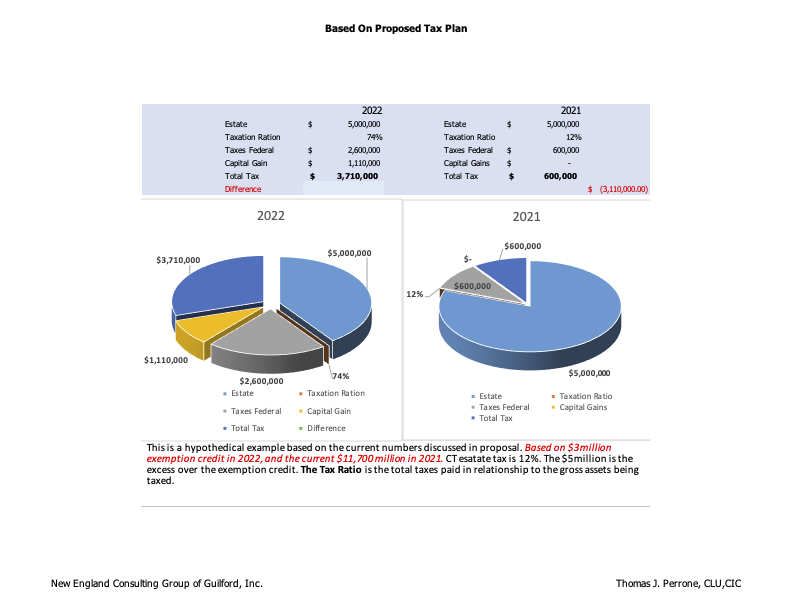
As you can see in the illustration below, when you consider the exposure of $5 million estate after exemption credits are use, you have the additional loss of the stepped up cost basis. There is a tax ratio of 74% vs. 12% in 2022 if some of the proposals go forth.

Image the business owner who has a high value property which has deferred gain locked in, and the results of that property when at death it is passed to the children?

Here is one of the reasons why business owners should pay attention.

zoom in.

Compensation of Business Owners! The Good And The Bad!

Owners of small private companies normally receive income as a salary, rather than dividends, and capital gain on the sale of their stock. They also receive other compensatory benefits. In many cases, the business owners can receive rental income from property and assets leased to the company and owned personally (either outright or in trust) by the business owner.  

Because of the tax structure of the company, business owners often find it more tax effective to pay the compensation, rent, royalties from their company to the owner, at the high end of the scale, rather than the low side (common in C Corps).  

A Detriment to The Owner When There Is an Exit 

Receiving this higher scaled income and rental, may have some advantages for tax purposes, and the creation of wealth.  

Having the tax advantages for the business owner, may be a detriment to the selling price during exit planning. This is because the rents and compensation paid to the owner on the higher side lowers the net income of the business.  

When rental and salary compensation are paid on the elevated level, they affect the net income/or net operating cash flow, which creates a downward impact on the selling price! 

At the Time of Exit Transition 

The owner must justify the payout of rental income, compensation, royalties, and other compensatory income. They need to justify the overpayment of this compensation. In a way, the owner must back track the justification of paying the enhanced payouts in the stated areas of compensation. This may put the owner in a position of receiving nondeductible “constructive dividends” paid by the company, resulting in a retroactive tax liability.  

Minority shareholders of the company could complain that the enhanced payments to the owner’s transgression of overpayments is a breach of a fiduciary duty owned to them. Since the over self-generous payouts to themself, there is an effect on the stock value. Consequently, minority stockholders are going to be affected by depressed value. This concerns stock bonus to minority stockholders and key persons.  

One of the solutions to this issue is to start to shift part of the enhanced payouts to more of a mid-level range of the fair market value. This will allow you to enhance the net income/net operating income for the company.  

Along with enhancing the net income and net operating income for the company the shifting of revenue to middle-management, will build a stronger management team.  

Success In Business Is Not Without Challenges!

DEFINITION OF BUSINESS GROWTH AND TRANSITION 

I often refer to my business planning as “Business Growth and Transition,” because I consider the business and the owner, as two separate and distinctive entities.  

For example, when the business is growing, the owner of the business needs to grow with the business and envision needed growth. As a business owner, he/she needs to continue to learn, ask more questions, depend on their instincts, experiment, be willing to fail, along with many other experiences to create the changes neededWithout the business owners’ creativity and involvement, the business will stop growing.  

Likewise, when planning for the business entity, we also plan for the owner personal needs. The business success creates personal challenges for the business owner, such as succession, estate taxes, family distribution, protection of the assets, and a host of financial and personal planning areas.  

STAGES OF A BUSINESS 

The business has two distinct stages it goes through which are critical; I define them as survival period and growth period 

Survival period is just what it means! Staying alive! This is where owner learns how to maneuver through the maze of “business savvy” strategies. “What doesn’t kill you, will make you stronger.” 

The survival period of business consists of: 

  • Excessive amount of time, sweat, and patience, luck, and much more.  
  • Bottom line:   Survive staying in business.  
  • Cash flow, Capital improvements, Inventory, client development create many challenges. 

The Growth Mode: 

 Not to simplify, but this is where the action is. It is up, up, and awayWhat needs to be done during this stage:  

  • Creates the opportunity for the future value of the business.  
  • To expand in all areas of the business. 
  • Inventing yourself and the company if needed, this includes building value drivers and transferable values. 
  • To become creative, reinventing of products, customers, process. 
  • To reinvent your markets and your clients. 
  • To build a customer base with loyalty, creating culture, and next level management. 
  • Much More… 

The expansion in Growth, (NOT ONLY) in markets and products, but also employees and the culture of the business. This is extremely important for the future of the business value, with the focus on growing your business value and to create transferrable value for the future. Owners need to start the process of giving up some of the control to middle management. This also means creating strategies which allow the owners to walk away and allow the business to run effectively and efficiently normally. This is my “Can you Take three months off” question, without an impact on your business profits?   

Disadvantages of Growth/ and letting Go 

You are giving up control to your management team! You are giving up things you controlled from the very infancy of the business. This is good because a future purchaser wants to buy your business as a running entity. They want a business that can run, and without YOU!  

When you start to delegate to others, things can happen. Your key people will learn how to run your business, and start thinking like an employer. They will develop greater relationships with your customers, advisors, and vendors. They will start to create profits for you, ease your time in the business, and allow you to enjoy more free time, however, there could be a price to pay!  

Tough Questions to Ask 

  1. What if your key people got to know your business so well, and they wanted to buy it from you, what would you do 
  1. What if you did not want to sell it to them at the time they want to buy? Will they walkWill they stay? Will the relationship change?  
  1. Will they go to a competitor 
  1. Will they take your customers and employees with them 

If this happened, what are you doing to protect yourself 

Consider this:  I recently had a client who went through this nightmare. The key people (2 key employees), left and started their own business. They also took other employees and customers with them.  

Unfortunately, the protection which we outlined to the owner three years prior was never implemented, and they are paying the price for it now.  

We told them to make sure they had programs in place to protect themselves from the business growth and success. 

Things Such As:   

  • Key person documents:  such as non-compete, non-disclosure and non-solicitation of customer and employee agreements.  
  • Benefits with Vesting:  We also suggested that they put in a vested benefit package for them and stagger the time where they would only have a partial vesting immediately  (we have found this to be a valuable motive to stay).  

Lesson to be learnedIf it happened to them, it could happen to you. Your key people will take over your business, which is good because as it creates transferrable value for the future. However, you must protect yourself from your business success.  

Insight 18 Key Groups Have a Voice In Your Company!

Your Key Group Holds The Key To Your Success! But! You Need To Listen To Them!

This was an interesting case we worked on. There were a few educational moments that I would like to share with you. 

Scenario:  Three brothers owned a successful manufacturing company. The company had several government contracts over the years and built an exceptionally good reputation with the government agency. These contracts were very profitable and kept the company busy. The company took pride in its work, delivery of the projects, and having the staff to accommodate the project, which lead to ongoing contracts. Over time, it became clear that doing work for the government and a few other companies was all the manufacturing company needed to be profitable and grow. 

So, what is the problem? On the outside, nothing, but inside there were some disturbing situations brewing. 

This scenario set up the problem we had to deal with. The key person in the firm developed a strong relationship with the agency head who awarded the contracts. He did an excellent job enhancing the relationship over the years. Through his efforts, the owners were able to be very profitable and to take sizable salaries each year. 

Because the key person ran the business like he was the owner, the three owners were able to take a lot of time off. They usually spend about two days in the business a week and took long vacations. 

The problem started when the owners decided to give the key person a large bonus the past year for doing a fantastic job. However, the key person assumed this would be the norm each year. A good salary and a fabulous bonus, which the key person was looking for each year. So, when a new year rolled around, there was anticipation by the key person to receive the bonus. When he approached the owners about the bonus, there was a clear disconnect between their vision and the employees. 

The owners felt that the bonus was based on performance of a particular year and did not think the key person would be looking for this substantial bonus each year. In a way, the owners felt they were being held hostage by the key person. “Once a luxury, it became the necessity”

However, when we broke it down for them, they realized the key person had the relationship with the government agency, not the owners (they did not even know the contact). The government contract represented about 40-50% of their sales. The keyman also had a great relationship with the private companies. We suggested to the owners that key person was more than a key person, he was their middle management! 

PROBLEM: The key person wants to receive a bonus as if it was part of his salary each year. Owners did   not want to pay it! Also, the company had 40% or more of its revenue in one basket (the government agency). 

Our part:  We communicated to the owners that based on the relationship the key person has with the vendors and customers, there would be a potential disaster if the key person were to leave. A few things which would happen: 

  1. He would take the business to a new employer.
  2. He could take employees with him. 
  3. He could stay but put less of an effort in building the business. 

After looking at all the facts, the owners realized they had a great deal and what they were receiving from the efforts of the key person was certainly more than what the keyperson wanted. 

 Educational moment:  We suggested the following.

  1. Owners communicate to the key person that he is a part of the growth of the company, and not only give him a bonus, but include an incentive of a % of business growth, or some metric that was measurable.
  2. Create a “graded-vested benefit,” which would be hard for the key person to walk away from. 
  3. Execute a non-compete clause and a non-disclosure agreement concurrently with the implementation of a selected benefit for the key person. “This is what we would like to give you, but for this we want you to agree to this.
  4. We discussed the disproportionate revenue from the government and discussed ways to increase their customer base. We suggested that no more than 10-15% of revenue should be coming from one source. 

These were only a few of the steps we suggested. 

It is common for owners to reevaluate their middle management; however, compensation is only part of the equation. Creating a middle management culture takes time, loyalty, along with compensation and benefits. Your key person(s), may be one of the most valuable assets of your company. Certainly, it is one of the value drivers which increase the value of your company. 

Critical Step Needed To Create An Exit Strategy! Part 1 

Some business owners think that selling their business is a matter of getting an appraisal and putting the business on the market hoping for a good offer.

Many business owners that I have worked with initially assumed they knew the value of their business and what they could sell it for.

Through our education process they realized there is much more to selling their business, then just the establishing a value and then going to market.     One of those factors or variables is whether the business owner needs the business value for their future retirement, most do!

Helping the owner figure out what they need for retirement is critical in establishing what they need to sell their business for, and what action is needed to increase the future value of the business (Value Drivers).  In this article I will cover two of the seven steps that  are the most critical when planning a future exit from the business.

Whether the sale is one year or ten years from now, these are the steps needed to sell  a business.

  1. Must identify the Exit Objectives (why, when, and in some cases who) 
  2. Identify Personal and business financial resources; (this is part of the future financial security of the business owner and their family).  
  3. Maximize and Protect Business Value
  4. Ownership Transfer to Third Parties
  5. Ownership Transfers to Insiders
  6. Business Continuity
  7. Personal Wealth and Estate planning

In this post I will cover steps 1-3, and cover steps 4-7 in the June issue.  

In comprehensive Exit planning, (when you break the process down it looks like this):

Your Exit Objectives

  • Building and preserving business value
  • Selling your company to a third party
  • Transferring your ownership to insiders

Your Business and Personal Financial Resources

  • Business Continuity
  • Personal wealth and estate planning

Owner’s goals and aspirations are

  • Financial Need
  • Overall Goals
  • Value based goals
  • Defining the owner’s goals and aspirations shows the client’s wants and needs and identifies what is  important to the business owner. By spending time collecting this information from the business owner we establish a strong relationship, while differentiating you, and allowing you to be the quarterback of the plan.

Accurate information from the owner is critical to planning.      Calculating what the GAP of resources the owner needs to have in order to supply their future retirement income is critical.  It is here where the measurement of their resources helps to decide what they need to sell their business for, to help fund the gap.    Continue reading “Critical Step Needed To Create An Exit Strategy! Part 1 “

Single Appraiser vs. Multiple Appraiser Choices

This month I wrote about multiple and single Appraiser choice.  My friend Ed Pratesi was nice enough to give me some of his thoughts, which I definitely respect due to his experience and training.   Ed, thank you for this contribution.

Ed Pratesi wrote:

I read with interest your comments on Single Appraiser vs. Multiple Appraiser choices that owners have for a BSA. I agree in part with your assessment that the single appraiser choice is preferred but I do have a number of caveats and suggest that before the number of appraisers needed is secondary to choices made before this decision. Let me explain my thoughts:

Firstly, the choice of number of appraisers almost always works, whether one, two or the three step approach – except when it doesn’t!

Prior to the determination of the number of appraisers needed is preceded by what I refer to as the education process that a business appraiser must take the owners through in order to develop an agreement and a process that will likely be triggered when an unanticipated or unfortunate event has occurred.

In never ceases to amaze me that owners will spend money on creating a business plan, invest in physical assets and talent and not spend enough time on one of the most important events that will occur in their lives – either their exit or a partners exit. My complaint is not pointed at the owners but at the appraiser called in to initially called in to assist in the valuation.

My point simply is the an appraiser needs to explain the valuation process, the valuation methods used to value a business, the applicability or not of the methods to the company, a discussion of the definition of value – (for example fair market value or fair value, more on this in a later discussion), a complete discussion of adjustments that appraiser consider in the valuation process, and what discounts could apply and the reasons for application of discounts.

This part of the valuation process is more consultative and sets the framework for the conduct of an initial appraisal and of the work product. Finally, once the appraisal is complete a meeting to discuss the results and the process is essential and should be prefeaced with scenario planning should a provision of the BSA be triggered.

The goal is to get buy-in on the process not just the number!

I hope I have addressed part of the discussion of the number of appraisers – more to follow if desired…

Ed Pratesi

Edward E. Pratesi, ASA, CM&AA, ABV, CVA

Managing Director | UHY Advisors N.E., LLC
6 Executive Drive, Farmington, CT  06032
D: 860 519 5648 | C: 860 558 0453 | F: 860 519 1982

epratesi@uhy-us.com |  www.uhyvaluation.com

www.linkedin.com/in/ed-pratesi-140b762