One Big Beautiful Bill

By Thomas J. Perrone, CLU, CIC

This video will give you a good idea of the “One Big Beautiful Bill”, and the strategies that can be employed for the long-term planning

The Trump Administration made life much easier in preserving legacy  for everyone.

If you wish to discuss any of this with me, please use my calendar link

Overview of the BBB and Planning Options and Strategies!

For Advisors and For Business Owners to Utilize. 

Tom covers some of the major areas of the bill, emphasizing income tax reduction and estate exclusion and estate shifting.  He urges estate owners to do planning now  and avoid delaying because although the BBB is now law, it can be changed by congress in the future.  Use it while you have it!


https://youtu.be/OgkPRr3JrDE?si=ajHUjvb5fi_hf9xZ


For overview of the BBB, click for a download

https://www.allclients.com/Form3.aspx?Key=78B769D475F542B7E20799CD205B9205

tperrone@necgginc.com

Strategies for Making Your Taxable Retirement Plan – Tax-Free

By Thomas J. Perrone, CLU, CIC 

Retirement plans such as 401(k), IRA, 403(b), Cash Balance, Profit Sharing, and other qualified plans are popular choices for securing one’s future. While these plans focus on accumulation and stock market returns, which can be quite exciting, there are significant drawbacks associated with them.

Although retirement plans offer the appeal of disciplined savings and the potential for growth over time, they also come with inherent risks that are often overlooked. These plans, designed to assist participants, can sometimes result in financial shortfalls or unforeseen tax liabilities. The unpredictability of market performance and regulatory constraints may cause participants to question the adequacy and reliability of such strategies. Addressing these concerns proactively is essential for ensuring a smoother retirement journey and providing stronger security for loved ones.

Life insurance can help mitigate these downsides. However, there are several critical discussions that are seldom addressed when dealing with qualified retirement plans:

  • Future taxation: 100% of the funds are taxed upon withdrawal.
  • Death, disability, or termination of the plan: These events can significantly affect the ultimate outcomes for the family. For instance, if the participant dies five years into the plan, the family may not receive the anticipated benefits.
  • Sufficiency: Will the plan provide 60-75% of your final earnings?
  • Contribution limits: Participants may struggle to contribute enough to create the principal needed to achieve the desired percentage, particularly highly compensated employees.

These issues can be addressed effectively by incorporating life insurance into the retirement strategy.

The accompanying video explores some of the most pressing questions regarding retirement plans.

Learn about the JFK ERA benefit plan used for high earners, a plan that will create tax-free benefits with very few restrictions. This is a plan every Business Owner should know about.

Get your FREE REPORT– CLICK THE LINK BELOW

https://www.allclients.com/Form3.aspx?Key=277641709EAD8CD47ED41034FB533AB4

Thomas J. Perrone, CLU, CIC

tperrone@necgginc.com

Using A SLAT with Life Insurance 

BY: Thomas J. Perrone, CLU, CIC 

Since 2017 the SPOUSAL LIFETIME ACCESS TRUSTS (SLAT) have been an exceptionally good planning tool, and a popular one in sheltering the growth of assets from estate taxation.  

With the event of up and coming “the sunset” in 2026, more attention has been given to using this planning tool.  

In this video, I discuss not only what a SLAT is, and how it is used, but bring into play the arbitraging of life insurance, and the powerful results from using it.  

It is suggested that the planner learn as much as possible about the use of the SLAT.  Also, the planner should work with a qualified attorney when presenting and implementing this planning technique.   

Free__ YOUR SUNSET PLANNING GUIDE –   CLICK THIS LINK FOR FREE DOWNLOAD 

Tperrone@necgginc.com  

THREE WAYS TO GROW YOUR BUSINESS WEALTH! 

Thomas J. Perrone, CLU, CIC – NEW ENGLAND CONSULTING GROUP OF GUILFORD, INC

Growing value in your business can create tremendous wealth, however, only 15-30% of the small businesses will sell, which creates the “if factor”, the unknown.  

The percentage of sales is lower for the smaller owned business, more like 15%.  

Building your business to its highest potential value is possible by having guidelines of what must be done as you grow the business.  

To hedge the “what if’s” of selling it, you can use the cash flow of the business to create other assets such as executive compensation and qualified benefits and plans.   

Many owners neglect to consider these options and end up with too much wealth in their business, causing liquidity and tax problems when they leave, die or become disabled. This presents the problem of “how do you get your wealth out of your business on a tax advantaged method” when you want to leave the business and you need it?  

Building Your Business to Sell in The Future! 

Here is a list of strategies that will help in growing a robust business and greatest potential value.  

  • Develop value drivers  
  • Create a culture- employees come to you because of it 
  • Develop a middle management 
  • Systematize your business 
  • Customer diversification  
  • Avoid being dependent on a few customers for your sales  
  • Marketing plan- and always update it and analyze it 
  • Focus on growth of revenue, lowing of costs 
  • Protect yourself from litig 
  • Make sure you protect yourself such as  
  • Fund your Buy & sell agreements, bank loans, audit your liability insurance, protective documents, etc. 
  • Have a strategy to sell or transition your business, such as growing the middle management, and key people to step in and run the company, or even buy it. This is a long-term process, but you must put things in order and work on strategies to get the greatest potential value from the business.  

When Considering Using Your Business Cash Flow to Develop Executive Compensation and Other Benefits,  

Such as:  

  • Executive Compensation plans, where the company contributes to the plan, and you as owner pay as little as 2% in taxes on the contribution.  
  • Salary Continuation and deferred compensation arrangements for you.  
  • Deposit into your company’s retirement plan (like 401k, profit sharing, 403b, etc.). However, if you are a “high earning business owner”, do not load up on 401k contributions and other contributory plans as the tax consequences are severe.  
  • Make sure your buy and sell agreements are funded and updated. Make sure they cover at least the seven major triggers (death, disability, voluntary and non-voluntary termination, divorce, bankruptcy, retirement).  
  • Have critical illness plans set up such as medical reimbursement plans, disability, and health coverage.  
  • Tie your major Key group to your company as they are the value of the company and contribute to the cash flow of your company, allowing you to implement these strategies.  
  • Create vested benefit schedules to keep them with you  
  • Have a company evaluation /appraisal periodically.  
  • Focus your attention on growing sales, as all things point to sales revenue. 

Executive Compensation Is a Fantastic Way to Extract the Value of Your Company on a Tax-favored Basis, And Not Tie It Up in Your Company, Having It Available to You When Needed. 

There are but a few thoughts concerning building wealth through your business while building your business.  

If you would like to receive my report on the “JFK ERA BENEFITS THAT CREATED SUBSTANTIAL WEALTH FOR BUSINESS OWNER”, CLICK THE link and it will download. This benefit was around in the 50’s, but only for the bigger companies, now it is available to the smallest of businesses, and may be one of the greatest business owner benefits available.  CLICK JFK 

You Don’t Need a Business Degree from Wharton to Build an Incredibly Successful Business,  

But you do need this…

Dear Fellow Entrepreneur, who wishes to grow their business and enjoy what they are building… 

did you ever wonder why some business owners run a successful business while others claw up a mountain to stay in business? It comes down to one STRATEGY, in my opinion.  

A Recent Survey Reveals That 86% of Small Business Owners Risk Bankruptcy or A Forced Exit by Missing This Strategy! 

Only 14% Of Business Owners Will Enjoy the Value of Their Business! i 

You and I are entrepreneurs, wired with passion to run our businesses.  I want to share with you a powerful strategy that will change how you run and grow your business. It will give you more clarity and create more simplicity in your life.  This powerful strategy is one of the major contributing factors to building value in your business.  

Have you ever noticed how some business owners keep more of the money they earn, work less, have unlimited family time, avoid getting drained by taxes, keep the best employees, and run their businesses, not the other way around? 

My clients tell me the strategy has given them clarity and has simplified their lives allowing them to enjoy more of what life offers! 

THE ISSUE and THE PROBLEM:   The mindset when you start or buy a business is to bring your product or service to market quickly to create cash flow. This is the “action planning”, and it’s all about cash flow. The problem is you stay focused on the ACTION PLANNING MODE and neglect the DETAIL PLANNING MODE altogether, creating financial chaos, and diminishing the chances of accomplishing your dreams and aspirations! 

Enter the Business Growth, Wealth, and Transition Plan (GWT PLAN) which focuses on the details of the Growth, Protection, Equity creation and Transition of your business.   The GWT PLAN is a “Designed Plan” and creates the future financial success of your business. The GWT PLAN is like Kryptonite, fighting off bad mistakes, lost opportunities and keeping you on the path of building your business’ future wealth! 

A TRUE STORY:  In 1971 my father died suddenly at age 51. His very profitable business in Hamden, CT, was sold for pennies on the dollar. My mother went from middle class to poverty level overnight. She was forced to sell the family home and move to a few different neighborhoods, giving up what she loved the most, which was cooking for the neighborhood kids.  This created great emotional turmoil in the family. 

THIS DID NOT HAVE HAPPEN, BUT IT DID.  Why?  Because my father had a “Default Plan”, NOT a “Designed Plan”.  He winged it, like so many business owners do.  Because of that, he lost his “Life’s Effort”, and his legacy, at an extreme cost to his family.  

If You Had a Financial Leak in Your Business That Was Going to Burst Your Financial Pipes, When Would You Want to Know About It?   

YOUR SCENARIO WITHOUT A GWT PLAN 

If you died or became disabled today, what will happen to your business?  Without a plan, the banker would call your credit line, the vendors would stop selling to you, your key people would be looking for new jobs along with other employees. Your family would need to get permission from the probate court to run the business without breaking the law.  

If your Key Person told you they were leaving along with five other employees, what would you do about this?  The banker will call the loan, your vendors will cease to give you credit, you may lose other employees, and you would lose income very quickly! 

What if you were in a squeeze economically, business was bad, costs were high, gross revenue is not covering expenses, what do you do? Call in Mr. Banker, and hope he has confidence in your business to solve the problem (remember Covid) and hope for credit! 

 You had enough; you want out. What’s the value of your business you want to sell?  86% of your fellow entrepreneurs are not going to sell their business, what would make you any different?  

The Same Scenario HOWEVER, You Implement Your GWT Plan! 

#1: Your banker doesn’t call your equity-line and they are satisfied with your continuation plan.  Your family has planned instructions on how to run the business, while your employees are satisfied and confident of the continued success of your business.  

 #2. Your key people stay on because you have incentives for them to stay. Also, you have protection documents that would thwart their ability to compete with your business if they left.    

#3. If you were so unlucky to hit a bad economic turndown, you have a special benefit in place to fund your cash flow without having to beg for money from the bank.  This was created through your business cash flow in advance.  It is substantial in value, and tax-effective, creating personal wealth outside of your business.  

#4. You have been systematically formulating plans over the years for the purpose of transition someday.  Because of that planning, purchasers are interested in buying your business at the highest potential value.   

If You Are Investing Money, Time, Pride, Sweat and Nerves in Your “Biggest Effort in Life” 

Why Would You Not Spend the Time to Protect It From the “What IF’S By Implementing Your GWT Plan! 

It’s Not Your Fault However! It’s the Planning Professionals Fault! 

Here is the difference between planners  and what we do and why we make a difference… 

It’s their agenda, not yours. –  

The GWT PLAN agenda is designed by you. You pick the subjects you wish to plan for. 

No respect for your brevity-take too long to plan. 

The GWT Plan uses educational tools such as short videos, so you learn on your own time and verification of what you learn via conference calls. 

They charge too much and complicate the planning making it more complex than necessary. 

 The GWT Plan charges are a fraction of the market charges for planning and is designed to be communicative and simple.  We use a patented plan called, “The One Page Solution”, which describes the issue and the solution on one page, and this is done, one issue at a time.  

They are averse to working with your other advisors. 

The GWT plan encourages your other planning team to join us, so we have all the information about your dreams and aspirations and what your team has been doing for you. We welcome all professionals to engage in your best interests.  

Many planners have never run a business or walked in your shoes. 

We have been in business for over 50 years and have never been in any other business professionally, and know what it is all about having staff, payroll, working with banks and having an array of tasks to deal with.  

They don’t spend time learning about your business and your value system, and don’t listen well. 

The GWT plan doesn’t start planning until we feel we understand what your dreams and aspirations are. By using our tools, we not only learn about what the facts are, we learn about how you feel about what you are trying to accomplish.  

Despite this…To Survive and Thrive in the Future Economy YOU NEED A GWT PLAN TO… 

Create a path to follow for success with clarity and simplicity for your business and personal life to help you enjoy your life.  

Create a business culture to help hire the right employees, develop middle management for your future transition, and free up more time for you. 

Uncover opportunities in creating wealth in your business with tax efficiency through your cash flow while protecting and growing your financial future. 

 Develop a solid transition plan to maximize the value of your business for your future financial security while creating wealth outside your business! 

Learn the secrets of developing your GWT Business Plan by requesting my FREE E-BOOK. I am offering a limited amount of copies for distribution over the next fee days! Take control of your future and go down the path the will give you CLARITY AND SIMPLICITY ALONG WITH GREAT SUCCESS!

REQUEST YOUR FREE COPY of my published book, “Unlocking Your Business DNA”, and learn the benefits of having a GWT PLAN!     ORDER NOW- distributing a limited number of E-Books.  

Click Here to get your Free DOWNLOAD E-BOOK

The Benefits Of Keeping Your Key Person And Key Group!


Recently, I wrote an article about the “Quintessential Employee” and covered all the benefits of having a key person in your company. 

The Education of the Quintessential Employee! 

Some of the attributes of the key person are:  

  • Creates more business value by freeing owners to focus on other profitable tasks 
  • Purchasers of a business want to have middle management in place 
  • Builds reputation and culture 
  • Key people tend to impress other employees as a good example 
  • Key people, as described, are also likely future purchasers of the business, or 
  • Likely to run the business while the owner enjoys life, but still has the control and wealth 

For the full article, download The Benefits Of Keeping Your Key Person And Key Group

Enjoy the download of the full article. The link in the article will download immediately the option of receiving the report.

Download The Article

“The Story of Retirement for The Business Owner” 

It is quite common for an employer to think in terms of a qualified retirement program when they think of retirement.  The benefits of having a company plan would be tax-deductibility, tax deferred, an employee benefit to help attract employees, and a host of other reasons to have one.  Most companies should have a long-term retirement plan for their employees. Most accountants will normally jump on this idea because it is another tax deduction.  

However, what is rarely discussed are the benefits that the owner of the company receives from the qualified retirement plan!   In most cases, the qualified retirement Plan will not be the best choice for the owner of the company, for various reasons.   

Here are a few disadvantages for the high-income business owner:  

  1. No control of deposit amounts  
  1. Limited contributions 
  1. Government controlled IRS FILING 
  1. Administration costs- actuarial costs, filing, accounting 
  1. Employer is the fiduciary is having responsibility and accountability to the plan (what happens when the employee loses money in the market?) 
  1. After-tax cost and non-recovery of the net outlay for the company 
  1. The percentage of payout for the employer is usually a much smaller percentage compared to the employees when they retire, so the employer owner is being discriminated against  
  1. The withdrawal is 100% taxable on all the funds 
  1. Tax exposure and penalty for using the funds before 59 ½.      
  1. Forced distribution RMD 
  • For the employee, having a 401k and/or profit-sharing plan is a great deal.  They could have matched contribution’s ability also.  It is probably one of the best ways for people to save for their retirement.   
  • The business owner or highly paid executive has the problem of creating enough capital for retirement so it can produce enough income to narrow the gap between their final pay and retirement needs.  In most cases, because of the limits imposed on qualified plans and the taxability of the withdrawals, the qualified plan will not be the answer.   
  • High Earning Business Owners – it’s a different story! 
  • However, for the high earning employer, this is not a great deal compared to other executive compensation plans the employer could be. implemented for them.  There are several major pension destroyers for the employer when comparing retirement plans vs executive compensation plans.  
  • Disadvantages of a qualified retirement plan to the “high earning business owner”, compared to using a CEEP! 

  • Limited contribution amount 
  • 100% of withdrawal taxable at retirement – With a CEEP you control the contribution amount 
  • Pre 59 1/2 with penalty.  
  • Funds in a qualified contribution plan would be very hard to extract (hardship clauses) 
  • Bottom line, when the employer needs funds to build inventory, buy equipment, payroll, retirement funds are not a source, however, in a private executive compensation plan, they would be.  
  • With a CEEP you have access to funds without a penalty 
  • Death benefit; limited to accumulated fund, and taxable in a pension.  
  • With an executive compensation plan like the CEEP, the death benefits are tax-free and large 
  • CEEP would have a large tax-free death benefit to finish the retirement that wasn’t even started, and the benefit would be tax-free 
  • Deductible:   
  • Contribution plans are tax deductible as the contributions are made, consequently showing a charge to earnings in the year of contribution.   
  • CEEPs are balance sheet friendly as a receivable asset with interest.  
  • CEEPs can be cost recoverable for the company, while retirement contributions are not. The qualified pension contributions are normally tax-deductible when made, but not recoverable for the company.  
  • With a qualified plan, you are forced to take RMD (Required minimum distributions) 
  • With CEEP, you are not.  CEEPS distributions are tax-free. 

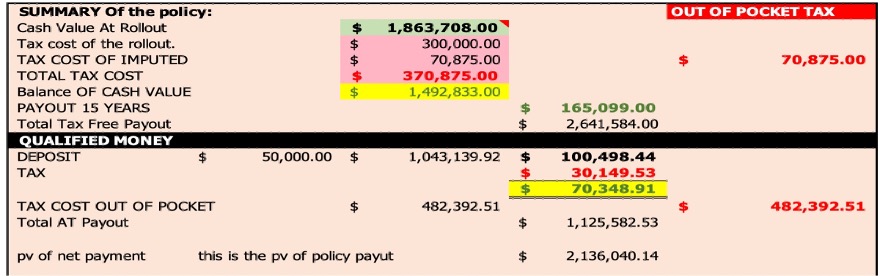
Table below: A qualified contributory plan doesn’t do the job when the owner of a company has an interest in growing wealth through their business.  As mentioned, the contribution must be shared with the other employees, and there are rules as to the maximum contribution which high earners can make.  In this case, the owner only could put the $30,000 in their account. With the CEEP Executive Compensation plan, the full $50,000 could be deposited into the account of the owner of the company! 

Plan Contribution Future Value 66 Gross 15 payout Taxes YRLY Net Income 
Qualified 30,000 893,351 80,348 24,104 56,244 
CEEP 50,000 1,863,708 165,099 165,099 

Many advisors including accountants, lawyers, and financial professionals are not aware of some of the great programs that can be designed using executive compensation.  The CEEP program (Corporate Executive Equity Plan) is a flexible design built around the tax code.   

Here is a chart comparing a Profit-Sharing Plan/401k and a specially designed CEEP Executive Compensation Plan.  

ITEM PROFIT SHARING 401K CEEP 
Tax deductible Yes Yes, optional 
Tax deferred growth Yes Yes 
Government Controlled Yes No 
Selective as to Participants No Yes 
Pre 59 1/2 availability  No Yes 
Tax Free withdrawal No Yes 
Death Benefit Only current accumulated value of account, taxable Immediate substantial tax-free benefit 
Required Minimum Distribution Yes  No 

Bottom line:   

Contributory plans like 401k’s, SEPS, simple plans and IRA are wonderful plans for employees to save money for their retirement.  However, given the above list of restrictions for employers, they are not effective for high income business owners in my opinion.   

Note:   I used 30% marginal bracket. Over a 15-year payout, the pension would have a $361,560 tax liability, while the CEEP was tax free.

To learn more about The Small Business Super Retirement Plan Just for Business Owners and High Earning Executives, request our free White Paper. CLICK HERE! 

The Costly KNEE JERK FINANCIAL SUGGESTION!

Over the years, I have been asked by business owners how they can use their company to create more tax deductions and to build retirement funds for themselvesWhen you put tax deductions and retirement funds in the same sentence, it suggests the vanilla response, of a pension plan of some type or a contributory retirement plan, like a profit-sharing plan, or a 401k. 

However, is that what a business owner is really askingOr, do they mean, they would like to build retirement funds through the business and assume they can get tax deductionsOr do both elements co-exist in the plan that they are thinking of? I think most advisors would suggest a 401k plan, a cash balance plan, a simple plan, or a profit-sharing plan for example. 


 This is what I call the costly, KNEE JERK REACTION. When asked by a business owner, about retirement plans, I have learned to slow it down and ask the business owner to clarify exactly what they are trying to accomplish, rather than rattle off a KNEE JERK response, such as a “profit sharing plan, or 401k plan”

Questions like:  

–      Do you want to include everyone in the plan? 

–      Do you only want to favor yourself and family? 

–      Are you trying to give a benefit to a specific employee?

Do you want all the contributions to end up in your account, or are you willing to share with other employees? If so, how many and who?

If the employer/employee is trying to stockpile contributions to their account, they will have limitations with money purchase plans (limitations on contributions for 2022 of $58,000.) This makes it hard to deposit substantial amounts of money into the employer’s individual account, since they must include everyone

Based on the response, this will determine how I design the planIf he wants to spread the dollar among the group, you are talking about a qualified retirement planOn the other hand, if they want limitations as to who can be involved, they are speaking about a non-qualified executive compensation plan

In this model, I compared two scenarios so my client would have an idea of the difference in absolute dollarsI based the model on conservative values and returns, staying consistent with both types of plansI am comparing a CEEP to a Hypothetical Pension plan (money purchase plan). [i]

As you can see in the chart below, based on the same parameters for each plan, the CEEP program created much more retirement benefits for the owner than a qualified retirement plan

The owner participant received a much higher payout (tax-free), than the pension plan. In addition, if the owner died, from day one, the CEEP plan would pay a substantial tax-free amount to the family, while the qualified plan would only pay what was in the account which would be taxable to the beneficiaryThe CEEP death benefit would be 100% tax free and would not be required to be withdrawn at death, or older ages like a pension or IRA plan would

Once you compare a CEEP to the Pension plan, you can then see why defining exactly what the owner wants to accomplish is important as both plans offer different benefits and different tax scenarios

KNEE JERK advice happens more than you thinkAnd when it does, it can cost your client a lot of money, NOT to mention your reputation as an advisor

In this case, the “Knee Jerk” suggestion to use a pension plan to solve the problem, shortchanged the business owner from having greater benefits for the future when compared to the suggested pension plan. 


[i] In this scenario, the owner could only put in $30,000 of contribution out of the $50,000.  Based on a five many company and different salary ranges. 

REQUEST our free Business Essentials Report.  This report is more than a report, it is a resource and guide to many planning ideas for business owners.  It is an immediate download CLICK TO RECEIVE

You As A Business Owner Have the Best Bank In Town!

WHO WANTS TO BUILD MORE WEALTH THROUGH THEIR BUSINESS?  

Did you know as a small business owner, have access to the best possible loan arrangements to create future wealth. This little know secret in the tax code, which has been used by large companies and savvy financial professionals for decades, allows you to use your company cash flow to create tax-free wealth, at a nominal tax cost.   

Take 10 minutes to see how $55,000 creates $1,875,000 of tax-free wealth.  

Wealth Without Taxes Report: Click For Your Report

How The Buy-Sell Agreement Fits Within the Scope of An S Corporation!  

Part 1 

BY Thomas J. Perrone, CLU, CIC 

Normally, a business makes up a substantial portion of the owners’ net worth. Many business owners do not think about what will happen to their business in the event of their death or a life changing event (trigger).  

This article will focus on why a buy and sell is an important document, one of the most important you will need. 

We will also discuss the buy and sell agreement in the context of an S Corporation since S Corporations are extremely popular. 1 

Consequences of not creating a buy-sell Plan.  

  • Stress on the business’ cash flow or credit line having to purchase the decedents owner’s interest  
  • Unqualified and instability with employees running the company 
  • Disagreements and conflict among heirs increasing administration time and costs 
  • Lack of a market for business which may potentially represent a significant value in the estate 
  • Suppressed value much below fair market value to raise cash for estate needs 
  • Termination of the business 
  • Instability amount employees and creditors 
  • Lack of liquidity to pay estate taxes and other administration costs 
  • Stream of income to remaining family members from the business is lost 
  • Valuation disagreements and IRS litigation 
  • Nightmares of not having a Buy and Sell agreement in a S Corporation! Loss of eligibility as a S Corporation resulting in involuntary termination of the S. Corporation status 
  • Most transfers to entities such as partnership, Corporation and most trusts are prohibited transfers 
  • A termination of S Corporation status will cause the Corporation to be taxed as a C Corporation as of the day of termination creating income tax consequences to the shareholders.  
  • Corporation, which is terminated, must wait five years before making a new S Corporation election, resulting in Corporation being taxed on its net profits for five years.  
  • The surviving shareholder could face additional tax burdens on future ongoing Corporation distribution and on those made upon the sale of the Corporation 

Funding the buy and sell agreement is always a challenge to companies, because it comes down to four ways of funding a triggering event 

  1. Borrowing money from the bank 
  1. Using cash flow out of the business 
  1. Life insurance death benefit 
  1. Cash  

When you compare the costs of funding the buy and sell agreement, life insurance will be the least expensive by a long shot, in most cases, especially, based on a death trigger.  

Other triggers, like divorce, sudden removal from the firm, voluntary and non-voluntary removal from the firm, bankruptcy, and disability are triggers where there is not a death benefit being paid, but money is needed. In these cases, a promissory note may be used in conjunction with a term payout, or installment loan payout.  

However, the cash buildup of a life insurance policy could be used as a funding vehicle especially if the policy has been in force for many years.  

In Part 2 we will investigate how the buy and sell agreement fits within the scope of an S Corporation.  

FREE REPORT “Jones Business Planning and Succession Report” ASK FOR REPORT R3 

CLICK HERE