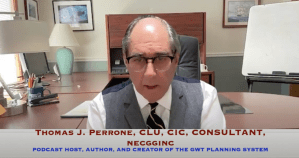
By Thomas J. Perrone, CLU, CIC
Your Business May Have a Plan. But Does It Have a Plan for the Details?
After more than 53 years working with business owners, I have noticed a recurring problem:
Business owners are often unaware of the things they don’t know.
And that lack of awareness can be expensive.
Most business owners are very good at running their businesses. They know their customers, their products, their employees, and their markets. They know how to generate revenue and solve the problems that show up every day.
But there is another side of business ownership that often gets overlooked—the planning that takes place behind the scenes.
I call this the Plan for Details.
It is the planning that addresses how you will grow the business, protect what you have built, create wealth from the business, and eventually transition out of the business.
It is different from the action plan that gets you into business and keeps the cash flow moving.
And that difference can have a tremendous impact on the ultimate value of your business.
Three Levels of Awareness
I believe there are three different levels of awareness among business owners.
1. You know there is a problem—but you tolerate it.
You recognize that something isn’t working perfectly, but because the business is still operating, you don’t address it.
“It’s working well enough” becomes the answer.
2. You discover a problem and fix it.
You weren’t aware of the issue, but once someone points it out, you understand it and take action.
This type of awareness can prevent financial leakage and help improve the business.
3. You don’t know what you don’t know.
This is the most dangerous situation.
You don’t know that an opportunity exists. You don’t know that a risk exists. You don’t know that something is costing you money.
And because you don’t know about it, nothing changes.
This is one of the biggest challenges facing business owners today.
There are opportunities to increase business value, protect the company, improve cash flow, retain key employees, create wealth outside the business, and prepare for a future transition—but many owners simply aren’t aware that these opportunities exist.
The Business Owner’s Action Plan vs. the Plan for Details
When most people start a business, their attention naturally goes toward the Action Plan.
They want to get their product or service to market.
They want customers.
They want revenue.
They want cash flow.
They want the business to grow.
And that’s exactly where an entrepreneur should be focused in the beginning.
The Action Plan is exciting. It’s where the energy is.
But the part that often gets avoided is the Plan for Details.
The Plan for Details addresses four critical areas:
These are the areas that can determine whether a business simply produces an income—or ultimately creates substantial wealth for its owner.
What Happens Without a Plan for Details?
Without this type of planning, business owners can find themselves facing problems they never anticipated.
They may:
-
Lose key employees.
-
Lose customers or valuable relationships.
-
Face lawsuits or other unexpected risks.
-
Have no plan if the owner dies or becomes disabled.
-
Experience significant financial consequences when an owner dies.
-
Lose money unnecessarily through inefficient tax planning.
-
Fail to build wealth outside the business.
-
Struggle to create a strong company culture.
-
Have difficulty attracting and retaining talented employees.
-
Miss opportunities for innovation.
-
Discover too late that their business isn’t attractive to a buyer.
None of these problems necessarily mean the owner did a poor job running the business.
They may simply mean that the owner never had a comprehensive Plan for Details.
Building Business Value Is More Than Increasing Revenue
One of the most important concepts in business planning is understanding value drivers.
Value drivers are the characteristics of a business that make it attractive to a prospective buyer.
A buyer doesn’t simply look at what the business makes today.
The buyer wants to know:
Will this business continue to produce cash flow after I buy it?
That leads to questions about:
A business with strong systems, capable employees, good cash flow, and growth potential is generally much more attractive to a buyer than a business that depends almost entirely on its owner.
That’s why planning for a transition shouldn’t begin when you’re ready to sell.
It should begin years—even decades—before you leave.
What If You Died Tonight?
Here’s a question every business owner should ask:
What would happen to your business if you died tonight?
Or what happens if you become disabled?
What happens to your employees?
What happens to your customers?
What happens to your bank financing?
What happens to your family?
What happens to the value you’ve spent years building?
For example, the loss of an owner or key person can have an immediate impact on a company’s financial stability and operations.
And a key employee who leaves may take valuable relationships, knowledge, employees, and even trade secrets with them.
The solution isn’t simply to hope they stay.
The business needs a strategy for retaining the people who are critical to its success.
Key Employees Are Part of Your Business Value
A strong company doesn’t depend entirely on the owner.
The goal should be to develop people who can think and act like owners.
When you accomplish that, several things happen.
You create stronger management.
You create greater freedom for the owner.
You create more time for family and other priorities.
You improve cash flow.
You create a business that can operate without the owner being involved in every decision.
And you make the business more attractive to a future buyer.
A buyer wants to purchase a business—not purchase a job.
If the owner walks out the door and the business falls apart, the business becomes much harder to sell.
Culture Is a Business Asset
Another often-overlooked component of business value is company culture.
A strong culture can make recruiting easier because people want to work for companies where they feel valued and where they can see a future.
Culture can also improve retention.
And when good people stay, they accumulate knowledge, build relationships, develop systems, and become increasingly valuable to the organization.
The result is a stronger business.
Creating Wealth Outside the Business
Many business owners spend decades building wealth inside their company.
The problem is that their business may represent the overwhelming majority of their net worth.
That creates concentration risk.
It also creates a problem when the owner eventually wants to retire.
The question becomes:
How do you convert business success into personal wealth?
This is where careful planning can be particularly important.
The business may be capable of generating cash flow that can be used strategically to create wealth outside the company while continuing to grow and operate the business.
The objective isn’t simply to accumulate money.
The objective is to create a business that produces cash flow, builds equity, and ultimately allows the owner to convert business value into financial independence.
Why Traditional Planning Often Doesn’t Work for Business Owners
One reason business owners don’t have a Plan for Details is that traditional planning can become unnecessarily complicated.
Business owners are busy.
They don’t want a planning process that takes months and requires endless meetings.
They want to understand the issues, make decisions, and move forward.
Another problem is that different advisors often work independently.
The business owner may have a CPA, attorney, financial advisor, insurance professional, and business consultant—but nobody is bringing the pieces together.
In my experience, the best planning occurs when the appropriate advisors work together.
Your CPA understands the tax issues.
Your attorney understands the legal issues.
Your financial advisor understands investments and financial strategies.
Your business consultant understands the business.
Put the right people around the same table and you can begin solving the actual problems of the business rather than simply selling products.
The Four Areas of the GWT Business Planning System
The GWT Business Planning System focuses on four fundamental areas.
1. Growth
How can you increase the value of the business?
What systems, people, processes, and strategies can help the company grow?
2. Protection
What happens if something goes wrong?
What if the owner dies?
What if the owner becomes disabled?
What if a key employee leaves?
What if the company is sued?
What if cash flow suddenly becomes a problem?
Protection planning is about preparing for the “what ifs.”
3. Equity Creation and Distribution
How can the business create wealth for its owner?
And just as importantly, how can some of that wealth eventually be distributed outside the business?
The goal is to use the business strategically—not simply as a source of income, but as a vehicle for creating wealth.
4. Exit and Transition
Eventually, every business owner has to answer one question:
What happens to the business when you’re no longer running it?
That doesn’t necessarily mean selling tomorrow.
Transition could be 10, 20, or even 30 years away.
But the decisions you make today can have a tremendous impact on the options available to you later.
The GWT 30-Day Business Planning Pathway
The GWT Business Planning System was designed around a simple idea:
Business planning doesn’t have to consume your life.
The process uses a series of approximately 15–16 planning blueprints that help identify the areas that deserve attention.
You don’t necessarily need all of them.
You identify the areas that are most relevant to your business, prioritize them, and then work on them one at a time.
The process is designed to take approximately 2–4 hours of the business owner’s time over a 30-day period.
It includes short educational videos, forms, discussions, and planning sessions.
The goal isn’t to overwhelm you with information.
The goal is to help you become aware of what you don’t know, identify the areas that need attention, and establish a practical path forward.
The Real Goal Isn’t a Bigger Binder
Business planning shouldn’t be about creating a complicated document that sits on a shelf.
It should create action.
A good Plan for Details should help you:
-
Build business value.
-
Protect the value you’ve created.
-
Improve cash flow.
-
Develop key employees.
-
Build management depth.
-
Create a stronger company culture.
-
Reduce dependence on the owner.
-
Create wealth outside the business.
-
Prepare for unexpected events.
-
Increase the likelihood of a successful transition.
Ultimately, it should give the owner something that is often just as valuable as money:
freedom.
Freedom to spend more time with family.
Freedom to take time away from the business.
Freedom to make decisions based on opportunity rather than necessity.
And eventually, freedom to leave the business on your terms.
Your Business Needs More Than an Action Plan
The Action Plan gets the business moving.
The Plan for Details determines what happens after it starts moving.
If you are a business owner, ask yourself:
Do I know exactly what would happen to my business if I died, became disabled, or lost a key employee?
Do I have a plan for building value?
Do I know how I will eventually get my wealth out of the business?
Could my business operate successfully without me?
Would someone want to buy my business today?
If you don’t know the answers, that’s not necessarily a problem.
It may simply mean you’ve discovered something you weren’t aware of.
And that’s where good planning begins.
The Bottom Line
Most business owners don’t have a business planning problem because they don’t care.
They have one because they’re busy running the business.
The Plan for Details is designed to help close that gap.
It gives you a way to step back from the day-to-day operation of the company and look at the bigger picture—growth, protection, equity creation, and transition.
The earlier you begin, the more options you have.
And the objective isn’t simply to build a bigger business.
It’s to build a business that creates wealth, protects that wealth, and ultimately gives you the freedom to decide what happens next.
Lets Discuss: Toms Calendar
Free Download; The Planning GWT PLANNING SYSTEM® Guide
Article: Where you are- Where you Could Be
Tperrone@necgginc.com
If you would like to learn more about the GWT Business Planning System and the 30-Day Business Planning Pathway, contact Thomas J. Perrone, CLU, CIC at 203-530-6615.