“FORBES CONTRIBUTOR Reveals the Eight Reasons Why 70% of Small Businesses Fail Within Ten Years!”

Are you working hard to Grow and Prosper in your business?

Give Me Three Minutes and I’ll Reveal the Key Secret to Creating Greater Success and Prosperity!

You saw it coming… The instinct and driving force to create something…

While the outside world thinks building a business is magic and easy, you know differently!

You, like many entrepreneurs, are wired to build, discover, and create success and prosperity.  You have the fortitude to survive and grow.  

You know taking financial risk isn’t just about you, it involves your employees, vendors, and your family.

Many people would not understand why you take risks with no guarantee of success.  

Chances are you entered your business, like many of us, without a lot of business knowledge, but the excitement of a great idea and the boldness and motivation, to make it successful… With all of that going for you why do small business FAIL 70% of the TIME?

FACTS BEING FACTS…70 % OF BUSINESSES FAIL WITHIN 10 YEARS. [1]

86% OF BUSINESSES CAN’T BE SOLD [2]

The answer is obvious, but not to the busy and enthusiastic business owner in the thick of running their business…

The stickler is…. YOU GET HOOKED ON THE “ACTION PLAN”- (the process of bringing your product or service to market and creating cash flow, profits to feed your operations. This is the exciting part of being a business owner).  It’s “THE BUSINESS HIGH” …

Holy Cow… you’re saying just because I like doing something and want to be part of it all the time, IT WILL cause my business to fail?  Yes and NO!   Yes, because you not only spend most of your time there, but no, it’s good, because you are creating cash flow and profits…

THE PROBLEM: -You Have an Action Plan —————But No “PLAN FOR DETAILS”!

A critical part of the long-term success of the business.  It is the empowerment of your business, the “Vin Lombardi” attitude for success.  It creates confidence to grow.   It is the “BUSINESS PLAYBOOK”! In a Nutshell it’s the solution to the eight reasons why 70 % of businesses fail in 10 years, and the reason why 86% of the businesses can’t be sold…    IT’s That Simple…   

Let’s break it down… 

Eight Reasons Why 70% of Businesses Fail Within Ten Years!…

No Vision-No Niche-No Business Plan-No Marketing-No Commitment To Continual Learning-No Action –No Follow Through-No Consistency

The same reasons 86% of businesses can’t SELL!  ——— There is no “Plan for Details.” 

Why Don’t Business Owners Create a “PLAN FOR DETAILS” to fix the problem?… 

 The Major Reason Why …

Advisors make planning more complicated than it must be.

They charge too much in fees.

They don’t respect your brevity of time.

They don’t understand the business owner and never ran a business (employees, payroll, worked with bankers and inventory).

The advisors have their own agenda, not the agenda of the business owner.

Many advisors are not competent to plan the complexities of business and only want to sell products under a hidden agenda. 

Many advisors don’t specialize and have conflicts of interest- such as a lawyer or account selling investment products. 

YOUR “PLAN FOR DETAILS” – “YOUR “BUSINESS PLAYBOOK” to the RESCUE

NOT HAVING A “Plan for Details”, HAS CONSEQUENCES!

EASY TO PLAN You can plan your path to success and prosperity within 30 days or we do it for free. You will learn in about a total of 4 hours or less over the 30 days.
LEARN ON YOUR TIMEOur Educational videos are short and easy to understand AND LEARN. The basis for your “Plan of Details”
ONE ON ONE COACHINGFour videos explaining the material along with a discussion after each step.   This will clarify the questions you may have.
YOU CREATE AGENDA Sixteen Business areas of planning. We call it Blueprints.   You select the topics for your agenda. Solve one issue at a time and move to the next. 
BREVITY RESPECTEDVideos less than 20 minutes. Conference calls, less than 30 minutes.
EASY TO LEARN MATERIALResource Video Guide on many topics.  Resource Study Text Guide written in simple language.  Also, open a library to use for your knowledge base.
AUTO UPDATINGYou set the schedule to update and assess other areas in your planning.  You are always current because we make it automatic for you.   
ONGOING SUPPORTMonthly, you receive ideas on planning which you can use, and phone support.  You are given a link to our calendar to schedule conference calls. 

SituationNO “Plan FOR Details” THE RESULTS  Business Planning System-PLAN FOR DETAILS
Covid Hits- Lack of Capital Shut down, layoffs, a business closes.   Banks recall your credit line, you incur debt. Planned for reserve of capital, through cash flow. Bankers are pleased with your plan and extend credit. Business as usual! You are prepared!
You Die or Become DisabledKey employees leave with others. Family has no permission to run business Banks recall loans. Planning satisfies banker and probate courts. Employees stay, there is incentive in place for them, Family or key group run the business.  
You Want Out of BusinessWealth tied up in your business not liquid. Must sell at deep discount to raise money!Executive compensation plans set up. You have the capital to retire and sell your business without forced sale.   
Key Person (Group) LeavingBankers, vendors, end credit. Employees leave.You created a vesting benefit for your key people. Too rich for them to leave you, along with documents that are in place to protect you if they do leave. 

EMPOWER your growth by formulating a “Plan for Details”.  

 Consequences Don’t Always Happen to the Other Guy! Don’t Be That Other Guy!

Your “Business Playbook” Your Favorite Banker Will Be Impressed!

WHICH PATH?  Continue doing what you are doing without a “PLAN FOR DETAILS” and risk MANY UNKNOWN CONSEQUENCES! OR take the path of AWARENESS and Avoid Financial Mistakes through Knowledge!  

Educated Entrepreneurs Are Aware of BUSINESS OWNERS!

View the demonstration Video of the GWT Business planning System. Fill in the few questions on the form and it will take you to the short video .

Get My Video


[1]Lauren Cowan, Former Forbes Contributor CPA, Attorney, Elevate 

[2] Doug Baily Feb. 9, 2016, Talking Business

You Don’t Need a Business Degree from Wharton to Build an Incredibly Successful Business,  

But you do need this…

Dear Fellow Entrepreneur, who wishes to grow their business and enjoy what they are building… 

did you ever wonder why some business owners run a successful business while others claw up a mountain to stay in business? It comes down to one STRATEGY, in my opinion.  

A Recent Survey Reveals That 86% of Small Business Owners Risk Bankruptcy or A Forced Exit by Missing This Strategy! 

Only 14% Of Business Owners Will Enjoy the Value of Their Business! i 

You and I are entrepreneurs, wired with passion to run our businesses.  I want to share with you a powerful strategy that will change how you run and grow your business. It will give you more clarity and create more simplicity in your life.  This powerful strategy is one of the major contributing factors to building value in your business.  

Have you ever noticed how some business owners keep more of the money they earn, work less, have unlimited family time, avoid getting drained by taxes, keep the best employees, and run their businesses, not the other way around? 

My clients tell me the strategy has given them clarity and has simplified their lives allowing them to enjoy more of what life offers! 

THE ISSUE and THE PROBLEM:   The mindset when you start or buy a business is to bring your product or service to market quickly to create cash flow. This is the “action planning”, and it’s all about cash flow. The problem is you stay focused on the ACTION PLANNING MODE and neglect the DETAIL PLANNING MODE altogether, creating financial chaos, and diminishing the chances of accomplishing your dreams and aspirations! 

Enter the Business Growth, Wealth, and Transition Plan (GWT PLAN) which focuses on the details of the Growth, Protection, Equity creation and Transition of your business.   The GWT PLAN is a “Designed Plan” and creates the future financial success of your business. The GWT PLAN is like Kryptonite, fighting off bad mistakes, lost opportunities and keeping you on the path of building your business’ future wealth! 

A TRUE STORY:  In 1971 my father died suddenly at age 51. His very profitable business in Hamden, CT, was sold for pennies on the dollar. My mother went from middle class to poverty level overnight. She was forced to sell the family home and move to a few different neighborhoods, giving up what she loved the most, which was cooking for the neighborhood kids.  This created great emotional turmoil in the family. 

THIS DID NOT HAVE HAPPEN, BUT IT DID.  Why?  Because my father had a “Default Plan”, NOT a “Designed Plan”.  He winged it, like so many business owners do.  Because of that, he lost his “Life’s Effort”, and his legacy, at an extreme cost to his family.  

If You Had a Financial Leak in Your Business That Was Going to Burst Your Financial Pipes, When Would You Want to Know About It?   

YOUR SCENARIO WITHOUT A GWT PLAN 

If you died or became disabled today, what will happen to your business?  Without a plan, the banker would call your credit line, the vendors would stop selling to you, your key people would be looking for new jobs along with other employees. Your family would need to get permission from the probate court to run the business without breaking the law.  

If your Key Person told you they were leaving along with five other employees, what would you do about this?  The banker will call the loan, your vendors will cease to give you credit, you may lose other employees, and you would lose income very quickly! 

What if you were in a squeeze economically, business was bad, costs were high, gross revenue is not covering expenses, what do you do? Call in Mr. Banker, and hope he has confidence in your business to solve the problem (remember Covid) and hope for credit! 

 You had enough; you want out. What’s the value of your business you want to sell?  86% of your fellow entrepreneurs are not going to sell their business, what would make you any different?  

The Same Scenario HOWEVER, You Implement Your GWT Plan! 

#1: Your banker doesn’t call your equity-line and they are satisfied with your continuation plan.  Your family has planned instructions on how to run the business, while your employees are satisfied and confident of the continued success of your business.  

 #2. Your key people stay on because you have incentives for them to stay. Also, you have protection documents that would thwart their ability to compete with your business if they left.    

#3. If you were so unlucky to hit a bad economic turndown, you have a special benefit in place to fund your cash flow without having to beg for money from the bank.  This was created through your business cash flow in advance.  It is substantial in value, and tax-effective, creating personal wealth outside of your business.  

#4. You have been systematically formulating plans over the years for the purpose of transition someday.  Because of that planning, purchasers are interested in buying your business at the highest potential value.   

If You Are Investing Money, Time, Pride, Sweat and Nerves in Your “Biggest Effort in Life” 

Why Would You Not Spend the Time to Protect It From the “What IF’S By Implementing Your GWT Plan! 

It’s Not Your Fault However! It’s the Planning Professionals Fault! 

Here is the difference between planners  and what we do and why we make a difference… 

It’s their agenda, not yours. –  

The GWT PLAN agenda is designed by you. You pick the subjects you wish to plan for. 

No respect for your brevity-take too long to plan. 

The GWT Plan uses educational tools such as short videos, so you learn on your own time and verification of what you learn via conference calls. 

They charge too much and complicate the planning making it more complex than necessary. 

 The GWT Plan charges are a fraction of the market charges for planning and is designed to be communicative and simple.  We use a patented plan called, “The One Page Solution”, which describes the issue and the solution on one page, and this is done, one issue at a time.  

They are averse to working with your other advisors. 

The GWT plan encourages your other planning team to join us, so we have all the information about your dreams and aspirations and what your team has been doing for you. We welcome all professionals to engage in your best interests.  

Many planners have never run a business or walked in your shoes. 

We have been in business for over 50 years and have never been in any other business professionally, and know what it is all about having staff, payroll, working with banks and having an array of tasks to deal with.  

They don’t spend time learning about your business and your value system, and don’t listen well. 

The GWT plan doesn’t start planning until we feel we understand what your dreams and aspirations are. By using our tools, we not only learn about what the facts are, we learn about how you feel about what you are trying to accomplish.  

Despite this…To Survive and Thrive in the Future Economy YOU NEED A GWT PLAN TO… 

Create a path to follow for success with clarity and simplicity for your business and personal life to help you enjoy your life.  

Create a business culture to help hire the right employees, develop middle management for your future transition, and free up more time for you. 

Uncover opportunities in creating wealth in your business with tax efficiency through your cash flow while protecting and growing your financial future. 

 Develop a solid transition plan to maximize the value of your business for your future financial security while creating wealth outside your business! 

Learn the secrets of developing your GWT Business Plan by requesting my FREE E-BOOK. I am offering a limited amount of copies for distribution over the next fee days! Take control of your future and go down the path the will give you CLARITY AND SIMPLICITY ALONG WITH GREAT SUCCESS!

REQUEST YOUR FREE COPY of my published book, “Unlocking Your Business DNA”, and learn the benefits of having a GWT PLAN!     ORDER NOW- distributing a limited number of E-Books.  

Click Here to get your Free DOWNLOAD E-BOOK

The Benefits Of Keeping Your Key Person And Key Group!


Recently, I wrote an article about the “Quintessential Employee” and covered all the benefits of having a key person in your company. 

The Education of the Quintessential Employee! 

Some of the attributes of the key person are:  

  • Creates more business value by freeing owners to focus on other profitable tasks 
  • Purchasers of a business want to have middle management in place 
  • Builds reputation and culture 
  • Key people tend to impress other employees as a good example 
  • Key people, as described, are also likely future purchasers of the business, or 
  • Likely to run the business while the owner enjoys life, but still has the control and wealth 

For the full article, download The Benefits Of Keeping Your Key Person And Key Group

Enjoy the download of the full article. The link in the article will download immediately the option of receiving the report.

Download The Article

Estate Planning Chaos for the Business Owners

Why do some Business Owners have higher costs than others when…


–      They settle their estates…
–      They retire…
–      They transfer their business….
Let’s call the above items, “triggers” 
Over the years I have had the experience of seeing the end results of the estate settlement process for many business ownersIn many cases the results were not pretty because of the excess settlement costs. From my own experiences and case studies with associates, I have come to the realization that some business owners have higher estate transfer costs than other business owners. The interesting thing is the excess costs can be controlled by the estate owner. 

Business owners usually have more value in their estates because of business values and settling the estate can be usually more complex. But as mentioned, in my opinion, there are controllable aspects of the costs and ways to mitigate these costs.


Estate transfers Cost: Three major reasons for higher costs!

 No planning: This includes not having any plan, or not updating any earlier planningTheir estates are complex, and they need more than surface planning when their situation calls for more complex planning to carry out their goalsThis takes more time and moneyWithout it they pay a price in estate settlement because they designed the wrong plan or have no plan at all. 

No time: In many cases, there isn’t any time to make changesIt is too lateAll the changes should have been made in advance. Therefore, working on their business and estates yearly is a major benefit as opposed to waiting until it’s “too late”. 

Owners don’t spend enough time asking the “what if’s” of their situations. Every year many changes come out of Washington that affect business and estate planningBeing unaware of these changes makes them vulnerable to excessive estate settlement costsIn many cases the business owner loses by default. 

No liquidity: Settling the estate takes moneyIn many cases, most of the wealth is in the business and other personal hard assets which are difficult to turn into cash within a o  brief period.

§  Even if they could be liquidated, they either run the risk of losing value, or causing major tax issuesConsequently, the estate is open until the taxes are paid and dissolution of assets is completed, causing major costs. Wealth gets stuck in business and its value is at the mercy of the market and other economic factors. 

§  To prevent the lack of liquidity, we suggest that business owners use the business cash flow to create executive compensation plans with tax-free death benefits, and tax-free withdrawals. By doing this they create liquidityWhen an estate owner dies, there is a guarantee that a tax-free death benefit will create the liquidity neededFunded by the company cash flow

Succession of the Business

No planning within the business for successor management. No building of a key group or key person to learn the business as an owner. Consequently , when the time for transition is near, there aren’t many optionsThis affects the “most potential value” of the business. The time to start planning transition of the business is when you start your business or buy a business! The key group is also the group that starts to define the culture of the business, making it easier to attract talented employees. 

 No systematizing of the business- the owner has not taken the time to prepare systemsEverything is in their heads, literallyThere are no written down notes, no manuals or guides to pass on the instructions to others“In simpler terms, the boss must be around for things to get done.”   This limits the future ability to sell the businessPurchasers are looking to buy a business that has growth potentialNor do purchasers in most cases want to invest in a company that has to restructure its operations. A purchaser is not likely to invest in a company where systems are not in place, and which are not transferable. 

  No development of “value drivers” to create growth and culture. Consequently, there is no culture, systems, and no middle management to take on responsibilities or a group to transfer the business to as mentioned aboveThis is a major issue with companies. A true test is asking the business owner if they can take 30 or more days off a yearIf not, I tell them they have a job, but not a business. The owner of the business has not let go of the control they have of the business. It’s the business that controls the owner


Retirement Planning and Why the Wrong Type Causes Chaos!

 The wrong type of retirement plan- although qualified plans like 401k’s or profit-sharing plans are good for rank and file. They are not always the best retirement vehicle for high income business owners for a few reasonsQualified plans are riddled with rules that business owners don’t need in their life. Qualified plans are needed in the company to attract employees, so in many cases, they are a particularly good method of attracting employeesHowever, for the business owner, Executive Compensation plans are more usefulHere are why qualified plans can be a thorn in the side of the high earning business owner:   

  • No discretion as to who gets what amount in the plan-meaning the owner doesn’t get 100% of the distributed amount.
  • Who is to be in the plan- The owner can’t discriminate as to who should take part in the plan
  •  No use of money 59 1/2 without penalty- Business owners are always looking for cash to support their businesses. The inability to withdraw funds from their retirement account is problematic when funds are needed
  •   Age 72 RMD forcing high income owners to pay more taxes- business owners usually have other assets to rely on for incomeIt could be passive income from rents, income from the business and income from investments
  •   IRS in your life – Qualified plans need to file with IRSHowever, if business owners used executive compensation plans, this is something they could avoid. 

Many business owners can use executive compensation programs to develop wealth outside of their businesses and get great tax efficiency. For example, using a “Corporate Equity Executive Plan” will allow the owner of a company to use the company cash flow, pay 10% of the tax they would pay under a pension plan, and create a tax-free family bankThe family bank allows the owner to use the money, tax-free, any way they wishAlso, they are not forced to take the money out when they are retired. 

For more information about business planning, I am offering YOU A FREE copy of my eBook, “Unlocking Your Business DNA” FREE Business guide which will help you understand some of the planning concepts used in retirement planning, business succession and estate planningCLICK HERE for your free download. Your book will be downloaded automatically. 


If any problems with your download please email me; tperrone@necgginc.com

Someday You Will Leave Your Business By Retirement, Death, Disability Or Drop Dead At Your Desk! Do You Have A Method Of Taking Your Business Equity With You In A Tax Efficient Way?

There are millions of small businesses in the United States, and many of them have something in common, and that is that they do not have a succession plan.  

I have heard figures like 80% or higher do not have a succession plan. Over 50% of the companies that have a succession plan, have either outdated plans, or incomplete plans.  

Why is this an over whelming problem with small business owners? Why would a business owner not want to make sure their “lifetime of effort” isn’t lost because of a lack of planning? 

SCENARIO: Someday all business owners will leave their business, either by retirement, death, disability, or just drop dead at their desks.  

 There will be a great loss in the value of the company because of this lack of planning, and consequently, the owner or the family will not receive the true potential value of the business. 

While I cannot explain why business owners do not do their planning, I can tell you some of the reasons the business owners and their family will not get the true value of their company when one of the three triggers occurs (retirement, death, and disability) They would be: 

Lack of planning -. They do not implement systems such as value drivers’ systems, next middle management, systematizing procedures, and others business building procedures. These are the elements that create the future value which a purchaser looks for when buying a business. 

The lack of planning also includes the failure to develop a middle management which could take over most of the tasks of the owner. By not creating a middle management, it leaves the owner as the indispensable person, the essential person in the firm. This is a dangerous position for the future of the company. It may be the greatest threat to the future value of the business.  Like anything else, when you lose the essential indispensable part of a machine, the machine will not work.  This is the same for the company when the owner is the “essential and indispensable” employee.  

Time- Most systems need time to develop and cultivate when building a business. Processes and systems need years to mature and create the potential value of the company. Consequently, when the owner gets near retirement with no more road left to plan, it is too late. Selling the business at the most potential value is not attainable. 

No liquidity: Many business owners put too much of their wealth in the business, such as inventory, machinery, receivables, and benefits, to name a few. They do not make the adjustment to using business cash flow to create wealth outside of the business, like pension plans, executive compensation plans, and other value building programs. Consequently, when capital is needed, it is hard to raise it, and is not readily available to the owner when needed the most.  

When business owners, decide they want to retire, and leave their business, they find themselves in a conflicted position. Because they did not take the time to plan, they have run out of time, and they will not yield the value they would have normally received if they had done planning over the years.  

The only options they may have:  

  • Sell at a reduced price 
  • Stay in the business until they find a buyer willing to buy at this price 
  • Continue in the business to fund their “retirement years” 

The bottom line is to start your planning early. My suggestion would be on the day you buy or start your business, start implementing a transition plan, as most of the transition planning requires an extended period in order to implement.  

Get your free Business Transition Commonly Asked Questions Report! Click here! 

Unknown Ways You “Shipwreck” Your Business!

This blog post is for the business owners who want to make sure their planning is solid and won’t shipwreck their businesses, estates, and legacy.  However, because of past experiences dealing with some professionals, their planning is incomplete, and they have put their financial planning on hold.  In summary, they are motivated to make sure they have good plans but are frustrated with the system of getting their planning efficiently completed.  

Throughout my career I have often wondered why business owners put things off that should not be delayed, as the price of doing nothing can be very costly. Ask any attorney how many unsigned wills they have in their file cabinets and watch them roll their eyes.

I have concluded owners end up with incomplete plans because of the way some professional advisors work with the business owners [1].   

  1. Advisors have their own agenda and put the business owner’s aside.
  2. Advisors don’t work together to share knowledge about the business owner to maximize the effectiveness of the planning. 
  3. They protect their territory and don’t share information.
  4. They make planning more complicated than it needs to be.
  5. They are not good listeners.  
  6. They tell the business owner, as opposed to asking, them what they want. 
  7. Brevity- Business owners really like to get things done.  Advisors in many cases are not efficient time managers when it comes to presenting ideas to business owners.  
  8. Many advisors come to meetings without preparation and wing it. 
  9. In some cases, business owners don’t trust their advisors. 
  10. Some advisors are not open to educating themselves in other planning areas, and neglect bringing in a specialist for the purpose of protecting their planning turf. Consequently, the business owner never gets exposed to the planning that needs to be done. 

 Keep in mind that most business owners have many opportunities to plan, however, they are frustrated from their past experiences and give up, never getting their plans completed.   

Communication with the business owner

Business owners are busy people.  To get their attention requires communication skills. 

Business owners are looking for someone they can trust to get these things done.   Someone they can rely on, and someone who will take the time to really understand what it is that they want and need to do in their planning.  

Your Ears

You have two ears and one mouthGet it?   By asking poignant questions and listening, you can learn much about the business owner. Let me show you by an example.  Recently I was referred to, and helped, a business owner named BillBill was frustrated that he hadn’t done particularly good planning

Our first conversation was about estate planningI asked him, “up to now, what has been the extent of your estate planning”He said he had a will but did it many years ago

I asked him if he knew who Doris Day was, and told him a story of when Doris Days’ husband died (he was her manager and took care of every detail in her life), she found herself in a huge dilemmaYou see, she never bothered to know anything about her business arrangementsShe avoided the business part of her lifeShe left it up to her husband 100%. He died in his 40’s of a heart attackBecause she did not have any knowledge of the personal estate and business estate arrangements, she ended up owing a fortune to the IRS in income and estate taxes. 

Bill, “I am sure the last thing you want to happen is to have your wife end up being like Doris Day.” He agreed. 

How much do you discuss estate planning with your spouse?” Followed by the question “Do you have an estate equalization plan for your children”?   Our discussion lasted over an hour, while I asked questions and took notes.

How many business owners do you know who died at the right time? In other words, they die when they start things (new loans for expansion), or in the middle of things like expanding key groups in the business, but they never seem to die after they finished something. 

They never die at a good time, and because of that, they normally have chaos in their estates, causing hardship during the estate settlement phase, costing much more to settle their estates

My question to Bill was, “Someday you will leave your business by death, disability, or retirement”.  What plans have you made to take your equity of your business with you in a favorable manner”

You see most business owners haven’t planned for this transition. When the time comes to retire, they can’t get their money out of the business, they don’t have any updated plans, and they have no time to adjust. Consequently, their “Lifetime of effort” is stuck in the business. If they tried to sell it, they wouldn’t get the true potential value from the business, because of a lack of planning Normally they want out and end up selling at a discount. They don’t have time to create a better value because they have run out of time. They haven’t done the necessary planning to build systems in the business to increase market value.

The business poured out the gravy!

By the time they want to retire, they have been used to a nice lifestyle, supported by the business.  This may include the social club, lunches, luxury vacations, entertainment, and in other areas of their life.

Because they can’t get the value they need out of the business, they are forced to stay in the business and hope it can continue being profitable, even though the business owner doesn’t have the heart to run hard any longer. In most cases, the business owner is trapped in their own creation[1]     

Building value in your business takes a long time to create the systems and strategies to maximize the fullest potential value.  Unless the business owner takes the time to discuss this with advisors, implement value drivers and systems needed; they will never realize the greatest value of their business.  

 As Bill and I talked, he realized the story of his business and future needed to change. 

My story is really about business owners that pour a “lifetime of effort” in their business but don’t put the necessary time and consideration in how to get their “lifetime of effort” out of the business when they or their family need it the most.   

The business poured out the gravy!

By the time they want to retire, they have been used to a nice lifestyle, supported by the business.  This may include the social club, lunches, luxury vacations, entertainment, and in other areas of their life.

Because they can’t get the value they need out of the business, they are forced to stay in the business and hope it can continue being profitable, even though the business owner doesn’t have the heart to run hard any longer. In most cases, the business owner is trapped in their own creation[1]     

Building value in your business takes a long time to create the systems and strategies to maximize the fullest potential value.  Unless the business owner takes the time to discuss this with advisors, implement value drivers and systems needed; they will never realize the greatest value of their business.  

 As Bill and I talked, he realized the story of his business and future needed to change. 

My story is really about business owners that pour a “lifetime of effort” in their business but don’t put the necessary time and consideration in how to get their “lifetime of effort” out of the business when they or their family need it the most.   

The Indispensable Owner

 The problem was that nobody else knew what Bill knew. Nobody would know what to do if something happened to Bill.  He was an indispensable owner and an essential employee.   He knew the clients, vendors, bankers, advisors, and the key people he needed to know to run his business.  

I told him that when a motor loses its “indispensable and essential part”, the motor will not run any longer.  I told him when he dies, retires, becomes ill, and leaves his business, the “indispensable part” will destroy his “lifetime of effort”.  

That resonated with Bill.  We are now working on building a middle management and putting together an estate plan and a succession plan.  

MESSAGE TO PROFESSIONALS:  

When dealing with business owners keep in mind that they are focused.  They don’t like complexity, and they want to completely understand everything before they make any decisions on issues.  Listen to them and ask them questions.

To Business Owners

Business owners make a big mistake by not putting in the effort and being aware of the other parts of their business.  They don’t need to learn it, but they need to be aware of it.  By not being aware of certain parts of business planning, they end up in a financial chaos situation. 

The solution is to have discussions with your advisors regularly about the different areas of your business that you are not involved in.  Such as; succession planning, estate planning, keeping your key group, executive compensation plans.  These are areas that need to be reviewed and considered.   Without them you will “shipwreck” your family legacy or create missed opportunities. 

In my practice I have set up a bi-monthly sessions to cover issues and topics for our business owners.  This keeps them up to date and gives them a resource to address other issues.  


[1] If he sold his business, paid all the taxes and fees (which would reduce his net value by about 40-50%), and then took that value and invested it at 3-4% (to avoid taking risks), his return would probably be much less than the perks and income he was taking from the business.  And that is what provided his lifestyle.  


Request your Free Harvard Bundle Reports, A White Paper “Business Essential” and your Business Guide to help you grow your business.

Tor receive it, CLICK HERE

[1] Professional financial advisors (anyone who is giving financial advice to business owners)

LISTEN to my podcast and feel free to share it with others.

https://podcasts.apple.com/us/podcast/building-and-protecting-your-business-worth/id1539791693

The Costly KNEE JERK FINANCIAL SUGGESTION!

Over the years, I have been asked by business owners how they can use their company to create more tax deductions and to build retirement funds for themselvesWhen you put tax deductions and retirement funds in the same sentence, it suggests the vanilla response, of a pension plan of some type or a contributory retirement plan, like a profit-sharing plan, or a 401k. 

However, is that what a business owner is really askingOr, do they mean, they would like to build retirement funds through the business and assume they can get tax deductionsOr do both elements co-exist in the plan that they are thinking of? I think most advisors would suggest a 401k plan, a cash balance plan, a simple plan, or a profit-sharing plan for example. 


 This is what I call the costly, KNEE JERK REACTION. When asked by a business owner, about retirement plans, I have learned to slow it down and ask the business owner to clarify exactly what they are trying to accomplish, rather than rattle off a KNEE JERK response, such as a “profit sharing plan, or 401k plan”

Questions like:  

–      Do you want to include everyone in the plan? 

–      Do you only want to favor yourself and family? 

–      Are you trying to give a benefit to a specific employee?

Do you want all the contributions to end up in your account, or are you willing to share with other employees? If so, how many and who?

If the employer/employee is trying to stockpile contributions to their account, they will have limitations with money purchase plans (limitations on contributions for 2022 of $58,000.) This makes it hard to deposit substantial amounts of money into the employer’s individual account, since they must include everyone

Based on the response, this will determine how I design the planIf he wants to spread the dollar among the group, you are talking about a qualified retirement planOn the other hand, if they want limitations as to who can be involved, they are speaking about a non-qualified executive compensation plan

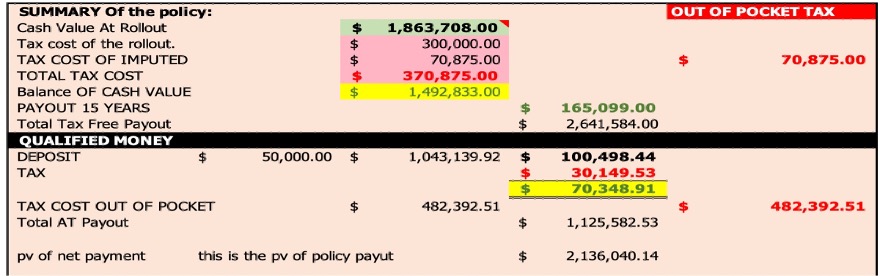
In this model, I compared two scenarios so my client would have an idea of the difference in absolute dollarsI based the model on conservative values and returns, staying consistent with both types of plansI am comparing a CEEP to a Hypothetical Pension plan (money purchase plan). [i]

As you can see in the chart below, based on the same parameters for each plan, the CEEP program created much more retirement benefits for the owner than a qualified retirement plan

The owner participant received a much higher payout (tax-free), than the pension plan. In addition, if the owner died, from day one, the CEEP plan would pay a substantial tax-free amount to the family, while the qualified plan would only pay what was in the account which would be taxable to the beneficiaryThe CEEP death benefit would be 100% tax free and would not be required to be withdrawn at death, or older ages like a pension or IRA plan would

Once you compare a CEEP to the Pension plan, you can then see why defining exactly what the owner wants to accomplish is important as both plans offer different benefits and different tax scenarios

KNEE JERK advice happens more than you thinkAnd when it does, it can cost your client a lot of money, NOT to mention your reputation as an advisor

In this case, the “Knee Jerk” suggestion to use a pension plan to solve the problem, shortchanged the business owner from having greater benefits for the future when compared to the suggested pension plan. 


[i] In this scenario, the owner could only put in $30,000 of contribution out of the $50,000.  Based on a five many company and different salary ranges. 

REQUEST our free Business Essentials Report.  This report is more than a report, it is a resource and guide to many planning ideas for business owners.  It is an immediate download CLICK TO RECEIVE

The Education of the Quintessential Employee!

My friend of fifty-four years, George, is a very remarkable personIn a recent conversation I had with him, I realized that George defines the “quintessential employee.”  Why? He makes the “quintessential employee” easy to spotJust follow him around when he works.

As George was telling me about his history with his company, he related how the company owner came to visit him unexpectedly to thank him for his service of 29 yearsWhen I asked him why he thought the owner appreciated him, he described for me all the things he did over that period. 

Consequently, what George told me was the definition of the “model key person.” A person that every business owner wants, and needs, in their organization. 

You can spot a model employee in a heartbeat because:

They are the first ones to come to work. They almost never take time offThey volunteer time when needed to cover for others. They learn more than they must and are eager to learn. They are so good at their job (s) you would think that they were the owner. 

Key employees like George are valuable for the owners because, they always make life easier for the ownersKey people bring so much to the table, and are the most valuable asset in a company

Intrinsic rewards examples in the workplace

Below are some intrinsic rewards that may affect your workforce. Fostering these activities and feelings in the work environment could help your team grow and thriveA key person exemplifies these values. 

  • Completing meaningful tasks
    • Letting employees be selective
    • Gaining a sense of competence
    • Making noticeable progress
    • Feeling inspired to be more responsible
    • Being an important part of an organization or team
    • Feeling accomplished
    • Feeling pride

I have frequently suggested to many business owners that they groom talented people in their firms who have the take charge values and attitudes which parallel the owner’s. They normally get it, want it, and can do it. 

A key thing an owner can do is to surround themselves with like-minded and value driven employees and build from there. The key person has the values of the owner, and the key person influences other workers over time. They set the example of the company’s culture and the value of the owner and the company

Two Questions:  

  1. How do you find such a person? 
    1. How do you keep them

Finding is the hard part, keeping is the easy part.

Finding the right person really comes down to the culture which the company portrays to the publicLike Costco or Trader Joe’s, who have the reputation of a wonderful place to work. They continually enhance their reputation of wonderful places to workBy having a well-known culture, companies attract like-minded individualsAlso, having the sense of value, the company can immediately filter applicants who apply for a position. Knowing the company values, is a built-in filter and a screening tool for the company when hiring. Question: “Can this person develop into a key person”And “Does this person have the values that represent this company?”

Small family businesses can build that type of culture by hiring based on value, creating good compensation, benefits, giving respect to workers, positioning them in the right seat, (also taking them out of the seat if it does not fit, and putting them in another seat the is more appropriate), respect for the workers, along with other factors

Retaining employees can be accomplished through benefits, time off, respect, vested benefits, ownership interests, and several other ways

The importance of developing and keeping key people cannot be overlooked

  • Creates more business value
    • Purchasers of a business want to have middle management in place
    • Builds reputation and culture
    • Key people tend to impress other employees as a good example 
    • Key people, as described, are also likely purchasers of the business, or
    • Likely to run the business while the owner enjoys life, but still has the control and wealth

My suggestion to many small business owners over the years has been to find ways to build a key group as quickly as they can and to build the group around the values which the owners have

If you have an interest in learning other ways of keeping your key people, this video will be of value. 

Case Study #3. Corporate Executive Equity Plan (CEEP)

For A Free White Paper called, “Wealth Without Taxes”. Click


You As A Business Owner Have the Best Bank In Town!

WHO WANTS TO BUILD MORE WEALTH THROUGH THEIR BUSINESS?  

Did you know as a small business owner, have access to the best possible loan arrangements to create future wealth. This little know secret in the tax code, which has been used by large companies and savvy financial professionals for decades, allows you to use your company cash flow to create tax-free wealth, at a nominal tax cost.   

Take 10 minutes to see how $55,000 creates $1,875,000 of tax-free wealth.  

Wealth Without Taxes Report: Click For Your Report

The Easy Process To Identify and To Solve The Problems!

The Easy Process To Identify and To Solve The Problems!

Excerpts from My book, “Unlocking Your Business DNA”

The One Page Solution!

As we start the process of fixing the problems, they need to be identified. In chapter 1, I discussed how the business owner needs to find their “Business DNA”. Again, this is about focus and asking the right questions, and giving the business owners the amount of time, they need to think it through.

I break down the issues into two categories, BUSINESS GROWTH AND TRANSITION.

Business Growth: Focuses on the business itself such as the strategies needed to grow the business, the systems, the culture, and its employees. It is all about the business future.

Transition: Focuses on the categories that relate to the owners, and the changes they need to make in their personal life because the business is growing.

I keep these categories separate because the issues concerning the business growth are different than the owners transition issues. However, as the business growth changes, it affects the transition of the owners, and vice versa.

It is very important that the business owner is committed to fixing their problems.  If they are not, the first time they have a business roadblock, they will tend to put planning on the back burner.  This is a mistake, because most of the time it does not resurface until there is a crisis.

However, in our planning we do create action plans in small steps. Having a team of advisors working together creates the ability to complete the small steps needed to accomplish our goals.

An Example:

A perfect example was when a company we were working with had plateaued in growth and wanted to create more business growth. When we went through some of the planning questions, I realized the owner had spent no time systemizing their business.

The owner had no documentation of operational systems of his business, but instead it was all in his head. He would delegate the tasks to his employees like a drill sergeant.  He never even thought of the fact that there was no continuity in his business, consequently, if something happened to him, the business would have ended.

I asked him, “could you go on vacation for three months and not check in during that time”?

He looked at me and laughed, replying, “are you kidding this place would fold in seven days.”

I replied, at least you are real, the sad part however is you do not have a business, you have a job. You have a position, a paycheck, and a place to go, but you do not have a business.

He looked at me dazed! But he knew I was right.

The Process Using “One Page Solutions”, will keep everyone on track.

To uncover the issues and problems with the business owner we go over the main subjects called “ONE PAGE SOLUTIONS.”  On any subject there are always a few directions in which the business owner can go. We discuss them and analyze what are the most important subjects the business owner needs to deal with currently. “THE ONE PAGE SOLUTIONS” ARE LISTED BELOW.

Each Subject has a few sub-topics we review with the owners. As we DISCUSS the One Page Solutions, we find the strategies which will solve the issues. Once we are done with the subject, we move on to the next One Page Solution, if any.

THE FOCUS AREAS of the “One Page Solution” ARE:

1-Sale of Business (outside)/ Evaluation Methods/Timing

2- Inside Transition (Family, Co-Owners, or Key Employee/s)

3-Passive Ownership- Owner wants to still run the business, but take long trips

4-Retirement; defining and preparing

5-Wealth Accumulation & Asset Protection (both in and out of the business)

6-Premature Death- Consequences

7- Estate Distribution- updating

8- Life Insurance Contracts and Benefits

9-Legacy Planning / Management of Legacy

10-Disability and Illness, Medicare, and Medicaid

11-Key Employee Retention- and Creating A Culture

12-Key Employee Owner’s Manual- systematically creating company manual, business coaching, marketing proceedures

13-Corporate Benefits and Retirement- cost and efficiency

14-Qualified Plans and Personal Liabilities- Executive Compensation

15-Family Relationships/Employee Relationships/Human Resource

We helped a business owner recently with the problem of not having business growth over a prolonged period of time.  The solution was to put in place strategies that would create transferable values for the future.

They included things like creating key group, documentation, standard procedure, diversification, and growth strategies.

In this case we realized this will take some time to implement. The owner was under no delusion that this will be done in one year. Most importantly the owner started the process. A few years from now he will see the outcomes in all its glory. Because we have experts in our toolbox, we shared our professional advisors with our client for coaching purposes, and education.

Besides implementing a few systems, they will also do a business appraisal every two years. Over a period, this will help them evaluate the growth of their company by implementing the systems suggested.

By doing this the company could allow for better planning in the future, and adjust the path towards financial security, and business growth.

One of the key elements to helping Business owners solve problems is to also identify the roadblocks. This eliminates the surprise factor should our implementation strategy not go as planned. In one of our planning agendas, we discuss these roadblocks and try to define the subsequent issues and challenges in the future.

What is extremely important in this process is that it makes the owner aware of any potential issues they must have to deal with in the future and stay ahead of the problem curve.

Over the years what has been extremely helpful has been the communication with the team. Again, these are the client’s advisors that may or may not have been in place before we started planning. Since we update the team regularly, we are often given new advice that has been helpful in forecasting future events in the business.

We normally would not have this knowledge if we did not have the team of advisors in communication. This is one of the biggest advantages of working with the team and having periodic reviews.

We have been successful helping business owners work on their business to get issues resolved and to focus on details. We use a One-Hour a month system for the business owner to do this.  This allows the business owner the brevity they want, but also, gives them quality time to organize the details of their business. Through our step-by-step system, we help business owner cover all the key issues that are needed to cover to run your business smoothly, take more time off, earn more money and just enjoy working and life much better.  

If you would like a FREE WHITE PAPER called “Your Business Essential” which will help you organize your business, CLICK THE LINK BELOW, download the white paper. This is a 128-page guide in business planning Your Free. When you click submit on the form, your file will immediately download.  Enjoy. 

Immediate Download  

You can purchase of “Unlocking Your Business DNA”, AT Amazon. All profits to to Wounded Warrior Foundation and other Veteran groups.