
The Costly KNEE JERK FINANCIAL SUGGESTION!

Over the years, I have been asked by business owners how they can use their company to create more tax deductions and to build retirement funds for themselvesWhen you put tax deductions and retirement funds in the same sentence, it suggests the vanilla response, of a pension plan of some type or a contributory retirement plan, like a profit-sharing plan, or a 401k. 

However, is that what a business owner is really askingOr, do they mean, they would like to build retirement funds through the business and assume they can get tax deductionsOr do both elements co-exist in the plan that they are thinking of? I think most advisors would suggest a 401k plan, a cash balance plan, a simple plan, or a profit-sharing plan for example. 


 This is what I call the costly, KNEE JERK REACTION. When asked by a business owner, about retirement plans, I have learned to slow it down and ask the business owner to clarify exactly what they are trying to accomplish, rather than rattle off a KNEE JERK response, such as a “profit sharing plan, or 401k plan”

Questions like:  

–      Do you want to include everyone in the plan? 

–      Do you only want to favor yourself and family? 

–      Are you trying to give a benefit to a specific employee?

Do you want all the contributions to end up in your account, or are you willing to share with other employees? If so, how many and who?

If the employer/employee is trying to stockpile contributions to their account, they will have limitations with money purchase plans (limitations on contributions for 2022 of $58,000.) This makes it hard to deposit substantial amounts of money into the employer’s individual account, since they must include everyone

Based on the response, this will determine how I design the planIf he wants to spread the dollar among the group, you are talking about a qualified retirement planOn the other hand, if they want limitations as to who can be involved, they are speaking about a non-qualified executive compensation plan

In this model, I compared two scenarios so my client would have an idea of the difference in absolute dollarsI based the model on conservative values and returns, staying consistent with both types of plansI am comparing a CEEP to a Hypothetical Pension plan (money purchase plan). [i]

As you can see in the chart below, based on the same parameters for each plan, the CEEP program created much more retirement benefits for the owner than a qualified retirement plan

The owner participant received a much higher payout (tax-free), than the pension plan. In addition, if the owner died, from day one, the CEEP plan would pay a substantial tax-free amount to the family, while the qualified plan would only pay what was in the account which would be taxable to the beneficiaryThe CEEP death benefit would be 100% tax free and would not be required to be withdrawn at death, or older ages like a pension or IRA plan would

Once you compare a CEEP to the Pension plan, you can then see why defining exactly what the owner wants to accomplish is important as both plans offer different benefits and different tax scenarios

KNEE JERK advice happens more than you thinkAnd when it does, it can cost your client a lot of money, NOT to mention your reputation as an advisor

In this case, the “Knee Jerk” suggestion to use a pension plan to solve the problem, shortchanged the business owner from having greater benefits for the future when compared to the suggested pension plan. 
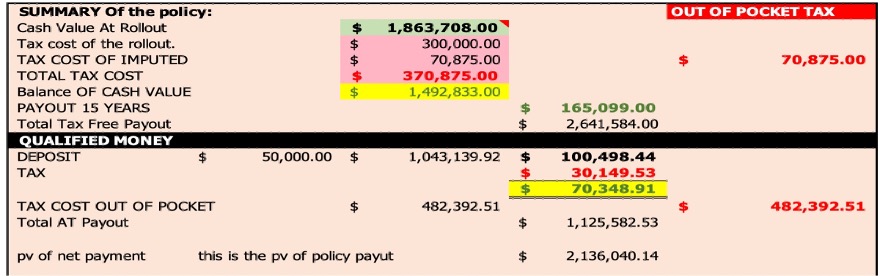

[i] In this scenario, the owner could only put in $30,000 of contribution out of the $50,000.  Based on a five many company and different salary ranges. 

REQUEST our free Business Essentials Report.  This report is more than a report, it is a resource and guide to many planning ideas for business owners.  It is an immediate download CLICK TO RECEIVE

Rushing Through the Most Important Document in Your Business!

In my career I have experienced several business owners rushing through the implementation stages of designing their buy and sell agreement (BSA), probably one of the most important documents they will ever need, treating the process with little thought.   As Rodney Dangerfield would say, “No respect”.  When it was completed, it was very basic, doing more harm than good. 

In some cases, maybe more than I think, the document being used by the drafting attorney was a “hand me down” from another attorney.  While the “hand me down form” may have been useful in drafting another person’s situation and making it easier for the drafting attorney to do, it was not going to maximize my client’s planning situation.

In Paul Hood’s great book, “Buy And Sell Agreements, Last Will And Testament For Your Business”, he covers the consequences of not designing the right buy and sell agreement, and how important it is to spend the time and money preparing and designing this important document, with an experienced lawyer.  [i]

Paul specifically speaks about attorneys using a “hand me down agreement”, and how it may be more harmful by having it than not. 

The “Paul Hood Fire Drill”

He uses the idea of the “fire drill”. What happens when a “trigger happens? What will be the outcome and the consequences based on how your BSA is set up (or not set up), when you play it out. Like you were the leaving owner, and then again as the remaining owner.  On a personal note, the “fire drill” advocated by Paul is something I use all the time and has been instrumental helping my clients and their attorneys in drafting the proper strategies for their situations.  I have found that this has been a great way of helping my clients design the best BSA for themselves. It has allowed them to make it real and start developing questions and ideas that they can implement in their design. It keeps them involved with the process.

The “Fire Drill” strategy has put my clients in the “power seat” of knowledge, so when they discuss their BSA with their attorney, the elements and strategies that are being used are not foreign to them. This consequently helps them design a better BSA, reducing the time needed to spend with their attorney ($$$$$).    

Keep in mind, many business owners start the process of designing the BSA when there has been no experience of consequences with an owner or co-owner leaving the company. 

Everyone is Equal at the Start!

When owners design their BSA, they are all equal in status.  People that enter into agreements want the agreement to favor them when a triggering event happens, even if the agreement has not been updated in years or there is no reference to the triggering event. 

When are clients initially design their BSA, it probably will be one of the few times that all the partners will be negotiating with each other, because when there is a triggering event, chances are they will be negotiating with someone other than their co-owner.  

The representative of the departing co-owner will have a different perspective as to what they want out of the BSA!  Whether it is the spouse, their child, their law firm, whomever, they will be negotiating from a different point of interest.

Business relationships, and friendships are put aside.  It is at this point you would hope your BSA covers all the areas of concern that need to be covered.  The bottom line is the agreement must be exact as to what will specifically happen based on the triggering event.  There is no room for errors if the document is specific.  The best time to do this is when everyone is on equal ground. 

For this reason, owners designing their BSA with their attorney should take it very seriously because they are really pre-negotiating for the people, they love the most without any certainty of which trigger will occur and which side of the trigger they will be on, leaving or a remaining co-owner.

It is extremely important that the triggering events be identified and that you will understand what will occur with each trigger event.  

Paul Hood’s “fire drill” has made it easier for my clients to understand the importance of designing a solid BSA.  By posing questions to the scenario, the BSA becomes very real to them.  

Examples of how they would play out the “fire drill”  

·       What if you’re the first co-owner to leave?

·       What if you’re the last remaining original owner? 

·       What if you end up with a co-owner you don’t want to be owners with? 

·       What happens if one of your co-owners, dies, divorces, or goes bankrupt?  

      By implementing your “fire drill”, you will start to formulate different scenarios for your own situation creating your own buy and sell design.  

This is a critical document in keeping your business going should a trigger happen to any of the co-owners.  Unfortunately, you must deal with it in advance and before there is a triggering event. 

Risks when implementing your BSA:  

·       Using an attorney who is using a fill in the blank form.

·       Not planning the scenarios before designing the plan. 

·       Not having a BSA.

·       Not signing it. 

·       No dealing with how to fund such triggers.  

There are so many elements to the buy and sell agreement that need to be covered, the planning of this document can’t be taken lightly.  However, that is not to say you can’t have a great BSA.  Having experienced professionals to help guide you through the process will pay off great benefits in designing and implementing your BSA. 

We suggest you find competent counsel who has experience in designing the buy and sell agreements and discuss your goals and objectives with them. 

Again, my best advice is pick up Paul Hoods book (“Buy and Sell Agreements, last will and testament for your businesss”.) Read and study it. 

 If you would like our free Business Succession and Transition Planning Guide, click the link and we will send you a FREE WHITE PAPER to get you started. in your planning.   YOUR FREE GUIDE


[i] E. Paul Hood is a prolific technical author. He has published a number of books on planning and is one of the leaders in estate planning and business succession planning.  

The Education of the Quintessential Employee!

My friend of fifty-four years, George, is a very remarkable personIn a recent conversation I had with him, I realized that George defines the “quintessential employee.”  Why? He makes the “quintessential employee” easy to spotJust follow him around when he works.

As George was telling me about his history with his company, he related how the company owner came to visit him unexpectedly to thank him for his service of 29 yearsWhen I asked him why he thought the owner appreciated him, he described for me all the things he did over that period. 

Consequently, what George told me was the definition of the “model key person.” A person that every business owner wants, and needs, in their organization. 

You can spot a model employee in a heartbeat because:

They are the first ones to come to work. They almost never take time offThey volunteer time when needed to cover for others. They learn more than they must and are eager to learn. They are so good at their job (s) you would think that they were the owner. 

Key employees like George are valuable for the owners because, they always make life easier for the ownersKey people bring so much to the table, and are the most valuable asset in a company

Intrinsic rewards examples in the workplace

Below are some intrinsic rewards that may affect your workforce. Fostering these activities and feelings in the work environment could help your team grow and thriveA key person exemplifies these values. 

  • Completing meaningful tasks
    • Letting employees be selective
    • Gaining a sense of competence
    • Making noticeable progress
    • Feeling inspired to be more responsible
    • Being an important part of an organization or team
    • Feeling accomplished
    • Feeling pride

I have frequently suggested to many business owners that they groom talented people in their firms who have the take charge values and attitudes which parallel the owner’s. They normally get it, want it, and can do it. 

A key thing an owner can do is to surround themselves with like-minded and value driven employees and build from there. The key person has the values of the owner, and the key person influences other workers over time. They set the example of the company’s culture and the value of the owner and the company

Two Questions:  

  1. How do you find such a person? 
    1. How do you keep them

Finding is the hard part, keeping is the easy part.

Finding the right person really comes down to the culture which the company portrays to the publicLike Costco or Trader Joe’s, who have the reputation of a wonderful place to work. They continually enhance their reputation of wonderful places to workBy having a well-known culture, companies attract like-minded individualsAlso, having the sense of value, the company can immediately filter applicants who apply for a position. Knowing the company values, is a built-in filter and a screening tool for the company when hiring. Question: “Can this person develop into a key person”And “Does this person have the values that represent this company?”

Small family businesses can build that type of culture by hiring based on value, creating good compensation, benefits, giving respect to workers, positioning them in the right seat, (also taking them out of the seat if it does not fit, and putting them in another seat the is more appropriate), respect for the workers, along with other factors

Retaining employees can be accomplished through benefits, time off, respect, vested benefits, ownership interests, and several other ways

The importance of developing and keeping key people cannot be overlooked

  • Creates more business value
    • Purchasers of a business want to have middle management in place
    • Builds reputation and culture
    • Key people tend to impress other employees as a good example 
    • Key people, as described, are also likely purchasers of the business, or
    • Likely to run the business while the owner enjoys life, but still has the control and wealth

My suggestion to many small business owners over the years has been to find ways to build a key group as quickly as they can and to build the group around the values which the owners have

If you have an interest in learning other ways of keeping your key people, this video will be of value. 

Case Study #3. Corporate Executive Equity Plan (CEEP)

For A Free White Paper called, “Wealth Without Taxes”. Click


You As A Business Owner Have the Best Bank In Town!

WHO WANTS TO BUILD MORE WEALTH THROUGH THEIR BUSINESS?  

Did you know as a small business owner, have access to the best possible loan arrangements to create future wealth. This little know secret in the tax code, which has been used by large companies and savvy financial professionals for decades, allows you to use your company cash flow to create tax-free wealth, at a nominal tax cost.   

Take 10 minutes to see how $55,000 creates $1,875,000 of tax-free wealth.  

Wealth Without Taxes Report: Click For Your Report

Consequences Of Not Creating A Buy and sell agreement!

Part 2 

BY Thomas J. Perrone, CLU, CIC 

S Corporations enjoy the advantages of limited liability, transferability of ownership and professional business operation and management. The S Corporation is taxed similarly to a partnership, as it is a pass through to the shareholders.  

The C Corporation is taxed at the Corporation level first. When the C Corporation is profitable and generates taxable profits. When profits are distributed to the individual shareholder it is taxed again when dividends are received by the shareholder.  

You will find S Corporations normally when the individual rates are lower than the Corporation rates. Also, losses in the S Corporation shareholders may benefit, by deduction, the losses on their individual tax returns.  

S Corporation requirement 

  • No more than 100 shareholders- members of family are considered one shareholder 
  • Must be a domestic corporation 
  • Only individuals, a decedent’s estate, estate of individuals in bankruptcy, and certain trusts are eligible shareholders of s Corporation 
  • No shareholder can be a nonresident alien 
  • One class of stock (different voting rights are allowed) 

Basis and S Corporation 

There is only one level of taxation in the S Corporation. That is at the shareholder’s level.  

If the shareholders basis exceeds the distribution, the shareholder usually will not be taxed when they receive the distribution.  

If the S Corporation has never filed as a C Corporation and has no retained earnings or profits, distributions received by an s Corporation shareholder are not subject to income tax if the distribution does not exceed the shareholder’s basis. Consequently, the larger the basis the greater amount of distribution can be taken tax-free.  

Quick overview of Basis 

  • nontaxable distributions of previously taxed income 
  • income distributed in the same year in which it was earned 
  • losses 
  • nondeductible expenditures such as life insurance expenses 

Keep in mind that the adjustments to shareholder basis is an ongoing procedure and will vary from their initial contribution to, or investment in, the Corporation. Usually, a service corporation will have a low basis because of the low initial investment made in these types of businesses.  

Life insurance to fund the Buy and Sell Agreement 

Life Insurance can have several advantages for S Corporations in a buy-sell agreement.  

A nondeductible expenditure such as life insurance premiums decreases a shareholders’ basis in an S Corporation. The cash value policy can help offset, eliminate, this adverse situation.  

Life insurance cash value helps offset the premium charged to the capital account. The cash value offsets the premium paid so that the decrease to the capital account is offset by the cash value of the policy.  

 As an example, if the premiums are $15,000 and the cash value increases by $12,000, then only $3,000 is charged to the capital account reducing the basis of the stockholder by $3,000. As opposed to having a term insurance policy with a premium of $4,000. The permanent coverage will have less effect on the basis reduction of the stockholder than the lower term insurance premium.  

Over a longer period, there will be in increase over the premium, consequently eliminating the basis reduction. In the term insurance scenario, the reduction of cost basis will continue. In some cases where the term must be renewed, or the term has an increasing premium, the lowering of the basis can be substantial.  

Death benefit and basis 

If the life insurance is set up as a redemption basis, it is possible to plan for an increase in basis for the remaining stockholders, by using a promissory note for the deceased stockholder before settling the life insurance claim. Since the death benefit is tax free income, it will increase the basis. Example:  there are three stockholders, A dies. Instead of making the claim on the life insurance, A is bought out using a short-term promissory note. Once completed, the death claim is filed, and proceeds will come in tax free for the remaining stockholders which will increase their basis. If the death benefit were used for the decedent, there would have been a wasting of the basis since the decedent’s estate would normally receive a stepped-up cost basis.  

Stock Redemption in S Corporation 

The buy and sell agreement are between the stockholders and the Corporation. The S Corporation owns the policy on the stockholders and is the beneficiary of the policy. Death proceeds to the Corporation are tax free and increase the basis of the stockholders. A big advantage to arranging the buy and sell agreement under an S Corporation is avoiding the alternative minimum taxes and the loss of basis found in a C Corporation.  

Cross Purchase buy and sell in s Corporation  

The arrangement all owners of a business agree upon in advance to purchase proportionate shares of the decedent shareholder’s interest. Each stockholder would own life insurance on the other stockholder(s) and be the beneficiary.  

  • Life insurance premium is a nondeductible personal expense 
  • Shareholders receive the death benefit federal income tax-free 
  • The surviving stockholder uses the funds to purchase the stock, which will increase the basis of their holdings, by the amount purchased.  

Some key issues:  

Section 318 Attribution Rules  

In a C Corporation, attributions can be avoided for tax purposes by arranging the buy and sell agreement under a Cross Purchase. Since the Corporation is not redeeming the stock, and it is the stockholder, attribution and the treatment of the redemption being treated like a dividend distribution is avoided.  

In an S Corporation, if the S Corporation does not have retained earnings or profits , it will have the same tax result as if the shares were sold or exchanged, allowing the shareholder to recover their basis tax-free, with any amounts exceeding. Basis being treated as capital gains.  

 A poorly structured buy-sell agreement could result in the loss of S Corporation status, as well as the possibility of increasing the surviving shareholder’s tax burden on future distributions from, or on, the sale of the S Corporation. However, there are some great advantages of setting up a proper buy-sell agreement which can be even greater advantages than those available to C Corporations.  

FREE REPORT “Jones Business Planning and Succession Report” ASK FOR REPORT R3 

CLICK HERE 

Conclusion: 

The S corporation can be a great tool for many business owners as a corporate structure. A Buy and Sell Agreement must be carefully considered and drafted with consideration of avoiding the loss of an S Corporation Election.  

How The Buy-Sell Agreement Fits Within the Scope of An S Corporation!  

Part 1 

BY Thomas J. Perrone, CLU, CIC 

Normally, a business makes up a substantial portion of the owners’ net worth. Many business owners do not think about what will happen to their business in the event of their death or a life changing event (trigger).  

This article will focus on why a buy and sell is an important document, one of the most important you will need. 

We will also discuss the buy and sell agreement in the context of an S Corporation since S Corporations are extremely popular. 1 

Consequences of not creating a buy-sell Plan.  

  • Stress on the business’ cash flow or credit line having to purchase the decedents owner’s interest  
  • Unqualified and instability with employees running the company 
  • Disagreements and conflict among heirs increasing administration time and costs 
  • Lack of a market for business which may potentially represent a significant value in the estate 
  • Suppressed value much below fair market value to raise cash for estate needs 
  • Termination of the business 
  • Instability amount employees and creditors 
  • Lack of liquidity to pay estate taxes and other administration costs 
  • Stream of income to remaining family members from the business is lost 
  • Valuation disagreements and IRS litigation 
  • Nightmares of not having a Buy and Sell agreement in a S Corporation! Loss of eligibility as a S Corporation resulting in involuntary termination of the S. Corporation status 
  • Most transfers to entities such as partnership, Corporation and most trusts are prohibited transfers 
  • A termination of S Corporation status will cause the Corporation to be taxed as a C Corporation as of the day of termination creating income tax consequences to the shareholders.  
  • Corporation, which is terminated, must wait five years before making a new S Corporation election, resulting in Corporation being taxed on its net profits for five years.  
  • The surviving shareholder could face additional tax burdens on future ongoing Corporation distribution and on those made upon the sale of the Corporation 

Funding the buy and sell agreement is always a challenge to companies, because it comes down to four ways of funding a triggering event 

  1. Borrowing money from the bank 
  1. Using cash flow out of the business 
  1. Life insurance death benefit 
  1. Cash  

When you compare the costs of funding the buy and sell agreement, life insurance will be the least expensive by a long shot, in most cases, especially, based on a death trigger.  

Other triggers, like divorce, sudden removal from the firm, voluntary and non-voluntary removal from the firm, bankruptcy, and disability are triggers where there is not a death benefit being paid, but money is needed. In these cases, a promissory note may be used in conjunction with a term payout, or installment loan payout.  

However, the cash buildup of a life insurance policy could be used as a funding vehicle especially if the policy has been in force for many years.  

In Part 2 we will investigate how the buy and sell agreement fits within the scope of an S Corporation.  

FREE REPORT “Jones Business Planning and Succession Report” ASK FOR REPORT R3 

CLICK HERE 

Creating Great Personal Wealth With Your Business Income!

In my planning with many companies over the years, I realize that many business owners are not using the corporate cash flow to create wealth outside of the business. Normally they are using their after-tax dollars to buy financial products to create a benefit for them personally.

Many of the business owners feel they need to put all their current dollars into the business. This is a mistake! The reason this is a mistake is the business equity can get tied up just like a home-equity can. At a time when the business owner needs his business equity the most, is usually at a time when he cannot get it out for one reason or another. Business equity is not very liquid as it is tied up in receivables, loans, inventory, and the like. By putting too much of the business owner’s wealth in the business, they are risking the loss of it in the future, or the very least, the ability for its use for some major cost.

`

Owning a business creates opportunities to use the corporate dollars to create personal wealth outside the business. I call these benefits executive compensation. Normally you can arrange executive compensation programs to be highly effective and efficient tax wise. The corporate dollar can do more for you than the owner could do on their own personal dollar. We have many programs where the corporation is taking a deduction and creating wealth for the owner and their family which is positioned outside of the business.

Below is a project we worked on which shows the value of the corporate cash flow. The names of been changed to protect the innocent, but the case history explains how effective using your corporation cash flow to create wealth outside of your company!

The Case Of Joey Bag Of Donuts

This is the case of Joey Bag of Donuts and his pursuit of keeping wealth outside of his business.  You see, over the years working with Joey Bag of Donuts we told him that leaving too much of his wealth in the business can be problematic, especially when the time came that he needed to exit his business.  He heard me tell him many times, that someday he will leave his business by either a death, disability, or retirement_, and taking the wealth with you when you need it the most, can be a problem, if you do not have the right exit strategy. _

There are many reasons wealth gets lost in a business when it is sold.  It can range from bad planning to bad luck, but Joey Bag of Donuts always remembered to keep as much of his personal wealth outside of the business as possible.  Therefore, he purchased his company building and put it in a separate LLC.  Joey Bag of Donuts also believes in putting as much of his income into the company pension plan. Again, this plan is outside of the business.

We also taught him to have his company support whatever it can legally towards his personal lifestyle.  For example, his cars, gas, some entertainment, health insurance, retirement, and other things are paid for through the company.

Joey Bag of Donuts wanted to put more money away for himself and his family’s future, but did not want to use his own funds, so why not have the company support more retirement contributions?

He already had a profit-sharing plan, and he was sharing company contributions with his employees.

We decided that a non-regulated plan was the best way to go, so we developed a plan for only him.  The plan is a combination of two concepts.  We call this the CEEP PLAN (CORPORATE EXECUTIVE EQUITY PLAN).

The plan is a discriminatory plan, so Joey Bag of Donuts can pick himself or anyone else he wants, unlike a profit sharing or 401k plan, which is a regulated plan.

THE PLAN: As you can see, the company made all the contributions, and took the deductions for them.  Joey Bag of Donuts was the sole participant of the plan. His cost was “0” out of pocket and he ends up with almost $800,000 of cash at retirement.  He also could turn the cash into a tax-free income stream.  In this case it was $67,500 tax-free income. The stream of income is worth more than $1,215,000.  Along with that he has a death benefit of $2,300,000 payable to his family tax-free.

THE BOTTOM LINE: Joey Bag of Donuts gets retirement income using corporate funds.  All the contributions can be applied to just his account.  He also has the use of the account before retirement, like a “family bank,” along with the ability to withdraw funds tax-free.[1]  There would be no 10% penalty if withdrawn before 59 ½.

THE RESTRICTED PLAN: The “Restricted Plan” relates to an employee of the company that the owner wants to make a “A key person To Hold onto Forever.”  This is a terrific way of giving someone a benefit with a vesting schedule, so they stay longer.

Summary: If you own a company and are not taking advantage of the CEEP program, you are missing one of the genuinely great executive benefits available to you as a business owner.  The plan is flexible so you can design it to your needs.

OVERVIEW OF THE PLAN (Summary):[i]  Type of Model: CEEP

EMPLOYER

Yearly Premium Payment:  $25,000

Yearly Net Cost:  $17,500

Total Gross Premium to Retirement: $675,000

Total Net. Premiums to Retirement: $472,500

Total Loans:

For Tax Costs: $202,500

For Interest Costs:  $112,003

Net Cost of Loans: $314,503

If Loan Forgiven, Net cost:  $220,152

EMPLOYEE

Annual Average Interests: $4,148.25

Loan Payoff AT Retirement:[2]  $314,503

Net Cost:  0 (all funding came from Ajax Company)

AT RETIREMENT:

Rollout Amount:  $94,350.83

Tax Cost on Forgiveness of loan[3]:  $94,350.83

Net Cost to Mr. Joey Bag Of Donuts

ll :  0 cost out of pocket[ii]

Cash Value in policy after rollout/forgiveness:  $793,4 29

Death Benefit After Rollout: $2,306,317

Tax-Free Retirement Yearly Income: $67,500

Equivalent Pretax Payout Before Taxes:   $96,429

Years of Retirement Income:18

Total Retirement Income:  $1,215,000

All and all, not a bad arrangement.

[1] Fund in excess of the collateralized amount.

[2] Funds are withdrawn from policy tax-free, results are “0” cost to Mr. Joey Bag Of Donuts

[3] Fund come from policy tax-free.

[i]This is only a summary of the illustration attached to this book.  The illustration is a hypothetical model of how the policy would work.

[ii] This is a fully funded Employer plan. There is “0” cost out of pocket for Mr. Joey Bag Of Donuts

For a free repot on creating Wealth Without Taxes, CLICK HERE! REQUEST R2 REPORT
This report will discuss the methods which will allow your business to use its cash flow to create wealth for you outside your business at the most tax effective way of creating wealth. Executive Compensation CEEP planning is more tax effective than a 401k, 403b, or any other pension and retirement plan. 

As a business owner you have the opportunity to create an amazing amount of wealth with little tax cost. Start with the report and find out how you can create your wealth and your financial security for the future. 

Pension Maximization Using Life Insurance To Provide The Guaranteed Capital!

For people who are in pension plans, (yes there are some in the private section, but mostly in the government sectors), they face a decision at retirement  of how to take the retirement income distribution. 

Basically,  they have two options.  They can take a lifetime income, which is the highest income the annuitant can receive over their lifetimes.  Or, they can take some variation of a survivorship  benefit for their spouse.  The 50% joint payout is the normal payout, however, some plans will allow 75% and 100%.  The higher the percentage spousal benefit, the lower the annuitant payout.     

Example:  

This example uses the joint and survivor 50% payout. 

Let us assume if the annuitant takes the single life payout, the payout would be $2,100 per month.  If the annuitant took the survivorship options, the payout would be $1,600.  There is a $500 difference per month.  Should the spouse die first, usually, the surviving annuitant is stuck with the $1,600 for their life.  

On the other hand, if the annuitant took the life income of $2,100 and dies first, the spouse receives nothing.  

Options: 

A great guarantee options, is to purchase  a life insurance  plan in the amount which will represent the present value of the survivorship value would be. 

By purchasing a $285,000 life insurance policy, using an assumption of 3% earnings on the investment, the payout would be guaranteed for 20 years.  If the annuitant wanted the $1,600 a month for a 25 year period, the present value is $334,332.  

Scenario: 

If the annuitant dies first, the pension would end, however, the life insurance would be paid tax free.  The surviving spouse could invested  the proceeds and take withdrawals from the account  equal to what the spouse would have received under the joint and survivor pension payout.  The spouse could take more or less, as needed. 

If the spouse predeceased the annuitant the  life insurance can be cashed out, or continue to stay in force to create a legacy for the family.  The policy also can also be used to supplement a retirement income for the annuitant using the cash value. 

Unlike the pensions joint and survivor option, the Pension Maximization Plan offers much more flexibility in the planning.  It also allows for maximum payout should the annuitant live a long life while providing security for the spouse. 

Special Free Report”; If you are interested in a tax-free retirement sponsored by your company, get this special report called; Wealth Without Taxes.  This is a plan designed for business owners and key executives, not the rank and file.  Besides tax free benefits, the program offers business owners the ability to shift business income to their personal ledger with minimum tax exposure. To get this report, CLICK FOR YOUR REPORT   Once you fill out your email information, you will receive the report.  Thank you. 


https://youtu.be/DF-GwmDD6kQ

Click to view a 4 minute video.

The Six Most Costly Financial Mistakes Business Owners Make Costing Them to Owe Huge Taxes!

Many business owners are unaware of the opportunities they have in creating wealth through their business.  Many owners put too much wealth in their business, where it can be tied up or hard to get out.  It also prevents them from accumulating outside retirement funds.

There are several ways to create wealth through your business on a tax-efficient basis which many owners are not aware of.  

I would like to share with you the six mistakes that prevent owners from creating more wealth by utilizing the business cash flow. 

  1. NOT IMPLEMENTING A CEEP: (Corporate Executive Equity Plan) for themselves.  This is one of the most tax effective methods of creating personal wealth using corporate cash flow.  The cost of providing this wealth creating account costs the owner about 30% of the tax cost.  Example: if the company bonused $20,000 to the owner for a personal retirement plan, the tax cost would be $6,000 each year.  However, under a CEEP arrangement, the cost would only be a $60 the first year, and about $1,200 the 20th year. This is one of the most misunderstood concepts in executive compensation by attorneys, insurance professionals and CPA’S.  Consequently, it might be considered under used.  However, the executive compensation specialist understands how the plans work and how it can be of great value for the business owner in shifting income from the company to the personal side of the owner. 
  2. NOT TAKING ADVANTAGE OF THE SECTION 412(e)(1): which allows the owner to make a substantial number of tax-deductible contributions into a retirement plan skewed towards the higher paid owner.  Example, the owner aged 50 can deposit up to $213,905 fully tax-deductible.  Great for good cash flow companies.
  3. NOT USING THE “SAFE HARBOR RETIREMENT PLAN”: where a substantial amount of the tax-deductible contributions can be allocated to the higher paid participants.  Also, included in this arrangement is the “Cash Balance Plan”.  These plans create greater tax-deductions for higher paid employees.   
  4. NOT TAKING ADVANTAGE OF   A RESTRICTED BENEFIT PLANS (RBP): which is a discriminatory and tax-deductible plan.  It can be used to provide valuable benefits to retain key people.  The business owner keeps the forfeitures if the employee leaves before vested. This can lock your key group to your company.  
  5. NOT CREATING A DEFERRED COMPENSATION PLAN:  This is a flexible, separate, and discretionary retirement benefit that can also become a mechanism for funding the sale of your business in the future and create retirement income. The pot is sweetened when you add a DBO (Death Benefit Only) to the planning. 
  6. NOT CREATING AND NOT FUNDING YOUR BUY AND SELL AGREEMENTS: A disability, long term illness, or death may occur long before the owner planned to exit their business, creating a path to financial disaster not only for the owner, but their family, partners, and employees.  This is one of the most egregious mistakes I see business owners make.  Many times, it goes unnoticed by the advisors.  This is one of the reasons why I am an advocate of check-off lists, “fire drills”, and annual reviews.[i]

Simply Put!  By Utilizing These Common Benefits, Owners Can Maximize Their Fullest Potential Business Value! 

To help you understand some of the ways to utilize your business cash flow to create more wealth for you and your family, I put together this FREE WHITE PAPER, CALLED “A TAX -FREE LIFESTYLE FOR BUSINESS OWNERS”, AND I would like to GIVE this FREE WHITE PAPER TO YOU.  

THIS REPORT will help you understand how you can use your business to take advantage of discriminatory benefits   plans for yourself, family members, and key employees.    The Tax-Free Lifestyle REPORT is strictly for small business owners who want to grow their business while creating more wealth outside of their business.   I designed this white paper to help business owners avoid the COMMON MISTAKES made by other business owners which forced them to work more years, save less retirement, pay more in taxes, and tied up too much wealth in their business, creating more stress, and had no free time for themselves! 

You’ll also discover in the TAX-FREE REPORT:

  • One simple concept allowing you to retire with more wealth or retire years sooner.  (This one simple financial principle is rarely ever talked about on “pop news” financial TV shows or by other so-called “financial planners”. 
  •  2 proven strategies to increase cash flow and reduce expenses if you really want to sleep at night!
  • 3 secret ways to have your business build a tax-free wealth account for your personal and business use!
  • Your Business DNA” Understanding this key allows you to double your savings and retirement investing without making a single dollar more in income or investing in more capital equipment and labor.
  •  5 value drivers to prepare your business for a sale, even 20 years in advance!
  • How a simple inexpensive benefit plan can keep your key people! 
  • How creating a Deferred Compensation plan can help finance the future sale of your business.
  • How having a benefit plan for you in the future can lower your cost to sell your business?
  • Misleading and incorrect “old wives’ tales” about creating wealth in your business. 
  • Tax saving strategies that 9 out of 10 business owners don’t use and end up paying more taxes
  • Much more…

TO RECEIVE YOUR FREE   NO OBLIGATION WHITE PAPER Called: 

The Tax-Free Lifestyle for Business Owners”

To request your free white paper 

CLICK SUBMIT:     Wealth Without Taxes Report

Once you submit your email address, you will receive your report immediately! Enjoy!

Now you may be asking…Why would I spend my own money to send you this FREE WHITE PAPER? Think of it as my personal introduction… a way for you to get to know me better.  Nothing more than that! 

Often enough, when business owners learn the information in this guide, they decide they want to know more about what we do, and possibly do business with us so they can have our business owner expertise and in-depth knowledge of how business owners think.  I know, I am one of them. I know what you think because I think about it all the time.  Let’s say 24/7 to be safe! Just as you value the expertise in your business field, I believe working with a financial expert who knows what it is to run a business and knows the business world is critical to your financial health.

That’s it!  Let me send you “The Tax-Free Lifestyle for Business Owners”.   Do with it what you want. Maybe you’ll want to talk to us further, maybe you won’t.   There is no obligation to do so.

Either way, I think you’ll find the information in this report will be immensely valuable to helping deal with the “what if’s, grow your business value, enjoy it more, and create more time for you and your family while creating an almost “stress-free” life with tremendous financial freedom in the future.  Oh yes! NO TAXES EITHER!    Visit www.yourbusinessworth.com  to learn more! 

FOR A 7 MINUTE VIDEO


[i] Paul Hood: “Buy and Sell Agreements- the last will and testament for business owners”.  Paul discusses his check off list, and his “fire drill”.  I am an advocate for these systems to make sure the buy and sell agreement is a perfect of a fit to the entity and owners as possible. 

Pending Tax Changes May Be Around The Corner 2022!


I am currently reviewing some of the pending tax proposals being presented. Again, these are proposals and most of them will change before enacted.  

It occurred to me as I was reviewing the details of the tax proposals, how many changes I have seen over my long planning career.  It made me think of  how many times clients (YOU AND ME) had to  update our plans at our cost.  It is amazing the disregard the government has for the U.S. citizen in making this system easier to work with. I can understand why so many citizens put off planning, or just get tired of updating.  Unfortunately, this is the reality of the tax system and the changing of administrations.  

In 2017 we had a major income tax change which in most cases helped many  citizens lower their taxes.   It was easy to understand and it did what it was suppose to do, stimulated the economy along with increasing  public confidence.  

It also gave estate owners a path to plan to preservation their estates. The tax policy was working very well and our government tax coffers where growing.  

Pending Tax Changes- Again These are only proposals!  

The Green Book 2021  

Sr. Van Hollen (Sensible Taxation and Equity Promotion (STEP) and other plan such as the American Families Plan, and the “For the 99.5% Act (Bernie Sauders)”  

Income Tax Changes 

  • Top income tax rates 37%-39.6% effective January 2022; > $509,300 for married, and $452,700 for single 
  • Restrict tax deferral, “like-kind exchanges” (swaps of real estate that avoid current taxation that a sale would tigger  
  • Capital Gains might double-(sale of stock, investment real estate, etc. ) qualified dividend with incomes over $1million taxed at ordinary rates. This could be triggered for gains after April 28, 2021 

Social Security Taxes 

  • To coordinate the net investment income and self employment taxes, so unlike current law, a company could pay the owner a reasonable salary or guananteed payment, the overage became federal taxable profits, but not defined as payroll taxes.   This was assuming that the salary, and withdrawals were reasonable  compensation .  

The proposal is to tax pass-through business income (e.g. S Corps, limited liability companies, partnership) of high income taxpayers will be subject to either the net investment income tax or the social security taxes.   

Audits from the IRS: $80 BILLION increase over 10 years for IRS for audits.  

Estate and gift tax:  

  • Bernie Sanders proposal (For the 99.5% Act) calls for a return to lower estate and gift tax exemptions as well as significant changes to the rules on GRATs and grantor trusts 
  • Most dramatic:  Biden’s plan is to make the transfers of property by Giftand on assets owned at death (as of January 1, 2022) triggering events for capital gains taxes.  The gain is measured by the date of gift or death fair market value less basis.   
  • Exclusions: transfer at death to a US spouse.  

So there are other potential changes coming down the pike and we’ll have to wait and see.  Here is the bottom line:   

Split Interest Gifts: Grat’s ; watch for developments 

Grantor Trusts:  At Grantor’s death or trust is no longer revocable 

BOTTOM LINE- 

If you are a business owner with wealth in your business and you have not done any planning, it may be a good time to start thinking about a certified appraisal of your business and your holdings.  Also, you might want to start thinking about what your goals would be for passing your estate assets.  It’s to early to tell where the wind will blow and how you will be affected by any change, but it is not too soon to think of what you wish to accomplish in your estate and business planning. 

As I look some of the potential changes, Life Insurance Planning will become more significant in paying for the additional liabilities of passing your estate assets either by gift or death.  

To help you with your planning, I would like to offer to you my newly published Ebook called,”Unlocking Your Business DNA”. In the book I cover strategies I have used with business owners for over 50 years  with powerful strategies to create growth and profits in your business and also create an amazing amount of leisure time. 

To get the book, CLICK AND SUBMIT 
 
OR,  
 
If you with to receive a free business assessment of your business planning, take our ONE MINUTE SCORECARD SURVEY. Literally, it takes one minute to go through. Once submitted I will send you a FREE ASSESSMENT of our findings. We will be able to pin point the strong point and the points that you need to work on to create more business growth and profits.  

CLICK HERE FOR THE ONE-MINUTE SCORECARD  

More to come… stay tuned.