Creating A Final Pay Relative to Earnings!

BY: Thomas J. Perrone, CLU, CIC

One of the biggest problems with high earning business owners is the limitation on the amount of contributions they can make towards the 401k or other contributory plans. The limitation is driven by the makeup of the employee group and the comp 

The problem is trying to fund their final earnings of the last 3-5 years with a contributory plan where there are limitations to the number of contributions they can make.  

For example, a business owner currently earning $250,000 versus an employee earning $100,000.  

When you compare the same situation with an employee who is earning $100,000 a year you can see the inequities in the level of funding of a retirement plan and the final earnings. 

Because the high earning owner (HEO) is limited, they can’t use the contributory plan to fund a sizable percentage of their retirement. Consequently, executive compensation programs are needed to make of a good part of the difference in final pay.  

The video discusses one of the ways to make up the difference for the HEO. 

Endorsement CEEP 

A Blended Family, S Corp, And Marital Deduction! What do they have in common!

It’s very common to find this combination of family dynamics frequently! Blended families make up a good part of our family structure and like all families, they need planning.

However, in this type of situation, the final distribution of assets is not necessarily uniform. Each parent wants to treat their children differently in most cases, however, many times both spouses are on the same page in protecting each other.

In this short video I cover some of the planning objectives when you combine the blended family along with an S Corp ownership, and the goal or retaining a marital deduction.

When Running Your Business Gets in The Way of Your Retirement!

Many small business owners are focused on running a business that they neglect to plan for their retirement when they retire.   

In many cases they put too much wealth in their business and have a hard time getting it out when they retire. 

Too much wealth is tied in most business owners business. When the time comes that they need it, it becomes difficult to turn into a liquid asset quickly.

This report will help you understand the options that small business owners have and why they need to pay attention to the details of retirement.

Download this free report on how to build your retirement plan for the future. 

Buy And Sell Agreements and The Use of an LLC! 

By Thomas J. Perrone, CLU, CIC 

A much-overlooked area of planning for small business owners is their buy and sell planning.  A business is fluid and forever changes its financial position. In many cases industry changes and markets affect the value of the company.  Because of the ongoing changes in business value and growth pattern, the buy and sell agreement should be reviewed more than periodically. I suggest the professionals and parties to the agreement review the value and the elements of the buy and sell, yearly.  There are two parts of the review. 

  1. The agreement should be reviewed for the “triggers” which will set in motion the BSA.  There are many BSA that have been executed which only deal with the death, disability, and retirement of the owners.  Some other triggers would be bankruptcy, divorce, non-voluntary termination, voluntary termination.   

The Funding:   

This area strives to make sure the parties are sufficiently liquid when needed to fulfill the obligation of purchasing the ownership value.  

Cross purchase: Members buy and own life insurance on other members.  For example, if you had four owners, twelve policies would be in force (3×4).   

Endorsement: The Company purchases and owns life insurance on the parties to the agreement. At their death, the company receives the proceeds and purchases the value from the deceased’s estate.  

The endorsement method is simple, as the company will purchase life insurance on the party to the agreement.  For example, if there are only four owners, the company will purchase life insurance on each of them, or four policies.  Upon the purchase of the decedent’s equity, the surviving owners will not have an increase in business cost basis.  

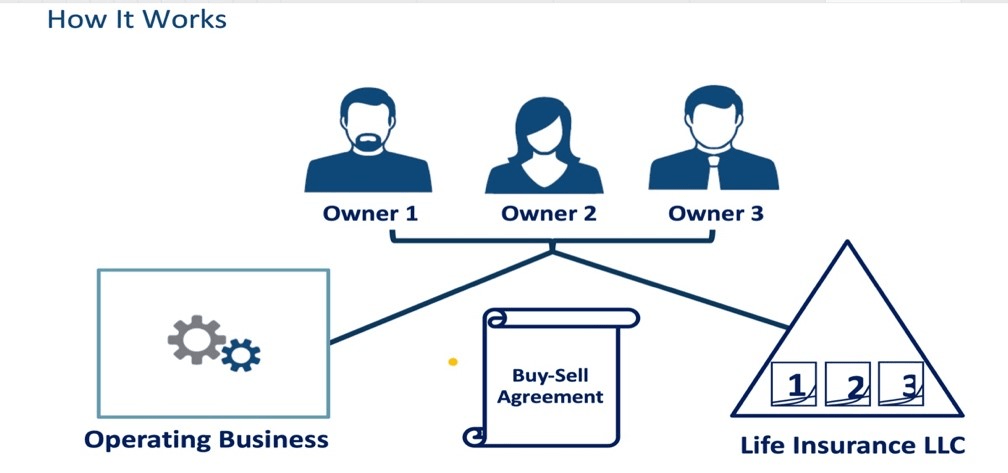
Using the LLC 

The LLC is set up to purchase life insurance policies on each owner.  Upon their death, the LLC collects the proceeds and purchases the ownership for the surviving owners.  

There is no “transfer for value,” as partnerships are an exemption for the transfer of value.  The remaining owners have a cost basis increase.  

This short video discusses buy and sell in more detail.  

BUY AND SELL MISTAKES FUNDING 

If you would like our comprehensive business planning guide, click the link and the report will download immediately.  

GET YOUR BUSINESS KIT  

Get Your Business Kit – Click to download

The Costly KNEE JERK FINANCIAL SUGGESTION!

Over the years, I have been asked by business owners how they can use their company to create more tax deductions and to build retirement funds for themselvesWhen you put tax deductions and retirement funds in the same sentence, it suggests the vanilla response, of a pension plan of some type or a contributory retirement plan, like a profit-sharing plan, or a 401k. 

However, is that what a business owner is really askingOr, do they mean, they would like to build retirement funds through the business and assume they can get tax deductionsOr do both elements co-exist in the plan that they are thinking of? I think most advisors would suggest a 401k plan, a cash balance plan, a simple plan, or a profit-sharing plan for example. 


 This is what I call the costly, KNEE JERK REACTION. When asked by a business owner, about retirement plans, I have learned to slow it down and ask the business owner to clarify exactly what they are trying to accomplish, rather than rattle off a KNEE JERK response, such as a “profit sharing plan, or 401k plan”

Questions like:  

–      Do you want to include everyone in the plan? 

–      Do you only want to favor yourself and family? 

–      Are you trying to give a benefit to a specific employee?

Do you want all the contributions to end up in your account, or are you willing to share with other employees? If so, how many and who?

If the employer/employee is trying to stockpile contributions to their account, they will have limitations with money purchase plans (limitations on contributions for 2022 of $58,000.) This makes it hard to deposit substantial amounts of money into the employer’s individual account, since they must include everyone

Based on the response, this will determine how I design the planIf he wants to spread the dollar among the group, you are talking about a qualified retirement planOn the other hand, if they want limitations as to who can be involved, they are speaking about a non-qualified executive compensation plan

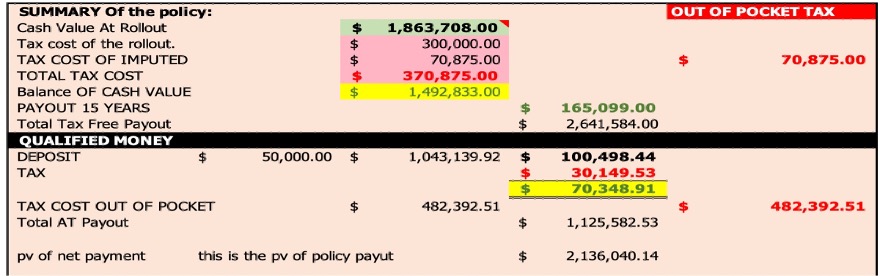
In this model, I compared two scenarios so my client would have an idea of the difference in absolute dollarsI based the model on conservative values and returns, staying consistent with both types of plansI am comparing a CEEP to a Hypothetical Pension plan (money purchase plan). [i]

As you can see in the chart below, based on the same parameters for each plan, the CEEP program created much more retirement benefits for the owner than a qualified retirement plan

The owner participant received a much higher payout (tax-free), than the pension plan. In addition, if the owner died, from day one, the CEEP plan would pay a substantial tax-free amount to the family, while the qualified plan would only pay what was in the account which would be taxable to the beneficiaryThe CEEP death benefit would be 100% tax free and would not be required to be withdrawn at death, or older ages like a pension or IRA plan would

Once you compare a CEEP to the Pension plan, you can then see why defining exactly what the owner wants to accomplish is important as both plans offer different benefits and different tax scenarios

KNEE JERK advice happens more than you thinkAnd when it does, it can cost your client a lot of money, NOT to mention your reputation as an advisor

In this case, the “Knee Jerk” suggestion to use a pension plan to solve the problem, shortchanged the business owner from having greater benefits for the future when compared to the suggested pension plan. 


[i] In this scenario, the owner could only put in $30,000 of contribution out of the $50,000.  Based on a five many company and different salary ranges. 

REQUEST our free Business Essentials Report.  This report is more than a report, it is a resource and guide to many planning ideas for business owners.  It is an immediate download CLICK TO RECEIVE

Awareness to succeed!

This is the video and the narrative to post

This video is a 19-minute quick course which I put together in order .to share with you the biggest mistakes business owners make.

I call this the “Awareness to Succeed,” course. 

Owners spend most of their time on their product and services, and employee relations. This takes up much of their time. 

However, because of these time-consuming tasks, they are unaware of the other areas of business that should be understood and focused on by them, or at least have an awareness of. 

By not having some type of awareness in these areas, they run the risk of being side swiped by some fiscal impact that may have a major effect on their finances, both business wise and personally. 

This quick course will make you aware of some of the major areas you need to understand better. 

As an owner, you may not have the time to learn all that you need to know about these areas. You will learn that they are especially important and assign a professional consultant to keep you informed of your status and future developments in these areas. 

There are many changes coming out of Washington weekly that affect your business. You need a system to stay up on many of the changes. This course is designed to help you understand critical information. Take the 19 minutes to learn more about, Growth, Protection, Equity, and Transition in your business.

Once you complete this course, request a FREE download of my book “Unlocking Your Business DNA,” and subscribe to “Building and Protecting Your Business Worth Podcast.”  These are two great areas for learning. 

Request The Bookhttps://www.allclients.com/Form2.aspx?Key=DEC5C5C207C9803747A0458C9EB2D7C6


Subscribe to our podcast. 

https://podcasts.apple.com/us/podcast/building-and-protecting-your-business-worth/id1539791693

Rushing Through the Most Important Document in Your Business!

In my career I have experienced several business owners rushing through the implementation stages of designing their buy and sell agreement (BSA), probably one of the most important documents they will ever need, treating the process with little thought.   As Rodney Dangerfield would say, “No respect”.  When it was completed, it was very basic, doing more harm than good. 

In some cases, maybe more than I think, the document being used by the drafting attorney was a “hand me down” from another attorney.  While the “hand me down form” may have been useful in drafting another person’s situation and making it easier for the drafting attorney to do, it was not going to maximize my client’s planning situation.

In Paul Hood’s great book, “Buy And Sell Agreements, Last Will And Testament For Your Business”, he covers the consequences of not designing the right buy and sell agreement, and how important it is to spend the time and money preparing and designing this important document, with an experienced lawyer.  [i]

Paul specifically speaks about attorneys using a “hand me down agreement”, and how it may be more harmful by having it than not. 

The “Paul Hood Fire Drill”

He uses the idea of the “fire drill”. What happens when a “trigger happens? What will be the outcome and the consequences based on how your BSA is set up (or not set up), when you play it out. Like you were the leaving owner, and then again as the remaining owner.  On a personal note, the “fire drill” advocated by Paul is something I use all the time and has been instrumental helping my clients and their attorneys in drafting the proper strategies for their situations.  I have found that this has been a great way of helping my clients design the best BSA for themselves. It has allowed them to make it real and start developing questions and ideas that they can implement in their design. It keeps them involved with the process.

The “Fire Drill” strategy has put my clients in the “power seat” of knowledge, so when they discuss their BSA with their attorney, the elements and strategies that are being used are not foreign to them. This consequently helps them design a better BSA, reducing the time needed to spend with their attorney ($$$$$).    

Keep in mind, many business owners start the process of designing the BSA when there has been no experience of consequences with an owner or co-owner leaving the company. 

Everyone is Equal at the Start!

When owners design their BSA, they are all equal in status.  People that enter into agreements want the agreement to favor them when a triggering event happens, even if the agreement has not been updated in years or there is no reference to the triggering event. 

When are clients initially design their BSA, it probably will be one of the few times that all the partners will be negotiating with each other, because when there is a triggering event, chances are they will be negotiating with someone other than their co-owner.  

The representative of the departing co-owner will have a different perspective as to what they want out of the BSA!  Whether it is the spouse, their child, their law firm, whomever, they will be negotiating from a different point of interest.

Business relationships, and friendships are put aside.  It is at this point you would hope your BSA covers all the areas of concern that need to be covered.  The bottom line is the agreement must be exact as to what will specifically happen based on the triggering event.  There is no room for errors if the document is specific.  The best time to do this is when everyone is on equal ground. 

For this reason, owners designing their BSA with their attorney should take it very seriously because they are really pre-negotiating for the people, they love the most without any certainty of which trigger will occur and which side of the trigger they will be on, leaving or a remaining co-owner.

It is extremely important that the triggering events be identified and that you will understand what will occur with each trigger event.  

Paul Hood’s “fire drill” has made it easier for my clients to understand the importance of designing a solid BSA.  By posing questions to the scenario, the BSA becomes very real to them.  

Examples of how they would play out the “fire drill”  

·       What if you’re the first co-owner to leave?

·       What if you’re the last remaining original owner? 

·       What if you end up with a co-owner you don’t want to be owners with? 

·       What happens if one of your co-owners, dies, divorces, or goes bankrupt?  

      By implementing your “fire drill”, you will start to formulate different scenarios for your own situation creating your own buy and sell design.  

This is a critical document in keeping your business going should a trigger happen to any of the co-owners.  Unfortunately, you must deal with it in advance and before there is a triggering event. 

Risks when implementing your BSA:  

·       Using an attorney who is using a fill in the blank form.

·       Not planning the scenarios before designing the plan. 

·       Not having a BSA.

·       Not signing it. 

·       No dealing with how to fund such triggers.  

There are so many elements to the buy and sell agreement that need to be covered, the planning of this document can’t be taken lightly.  However, that is not to say you can’t have a great BSA.  Having experienced professionals to help guide you through the process will pay off great benefits in designing and implementing your BSA. 

We suggest you find competent counsel who has experience in designing the buy and sell agreements and discuss your goals and objectives with them. 

Again, my best advice is pick up Paul Hoods book (“Buy and Sell Agreements, last will and testament for your businesss”.) Read and study it. 

 If you would like our free Business Succession and Transition Planning Guide, click the link and we will send you a FREE WHITE PAPER to get you started. in your planning.   YOUR FREE GUIDE


[i] E. Paul Hood is a prolific technical author. He has published a number of books on planning and is one of the leaders in estate planning and business succession planning.  

Case Small Business With Capital Needs

CASE #10. DATE: June 27, 2021

FACT PATTERN:

Bob started his business- a drill machine shop, with himself and one other worker-10 years ago. Currently, the business has 11 employees and is remarkably busy and receiving orders constantly and the future is bright. Half of the business comes from the state government as they have done work for the agency for many years. Bob has taken out loans for the growth of his business and has refinanced his home. He has an attorney and accountant. The company has a 401k plan and a good health plan. After we went through the Blueprint Issues[1]  , the owner admittedly has concerns that he has neglected his financial planning, putting most of his focus on his business. 

One Page Problem: 

  • At death, his estate is responsible for the debt; over $256,000– his estate is stuck with a business loan since he signed personally- this is now his spouse’s problem.
  • The business does not have a succession plan- this is a problem at death
  • No evaluation of the business:  For Estate and State taxation, and ultimate sale- This can mean a piece meal sell off. Competitors are not motivated to pay higher than discounted rates for assets affecting the ultimate value the asset will receive on liquidation
  • The owner has no will or distribution plan- 2nd marriage, 2 children and 2 stepchildren- Intestate law distribution. Spouse would be sharing assets with children- Client wants spouse to receive property.
  • Other issues- to work on in the future. These were the priority currently

One Page Solution: [2]

Based on the above issues we suggested the following to work on: 

  1. Updated estate plan:  Estate attorney to draft and execute wills, a bypass trust, healthcare directives, durable power along with other important documents.
  2. Apply for life insurance for the following purpose: 
    1. Family income and capital debt payment
    1. Business key person life insurance
    1. Based on the value of the business, the trust may end up being an irrevocable trust in which the trust will own the life insurance
  3. Start the process of getting a business valuation complete since one has never been done- for the purpose of future business succession planning 

If you would like to have a FREE QUICK ASSESSMENT OF WHERE YOU ARE IN YOUR BUSINESS PLANNING, CLICK THIS LINK, TAKE 1 MINUTE TO ANSWER THE QUESTIONS.  I WILL SEND YOU A FREE REPORT ON OUR FINDINGS. CLICK   YOUR   FREE ASSESSMENT


[1] Set up 16 major areas of concern for business owner which we address to see if there are issues to attend to. 

[2] This was the beginning of the planning. There were other issues to work on. These are the issues currently being planned.

Beneficiary Designations Can Become Very Critical Errors in Your Estate Planning!


June  2021  

Beneficiary Designations Can Become Very Critical Errors in Your Estate Planning!   

In all of the years that I have serviced my client’s planning their estates, one of the most important areas of the planning is making sure they are aware of the beneficiaries of their property.   

Many times, they have older life insurance and annuity contracts which haven’t been reviewed over the years, consequently, their family dynamics may have changed, and updating is necessary.  

The life insurance beneficiary and estate beneficiary are not exclusive to the planning.  Other property should always align with the overall planning, however, in this article, I want to focus on some of the pitfalls in naming beneficiaries, as this is, in my opinion, the most common mistake made in planning, not updating beneficiaries.i   

  1. Not thinking about the financial ability of the beneficiary to handle the inheritance they will receive. For example, they could be minors, incapacitated, or just uniformed in their thinking about finances, a bad marriage, and a host of other situations.  That being the case, a trust makes sense as they are flexible to design and can be amended over time. 
  1.  They are an adult, but you just don’t have the confidence that leaving a large sum of money to them is the right thing to do. Example:  leaving $500,000 to a 21-year-old son.  This will usually end up being a nightmare.  Again, a trust can be a great vehicle to control the outcome of paying the lump sum directly. 
  1. Leaving a large amount of money to your elderly sibling, or parents.  They are usually next in line to have to deal with the Medicaid system.  There are other ways of leaving the property to help them for future income and lifestyle needs, which will not jeopardize the asset to the Medicaid system.  
  1. Not naming contingent beneficiaries.  Should the primary beneficiary listed not be living at your death, the assets will pass to your estate versus to the next in line.  Naming contingent beneficiaries guarantees that should your primary beneficiary not be living at your death; the contingent beneficiaries will receive the assets.   
  1. Not naming “per stirpes” to your beneficiaries if you want your beneficiaries’ issues to receive the asset, should the beneficiary not be living.  Example, leaving asset to your child, if living, if not living, to their issues (your grandchildren).  

Tax ramifications are important also, Example, you want your two children to receive $125,000 each from your $250,000 IRA.  Child A has little income and is in the 12% income tax bracket.  They will pay $15,000 in taxes (Fed). Child B is a professional making over $450,000 a year.  They will pay much more in taxes, example 35% or $157,000.1 

Child A will pay $15,000 taxes on the IRA and net:  $110,000 and $150,000 (life insurance) = $260,000 

Child B will pay $37,500 taxes on the IRA and net $87,500 and $150,000 (life insurance) = $237,000 

In this case, more of the IRA could be left to child a with less tax than child b up to $329,000 before they hit the 24% tax bracket.  The equalizer would be to leave more of the life insurance tax free payment to child b, and less of the taxable IRA.  When you work it out, you would help save taxes on the IRA by 11%.   

There are many more Pitfalls which I can share with you, however, these seem to be the most common ones that I run into.   

For a free report on “Six Biggest Mistakes When Setting up A living Trust;” Requestion Report #9 in the Drop-Down menu>. We will send it to you immediately.   

To get your Report #9; “Six Biggest Mistakes When Setting up A living Trust”.  

CLICK Here:         FREE REPORT, Make sure to request report #9 on the drop-down menu.  

You Saw It Coming And I Saw It Coming, We Both Saw It Coming…But we still bought it!…

After fifty years of running a tremendously successful planning firm, WORKING ONLY eighty days a year, I can make this statement with full confidence!  

Every business owner deserves success and financial independence when they give all they must to build a business.  NO issue here.  If done correctly they will enjoy financial independence and an abundance of leisure time which I call “your beach”.   

What gets in the way of preventing a business owner from becoming financially independent and finding their “own beach”, are two things:   

First Reason: The business owner has their hands in everything. Nothing gets by them.    They work eighty hours a week and wonder why they have no time for themself or families.   They believe you must work “hard” (to them that means anything that keeps them busy).   While they are doing insubstantial work, they are neglecting the important work (The Business and Financial Key Elements to Their Business).   

Second Reason Archaic and falsehood beliefs that business owners “bought into”, such as.  

  • Your inventory and your receivables are like money in the bank,  
  • You must work hard in the early years so you can slow down in the later years 
  • Take every dime you have and invest it in your business 
  •  You need to invest in your business in order to grow 
  •  Every business needs time to grow 
  •  You can’t grow fast 
  •  Borrow as much as you can 
  •  It’s a lot of money, but it’s a write off 
  •  When you go into business you initially spend more money than you want to 
  •  You need to invest in your business   
  • Plow all your profits back into the business   
  • You don’t need to give your key people additional benefits 
  • “It’s easier for me to do it, I’ll do it the right way” attitude 
  • If I train someone to do it, they may leave me and start their own business 
  • You don’t need a business valuation just use a simple formula 
  • I have all the systems in my head, we don’t need a document 
  • I’m not worried about leaving the business, they will figure it out 

Falsehoods, and archaic business principals   do more to destroy businesses than a bad economy.   If you don’t fix this situation, no matter how hard you work; YOU WILL NEVER GET TO YOUR FINANCIAL INDEPENDENCE AND “YOUR BEACH”.   It’s that simple!  

But the good news is that you can correct these problems by using a technique that has worked for me and my business clients for over fifty years.    It’s called the “ONE PAGE BLUEPRINT SOLUTION”, and it only takes TWO HOURS MONTH (two lunch breaks) to implement and correct the two major reasons why business owners can’t become financially independent and find their “own beach.”    

To help you learn more on how you can eradicate the two reasons, I am offering a free copy of my eBook called, “Unlocking Your Business DNA”, (Cracking the code to a better business, bigger profits and more time on the beach).   THIS BOOK WILL help you understand the principals discussed.  Limited supply.  To receive your FREE EBOOK, CLICK.

* Book can be purchased on Amazon; Kindle and Paperback. All profits go to Wounded Warrier Project.

**Full Steam Ahead (title; You Saw It Coming)