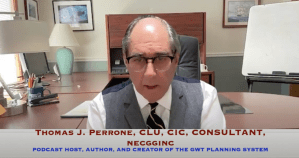
Overcoming Workplace Burnout with the 3.3 Rule

Thomas J. Perrone, CLU, CIC

Feeling stress or burnout in your career?  Feel like you have no life because you feel you must be working in your career? Feel you are missing time with your family. Starting to hate what you do?  

Tom and John discuss this fabulous and innovative book and how it can change the lives of many.   

Why do we work 40,50,60 hours of work a week?  Why do we feel guilty when we aren’t working. Why do we feel burnout often?   

These are some of the many questions John Briggs’ book covers in “The 3.3 Rule”.   

This book will give you the path you need to start enjoying more time away from work while starting to enjoy your work again.  It gives you permission to change the rules for yourself, your family and your employer.  

Throughout the book John proves that the idea of working till you drop does not make any sense for the modern worker. 

  CLICK TO LISTEN

**John Briggs, CPA 

38 W 13775 S suite 310 

Draper, UT 84020 

Phone: (801) 999-8295 

Email: adminteam@incitetax.com 

Located in Draper, UT 

The 39 Questions and the Paul Hood Method

By: Thomas J. Perrone, CLU, CIC

The 39 Questions and the Paul Hood Method 

One of the best resources to learn about buy and sell agreements, estate planning, working with clients, is to read Paul Hood’s books and articles.   

Much of my research and learning comes from reading Paul’s material.  

He is the author of at least Eight books and co-author of others. 

For example, Paul contributes to the legendary The Estate Planning Tool Book from Leimberg, which is an annual addition.

Paul teams up with other professionals and develops great research and learning tools for estate planning specialists.   He is the go to person in these planning areas. Visit his website and see for yourself.

Listen to Tom discussing case study and Paul’s services 

Not only does Paul have terrific books, but he is also the author of hundreds of great articles. Check out his website and enjoy the great articles.   

Paul’s contribution to the planning community is special and many of us appreciate it.   

Get your Free Business Kit Report – immediate download.  

https://bit.ly/3PNBKyz

necgginc@icloud.com

203 530 6615

New England Consulting Group of Guilford, Inc.

Using A SLAT with Life Insurance 

BY: Thomas J. Perrone, CLU, CIC 

Since 2017 the SPOUSAL LIFETIME ACCESS TRUSTS (SLAT) have been an exceptionally good planning tool, and a popular one in sheltering the growth of assets from estate taxation.  

With the event of up and coming “the sunset” in 2026, more attention has been given to using this planning tool.  

In this video, I discuss not only what a SLAT is, and how it is used, but bring into play the arbitraging of life insurance, and the powerful results from using it.  

It is suggested that the planner learn as much as possible about the use of the SLAT.  Also, the planner should work with a qualified attorney when presenting and implementing this planning technique.   

Free__ YOUR SUNSET PLANNING GUIDE –   CLICK THIS LINK FOR FREE DOWNLOAD 

Tperrone@necgginc.com  

Connelly – Alternative 2024 

Thomas J. Perrone, CLU, CIC

Connelly was a hard case to digest as most of us who have been around the planning world for an exceptionally long time. We took the consequences of funding a stock redemption agreement as very normal.  As normal as “cutting the end of the ham first.”  

We are now forced to rethink this situation after the ruling, care must be taken when arranging the Buy and Sell Agreement and funding of a company, to avoid the results we have seen in Connelly.   

Today I will bring you through a few options that advisors and business owners may consider when planning the transition of business interests.   

  CLICK HERE;     YOUR REPORT WILL DOWNLOAD IMMEDIATELY! 

tperrone@necgginc.com

Sharpening Your Planning Skills to Get Ready  

By Thomas J. Perrone, CLU, CIC

Last month I posted a video on some of the general planning tools you have not used in the past eight years because of the Jobs Act.  That is because of the high limits on the unified estate and gift tax amount.  The high limits sheltered many estate owners and business owners from an estate tax.  With the possible change around the corner it’s time to get ready.   

This month I share how to use some of the tools discussed and why.  Enjoy the video.  

For your free Sunset 2026 Planning Guide, CLICK THIS LINK  

The Guide will automatically download.   

PREPARE FOR 2026 AND GET ENGAGED WITH THE MARKET

Take the Planning Tools Out of the Shed- You’ll Need Them!  

Thomas J. Perrone, CLU, CIC

After the 2017 Jobs Act, many of us (estate and business planners), had to shift our planning topics to moderate estate, Medicaid and income tax planning.  

Many of the tools we used prior to the 2017Jobs Act were often used in the planning process, simply because more business owners were affected and exposed to the Federal and State Estate Tax System. Consequently, more sophisticated strategies were needed to shift value, freeze value, or shelter value from the estate.  

Once the Jobs Act came into play, the exemption amounts eliminated many small business owners from the problem of estate taxation.  

However, with part of the Jobs Act heading for Sunset, we may see more businesses becoming exposed to Federal and State estate taxation.  

Time to go to the shed if you want to play in this market.  

This video will help guide you to some of the areas of planning you will have to dust off and rekindle for use.  

Download your Free Business Guide which will help explain many of the topics discussed. Immediate download, CLICK HERE! 

Thomas J. Perrone, CLU, CIC

tperrone@necgginc.com

The Elephant in The Room!  

BY: Thomas J. Perrone, CLU,CIC

The elephant in the room is about the four major questions that need to be asked by a business owner and advisors for the business owner to avoid failure of the business. The four major questions are. 

  1. What happens to the business if you die become disabled or want to retire?  
  1. What happens to the business if you lose your key person or key group to competition, or they leave?  
  1. What happens to your business if you have a bad economy and cannot make cash flow to support the business? 
  1.  What happens if you burn out and want to leave the business?  

I cover these four areas in this video.  

The major question:   

How Will the Failure of the Business Affect Your Family!  

Get your Free Business Guide Download. This Free Guide will be invaluable as a quick reference for business planning. Our gift to you. CLICK THIS LINK AND THE REPORT WILL DOWNLOAD IMMEDIATELY!  

https://bit.ly/3hD9U6A

The Right Life Insurance Policy for Your Client? 

By Thomas J. Perrone, CLU, CIC

Before the advisors can give you their opinion, they need to know whether the problem is permanent or temporary.  See, buying term insurance when the problem is permanent is like wetting the bed, eventually you will have to get up and change the sheets.   

Not only does the insurance broker have to ask tough questions about the coverage, but also the other advisors that are part of the team.   

Too often, advisors knee jerk to one type of plan because of the lack of information they have, or their misconceptions of coverage.  In many cases, the knee jerk suggestion is the wrong one.   

This video covers some important points of what is needed to make the right decision about the coverage.   

Questions such as:  

  • How long will the problem exist 
  • Age of the insured 
  • Is the problem permanent like tax liability or does it have a predictable ending date 
  • Actual cost when comparing the value of cask value 
  • Renewal rates in the future 
  • conversions of coverage – is the coverage convertible 
  • cash flow predictable 
  • Is the problem a reoccurring one 

ENJOY your FREE Business And Estate COMPREHENSIVE GUIDE – CLICK TO DOWNLOAD

https://www.allclients.com/Form2.aspx?Key=76EB00B717E35DC55BDE502F30D6ACD6

THREE WAYS TO GROW YOUR BUSINESS WEALTH! 

Thomas J. Perrone, CLU, CIC – NEW ENGLAND CONSULTING GROUP OF GUILFORD, INC

Growing value in your business can create tremendous wealth, however, only 15-30% of the small businesses will sell, which creates the “if factor”, the unknown.  

The percentage of sales is lower for the smaller owned business, more like 15%.  

Building your business to its highest potential value is possible by having guidelines of what must be done as you grow the business.  

To hedge the “what if’s” of selling it, you can use the cash flow of the business to create other assets such as executive compensation and qualified benefits and plans.   

Many owners neglect to consider these options and end up with too much wealth in their business, causing liquidity and tax problems when they leave, die or become disabled. This presents the problem of “how do you get your wealth out of your business on a tax advantaged method” when you want to leave the business and you need it?  

Building Your Business to Sell in The Future! 

Here is a list of strategies that will help in growing a robust business and greatest potential value.  

  • Develop value drivers  
  • Create a culture- employees come to you because of it 
  • Develop a middle management 
  • Systematize your business 
  • Customer diversification  
  • Avoid being dependent on a few customers for your sales  
  • Marketing plan- and always update it and analyze it 
  • Focus on growth of revenue, lowing of costs 
  • Protect yourself from litig 
  • Make sure you protect yourself such as  
  • Fund your Buy & sell agreements, bank loans, audit your liability insurance, protective documents, etc. 
  • Have a strategy to sell or transition your business, such as growing the middle management, and key people to step in and run the company, or even buy it. This is a long-term process, but you must put things in order and work on strategies to get the greatest potential value from the business.  

When Considering Using Your Business Cash Flow to Develop Executive Compensation and Other Benefits,  

Such as:  

  • Executive Compensation plans, where the company contributes to the plan, and you as owner pay as little as 2% in taxes on the contribution.  
  • Salary Continuation and deferred compensation arrangements for you.  
  • Deposit into your company’s retirement plan (like 401k, profit sharing, 403b, etc.). However, if you are a “high earning business owner”, do not load up on 401k contributions and other contributory plans as the tax consequences are severe.  
  • Make sure your buy and sell agreements are funded and updated. Make sure they cover at least the seven major triggers (death, disability, voluntary and non-voluntary termination, divorce, bankruptcy, retirement).  
  • Have critical illness plans set up such as medical reimbursement plans, disability, and health coverage.  
  • Tie your major Key group to your company as they are the value of the company and contribute to the cash flow of your company, allowing you to implement these strategies.  
  • Create vested benefit schedules to keep them with you  
  • Have a company evaluation /appraisal periodically.  
  • Focus your attention on growing sales, as all things point to sales revenue. 

Executive Compensation Is a Fantastic Way to Extract the Value of Your Company on a Tax-favored Basis, And Not Tie It Up in Your Company, Having It Available to You When Needed. 

There are but a few thoughts concerning building wealth through your business while building your business.  

If you would like to receive my report on the “JFK ERA BENEFITS THAT CREATED SUBSTANTIAL WEALTH FOR BUSINESS OWNER”, CLICK THE link and it will download. This benefit was around in the 50’s, but only for the bigger companies, now it is available to the smallest of businesses, and may be one of the greatest business owner benefits available.  CLICK JFK 

The Importance of Beneficiary Designations!

Article Sponsored by:

Some types of assets allow the owner of the asset to name a “beneficiary.”  If the original owner later dies, ownership of the asset passes automatically to the named beneficiary.

Because beneficiary designations are easy to use, they can be a key estate planning tool.

However, significant negative tax, financial, and even personal problems can arise if the “wrong” individual or entity is named as the beneficiary.

Common Named Beneficiaries

A number of individuals, entities, or organizations are commonly named as a designated beneficiary:

●Spouse: A married individual’s spouse is perhaps the most common beneficiary

designation.  Assets passing to a surviving spouse generally escape federal estate tax because of the unlimited marital deduction.1

●Children: Children, as adults or minors,2 are often named as beneficiaries.  Step- children or other children adopted informally generally need to be specifically identified.

●Other family members: Brothers and sisters, aunts and uncles, and nieces and

nephews are frequently encountered beneficiaries.

●Estate: In some situations, the asset owner will name his or her estate as the

beneficiary.

●Trust: As a part of a more complex estate plan, a trust may be named as a beneficiary. The trust must exist at the time of death for the beneficiary designation to be valid.

●Charity: A charity may be a designated beneficiary, which can reduce the owner’s taxable estate.

●Corporation or partnership: Buy-sell agreements, key man insurance, stock

redemption, split-dollar arrangements, and salary continuation plans are all valid

business reasons why a corporation or partnership may be named as a beneficiary.

1 The discussion here concerns federal income and estate tax law.  Under federal law, If the surviving spouse is not a U.S.citizen, special rules apply.  State or local law may vary.

2 In most states, 18 is the age of “majority” when an individual is considered, for legal purposes, to be an “adult.”

The Importance of Beneficiary Designations

General Considerations in Making Beneficiary Designations

There are a number of general issues to consider when using beneficiary designations:

●Keep beneficiary designations current:Divorce, the birth of a child, the death of a beneficiary, or any number of other life changes can result in the need to update a beneficiary designation.  Lack of planning can result in an ex-spouse receiving

retirement benefits intended to provide for others or for assets to inadvertently be

paid to the estate when a named beneficiary has predeceased the owner.

●Your estate or executor as the beneficiary: In these situations, the transferred assets must generally go through a costly and time-consuming court-supervised process known as “probate.”  During probate the proceeds can be subject to the claims of creditors. In some situations there may be valid estate planning reasons for naming the estate as a beneficiary.

●A minor as beneficiary: In most states, a minor generally cannot legally enter into contracts or own property.  If a minor is named as the beneficiary of an asset, the end result is frequently an expensive court-appointed guardianship with court supervision of the use of these funds.  Once reaching his or her majority, the individual then takes control of the assets.

●Per Capita vs. Per Stirpes: A beneficiary designation form will generally use one of these two terms to specify how an asset will be distributed if a named beneficiary predeceases the asset owner.  In a “Per Capita” distribution, generally, each survivor (a living beneficiary or a deceased beneficiary’s heirs) receives an equal share.  In a “Per Stirpes” distribution, generally, a deceased beneficiary’s heirs divide his or her share into equal portions. Many states have modified these rules.

●Spousal rights: In some states, a surviving spouse may have the right to claim a

portion of a decedent’s estate, including part of assets that can be transferred by a beneficiary designation.  In Community Property1 states, a surviving spouse may have rights that need to be considered.

The Community Property states are Arizona, California, Idaho, Louisiana, Nevada, New Mexico, Texas, Washington, and Wisconsin. In Alaska, spouses may opt-in to a community property arrangement.

The Importance of Beneficiary Designations

●Common disaster: What provision has been made for a situation in which both the asset owner and a designated beneficiary (think of spouses who travel together) die in a common disaster?  This contingency is frequently addressed in an individual’s will.

●Impact on the beneficiary: Consider how receiving an asset will impact the

beneficiary’s life:

●Is the beneficiary capable of using the inheritance as the donor might wish, or will it be wasted?  Is the beneficiary capable of managing the inheritance?

●Are there income tax considerations?  Assets such as deferred annuities, or

retirement plans such as IRAs or 401(k) plans, have varying distribution

requirements, depending on who inherits the assets.  Will one beneficiary pay less

income tax than another?

●Does the intended beneficiary need the money?

●Are there other ways, such as via a will or trust, to transfer assets to the intended beneficiary that might ultimately benefit the beneficiary more than an outright gift?

●Conflict with other estate planning documents: In some cases, an individual will

leave contradictory instructions with regard to how his or her assets should be

distributed.  For example, a will may indicate that an individual’s retirement plan

assets are to pass to a child, while the beneficiary designation form for the retirement plan shows that the ex-wife is to receive the funds.  As a general rule, the instructions contained in the beneficiary designation form will take precedence over those contained in a will or trust.

Seek Professional Guidance

While beneficiary designations are easy to use, they should be considered to be only one part of an overall, coordinated estate plan.  The guidance of experienced, trained estate, income tax, and other financial professionals is strongly recommended.

CLICK HERE TO RECEIVE YOUR FREE “BUNDLE REPORTS”

\